On this page
Every protein in your body is made by ribosomes, molecular machines that read messenger RNA and join amino acids in the right order. For decades biologists knew what ribosomes did but not what they looked like at the level of atoms. Venkatraman Ramakrishnan, a physicist by training who grew up in Vadodara, helped change that. This post tells his story from his own account and the Nobel Foundation's records, explains what he found, and ends with what a student can learn from how he worked.
Who is Venkatraman Ramakrishnan?
The Nobel Prize facts page records that he was born in 1952 in Chidambaram, Tamil Nadu, and was at the MRC Laboratory of Molecular Biology in Cambridge when he won. In his Nobel autobiography he writes that his family moved to Baroda when he was three, where his father set up the biochemistry department at M.S. University.
His school record was not smooth. He writes that in Classes 7 to 9 he dropped "to being in the bottom third" of his class, before a science and mathematics teacher, T.C. Patel, revived his interest. He also did not do well enough in the IIT and Christian Medical College entrance exams to get in. A National Science Talent Search scholarship let him study physics in Baroda instead, using the Berkeley Physics Course and the Feynman Lectures.
How did a physicist end up in biology?
He took a PhD in physics at Ohio University, finishing in 1976, but he writes that he felt he had chosen the wrong field and was drawn to biology by articles in Scientific American. He then spent two years as a graduate student in biology at the University of California, San Diego, taking undergraduate courses in genetics and biochemistry.
In 1978 he joined Peter Moore's lab at Yale as a postdoctoral researcher, mapping the positions of proteins in the ribosome's small subunit. Jobs were hard to find. He writes that he applied for a large number of faculty positions and "did not get a single interview". He worked at Oak Ridge and then Brookhaven National Laboratory, learnt crystallography during a 1991 sabbatical at the LMB in Cambridge, and moved to the University of Utah before returning to the LMB in 1999.
What did he discover about the ribosome?
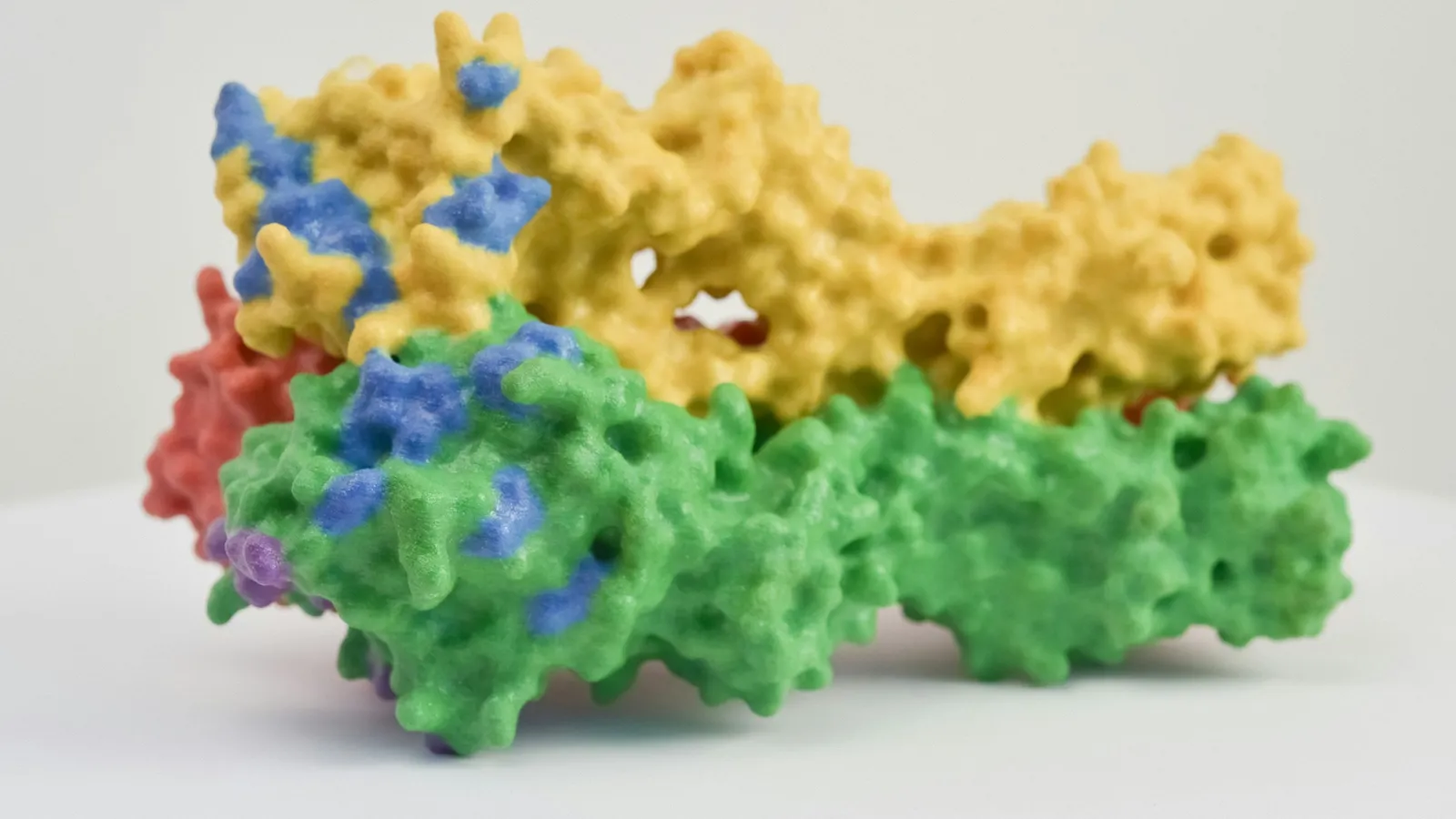
A ribosome has two parts, a small subunit and a large one. The small subunit reads the messenger RNA. Ramakrishnan's group used X-ray crystallography, which works out where atoms sit from the way a crystal scatters X-rays.
In September 2000 the group published the structure of the 30S ribosomal subunit in Nature, from the heat-loving bacterium Thermus thermophilus. A companion paper the same month showed how several antibiotics bind to the 30S subunit.
The Nobel Foundation's popular information on the 2009 prize explains why this mattered. His structures showed how the ribosome achieves its accuracy: nucleotides in the small subunit's RNA act like a molecular ruler, checking the fit between the codon on messenger RNA and the anticodon on transfer RNA. A tRNA that does not fit falls off. The Foundation notes that errors happen only about once per 100,000 amino acids.
What recognition did he receive?
The 2009 Nobel Prize in Chemistry went jointly to Ramakrishnan, Thomas Steitz and Ada Yonath "for studies of the structure and function of the ribosome". The Royal Society records that he was elected a Fellow in 2003, was knighted in 2012 and served as the Society's President from November 2015 to November 2020.
The LMB's page on him notes that his group later used electron cryomicroscopy to study translation in eukaryotes, and that he has written two books for general readers, Gene Machine (2018) and Why We Die (2024).
How this connects to your syllabus
Translation, codons and anticodons are part of Class 12 biology and NEET's molecular basis of inheritance unit. Our guide to the molecular basis of inheritance covers the textbook side, and the story of Har Gobind Khorana and the genetic code shows how the codons themselves were worked out.
If the steps of translation still feel abstract after reading, the Fermi Concept Library has a lesson for each concept in biology, so you can revise the idea in small pieces.
What can a student take from his way of working?
A bad patch is not a verdict. He fell to the bottom third of his class and missed IIT and medical college, and still did Nobel-winning science.
You can change fields. He moved from physics to biology by taking undergraduate courses again at UCSD. Years later, a colleague persuaded him that his physics background would make crystallography easy to learn.
Ask the simple question. Of his first stay at the LMB he writes that he learnt "that ignorance is not something to be ashamed of, and that no question is too stupid to ask if you want to know the answer."
Commit to a hard problem. He took a large salary cut to move to Cambridge and focus on the ribosome alone.
Read his Nobel autobiography this week; it is free on nobelprize.org and is one of the most candid accounts of a scientific career you will find.