

On this page
On the evening of 11 November 1572, the Danish astronomer Tycho Brahe stepped outside and saw a star in Cassiopeia that had not been there before (MacTutor biography). The same biography notes that comets were generally believed to belong to the “sublunary world”, the changeable region below the Moon. Was the new star the same? Tycho tested that with careful angle measurements and one piece of geometry. The answer changed astronomy, and the method still works in a school physics lab.
What did Tycho Brahe see in 1572?
When first seen, the new star outshone every fixed star, and Tycho judged it equal to Venus at its brightest, according to a 2023 paper in Frontiers in Astronomy and Space Sciences. It then faded and disappeared around March 1574, roughly 16 months later (Hinse et al., 2023).
He also measured its angular distance from the surrounding stars of Cassiopeia, recording results in degrees and minutes of arc, for example 7° 55′ from the star Schedar (Hinse et al., 2023). The same paper says he probably used a large, improved half-sextant on a plinth with finer scales, and that he published his findings in 1573 in *De nova stella*.
Why did no parallax mean the star lay beyond the Moon?
Diurnal (daily) parallax is the shift of a nearby object against the background stars caused by Earth's rotation, which offsets your viewpoint from Earth's centre by up to one Earth radius. The closer the object, the bigger the shift. Our post on using parallax to find the distance to the Moon walks through the geometry.
Tycho's key result was that he detected no diurnal parallax for the new star, which meant it had to be farther away than the Moon (Hinse et al., 2023). Anything in the air, or even near the Moon, would have shifted against Cassiopeia's stars. This one held its place.
That put a change in the “unchangeable outer heavens” of Aristotelian physics, the realm of its so-called crystal spheres (Nautilus).
Worked example: how far away is “no shift”?
You can redo Tycho's logic with Class 11 trigonometry. Use Earth's equatorial radius of 6,378 km (NASA Earth fact sheet) and the Moon's mean distance of 384,400 km (NASA Moon fact sheet).
The largest daily parallax p an object at distance d can show is the angle Earth's radius R makes as seen from it: sin p = R ÷ d.
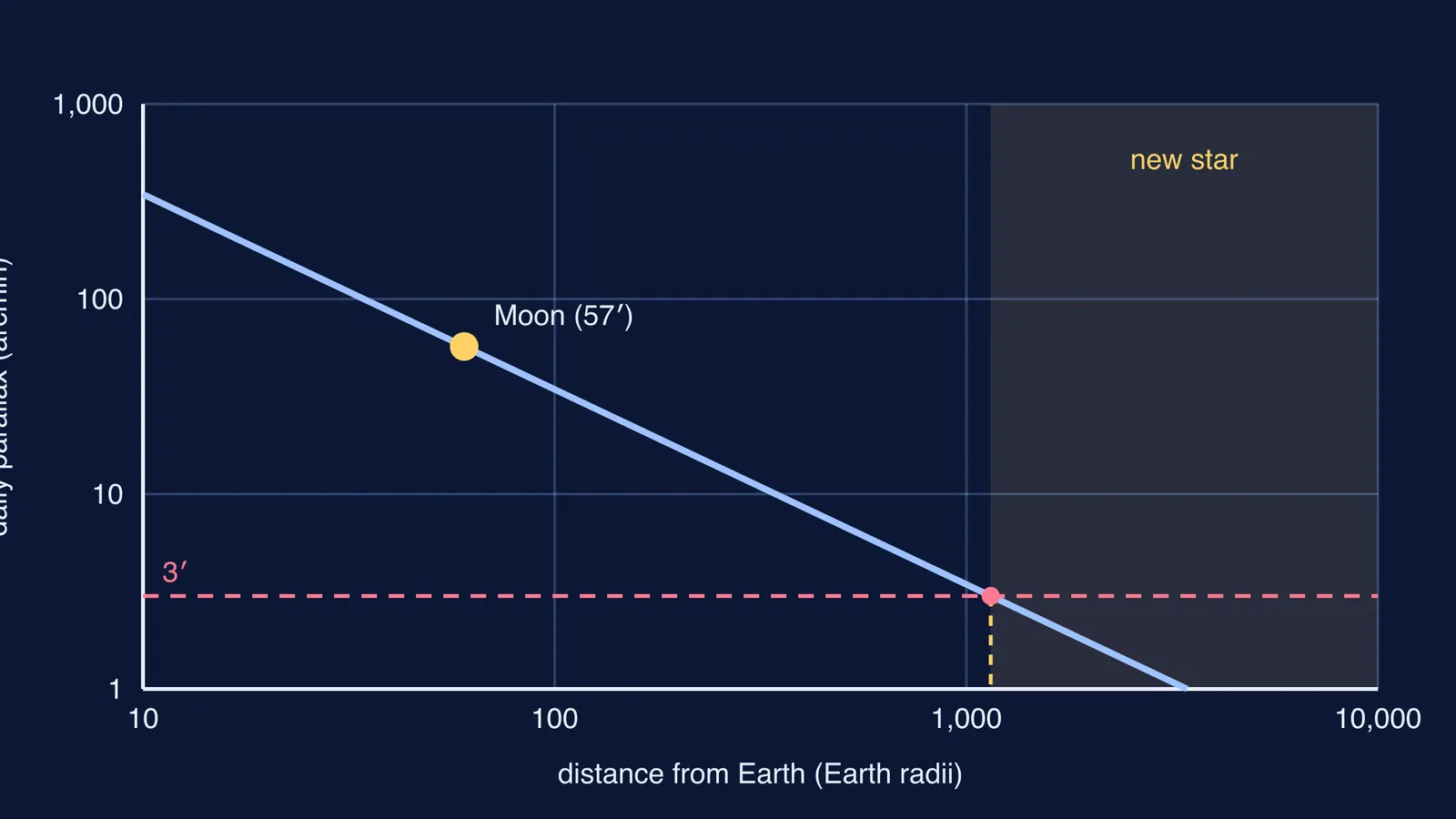
For the Moon: sin p = 6,378 ÷ 384,400 = 0.0166, so p ≈ 0.95°, about 57 arcminutes. A careful sighting instrument can detect that.
Now suppose your instrument could detect a shift as small as 3 arcminutes (0.05°) and you find nothing. Then d must be more than 6,378 ÷ sin 0.05° ≈ 7.3 million km.
That is about 19 times the Moon's distance. No shift does not give you the distance, but it gives you a floor.
The 3′ figure is our illustration, not a precision Tycho stated; the point is the shape of the argument. The chart at the top of this post plots the same formula.
Was Tycho's new star a supernova?
Yes. NASA's Chandra X-ray Observatory has imaged its expanding remnant, catalogued as SN 1572, at an estimated distance of 13,000 light years (Chandra). Chandra's team notes that the lack of a central point source fits other evidence that it was a Type Ia supernova, thought to be the explosion of a white dwarf star (Chandra).
Tycho's records still matter. His detailed brightness log let modern astronomers classify the event as a supernova and pin down where the remnant sits in the sky (Hinse et al., 2023). Measuring the far smaller parallax of an actual star came much later; that story is in our post on Friedrich Bessel and the first stellar parallax. For where Tycho's later planet data led, read how Johannes Kepler found his three laws.
How can you use Tycho's method in your own experiments?
Bring this checklist to any practical or project:
Measure relative to nearby references, as he measured the new star against Cassiopeia's stars, so shared errors cancel.
Ask what your idea predicts should change, and when. If the star were close, its position should shift during the night, so that is when you look.
Decide the smallest effect your setup can detect before you start.
If you see nothing, turn the null result into a bound, as in the worked example.
Write down raw readings with units, so someone else can check or reuse them later.
Parallax clicks faster when you can move the observer yourself and watch the near object jump; the Fermi Simulation Lab has interactive simulations for ideas that are easier to see than to read. If the sin p = R ÷ d step is where you get stuck, the Fermi Problem Library has worked problems with a step-by-step solver that explains the reasoning.
Tonight, find Cassiopeia's W shape in the northern sky and picture one extra star beside it: that is where Tycho looked.


