

On this page
A radio is only useful if you can switch it on. Around 1990, British inventor Trevor Baylis saw that for many people the problem was not the radio but the batteries, and he solved it with a spring you wind by hand.
Who was Trevor Baylis and why did he build a wind-up radio?
Baylis left school at 15 without qualifications and worked as a physical training instructor, an engineer and a stuntman before becoming a full-time inventor at 45, according to a tribute by Tracy Bhamra of Loughborough University.
The radio began with a television programme about the spread of AIDS in Africa. The Lemelson-MIT Program explains that in many areas radio was the only means of mass communication, but people often lacked electricity or batteries, so they could not hear advice meant to curb the spread of the disease. (Lemelson-MIT dates the programme to 1989; the Open University's tribute says 1991.)
His first test rig, Lemelson-MIT says, used a small transistor radio, an electric motor from a toy car and a hand brace, plus a clockwork mechanism that let a spring unwind at a controlled pace. Interest was lukewarm at first, until the BBC programme Tomorrow's World showed his prototype in 1994. With backers' funding, he set up BayGen Power Industries in Cape Town in 1995, and production of the Freeplay radio began a year later, Lemelson-MIT reports. Bhamra adds that the South African factory employed disabled people. Baylis died on 5 March 2018.
How does a wind-up radio work?
It is a chain of energy conversions you meet in school physics:
Your arm does work turning the crank.
The spring stores it as elastic potential energy.
A gear train turns the spring's slow unwinding into fast spinning.
A generator turns that spinning into electrical energy by electromagnetic induction, the effect Michael Faraday discovered.
The radio uses the electricity, and the spring slowly runs down.
Steps 3 and 4 were where the engineering got hard. Baylis's 1999 US patent says his earlier UK design had proved "exceptionally difficult to put into practice", and describes the problem as building a low-cost gear train that could reliably pass a powerful spring's energy to a generator while releasing it controllably and at the right rate. Its answer is feedback from the control circuit: a generator supplying current resists being turned, which is why a loaded generator is harder to turn. That resistance helps stop the spring simply spinning out.
Worked example: where does an hour of radio come from?
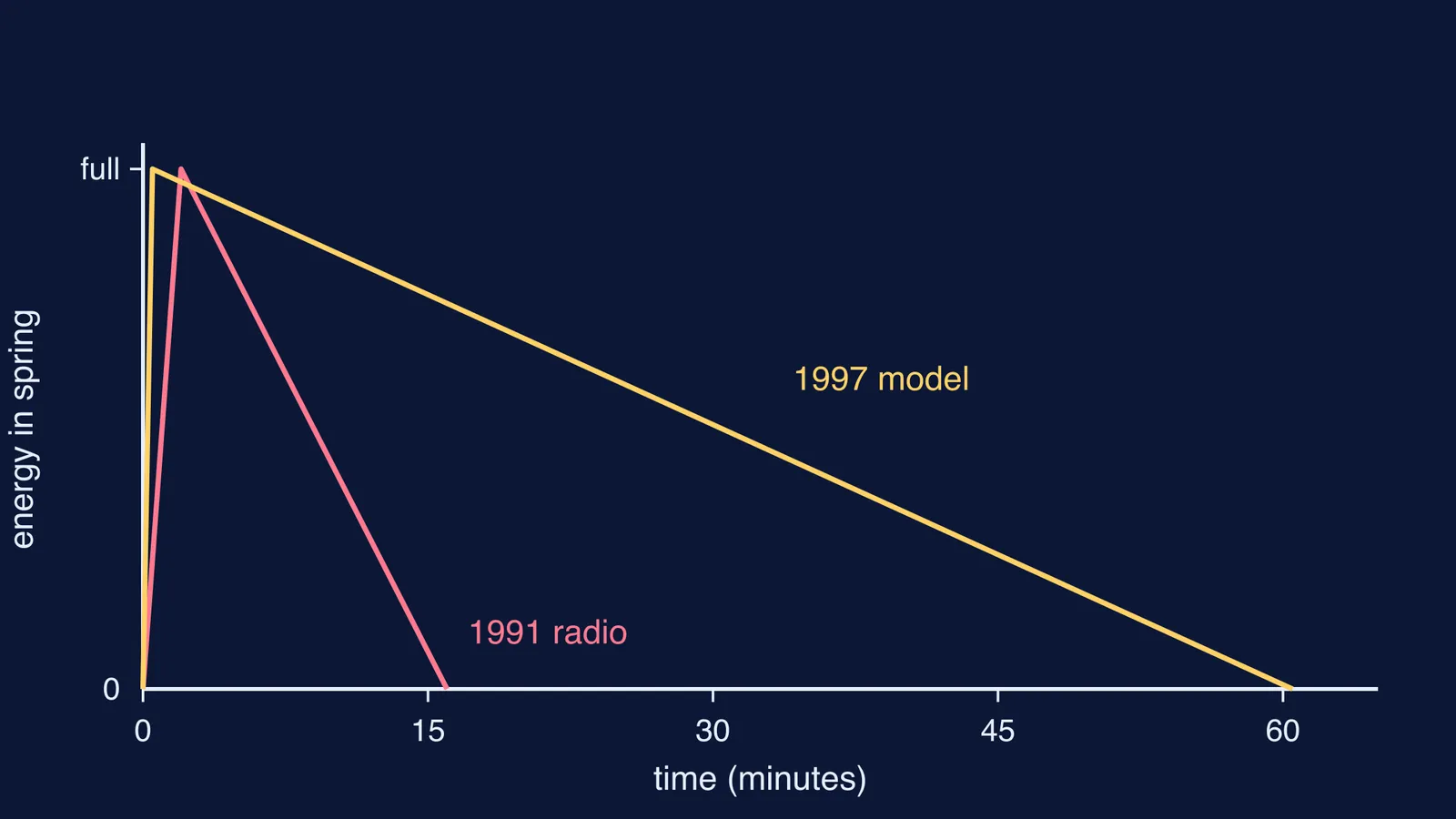
By 1991, Baylis's radio played for 14 minutes on a two-minute wind; a smaller, lighter model introduced in 1997 ran for up to an hour on a thirty-second wind (Lemelson-MIT).
First radio: 14 minutes of play ÷ 2 minutes of winding = 7 minutes of radio per minute of cranking.
Later model: 60 minutes ÷ 0.5 minutes = 120 minutes of radio per minute of cranking.
120 ÷ 7 ≈ 17, so the same effort bought roughly 17 times more listening.
Now an energy budget. Suppose, purely as a round number for practice (our assumption, not a Freeplay specification), the radio needs 0.1 W.
Energy for one hour: 0.1 W × 3,600 s = 360 J.
Delivered in a 30-second wind: 360 J ÷ 30 s = 12 W from your arm, and more once gear and generator losses are counted.
For scale, lifting a 1 kg bag by 1 m takes about 9.8 J, so 360 J is like lifting it about 37 times.
If the jump from a spinning coil to a current is hard to picture, the Fermi Simulation Lab has interactive simulations for ideas that are easier to see than to read.
What can students learn from Baylis's way of inventing?
Baylis put his approach simply, as quoted in the Open University's tribute: "If you find yourself trying to solve a problem, you are halfway to inventing something." Here it is as a checklist for a school project:
Name the person and what they lack. Not "energy", but "a family with no batteries who needs health news".
List what they do have. Muscle, sunlight, wind, water.
Build a rough version fast from parts you can find, as Baylis did with a toy motor.
Measure one honest number, like minutes of output per minute of input.
Find the weakest link. For Baylis it was the gears and the control of the spring.
Show it to people who can help, even if it looks unfinished.
The design mattered beyond health messages too: Bhamra reports that a 1998 study found the Baygen radio had a significantly lower overall environmental impact over a five-year lifetime than any other radio on the market at the time.
If your physics gets stuck at step 4, the Fermi Problem Library has worked problems with a step-by-step solver that explains the reasoning rather than printing an answer. Then try one energy budget of your own, for a torch, a fan or a phone charger, and see where the joules go.


