

On this page
Why did Thomas Drummond invent the limelight?
Thomas Drummond was not just an engineer, but an inventor who understood the value of applying pure science to practical problems. In 1824, he was assigned to the Ordnance Survey of Ireland, a monumental project designed to map the entire island for taxation and land valuation purposes. The survey relied on triangulation, a method of mapping the landscape by measuring angles between distant mountain peaks. Similar large-scale trigonometry would later be used by human computers in India, such as in Radhanath Sikdar's calculation of Everest's height.
To make observations by day, surveyors typically used heliostats—mirrors that reflected sunlight to mark distant stations. However, the Irish climate made this exceptionally difficult. Mist, fog and low clouds often hid the sun and the distant observation points from view for weeks at a time, bringing the mapping work to a standstill. The surveyors needed an artificial light source powerful enough to punch through the murk for night-time observations.
Drummond found the solution in a chemistry lecture by Michael Faraday. He had seen a demonstration of an effect originally discovered by Sir Goldsworthy Gurney in the 1820s: heating a block of lime produced a blinding light. Drummond built a practical surveying version of the device, creating what became known as the Drummond light. He paired the glowing quicklime with a parabolic reflector to focus the intense light into a concentrated, directional beam. He placed his invention on the summit of Slieve Snaght in Donegal, and surveyors successfully observed the intense beam from Divis mountain near Belfast. The light was observed from a distance of 68 miles. It was so powerful that it cast a strong shadow at a distance of 13 miles.
How does a limelight work with quicklime?
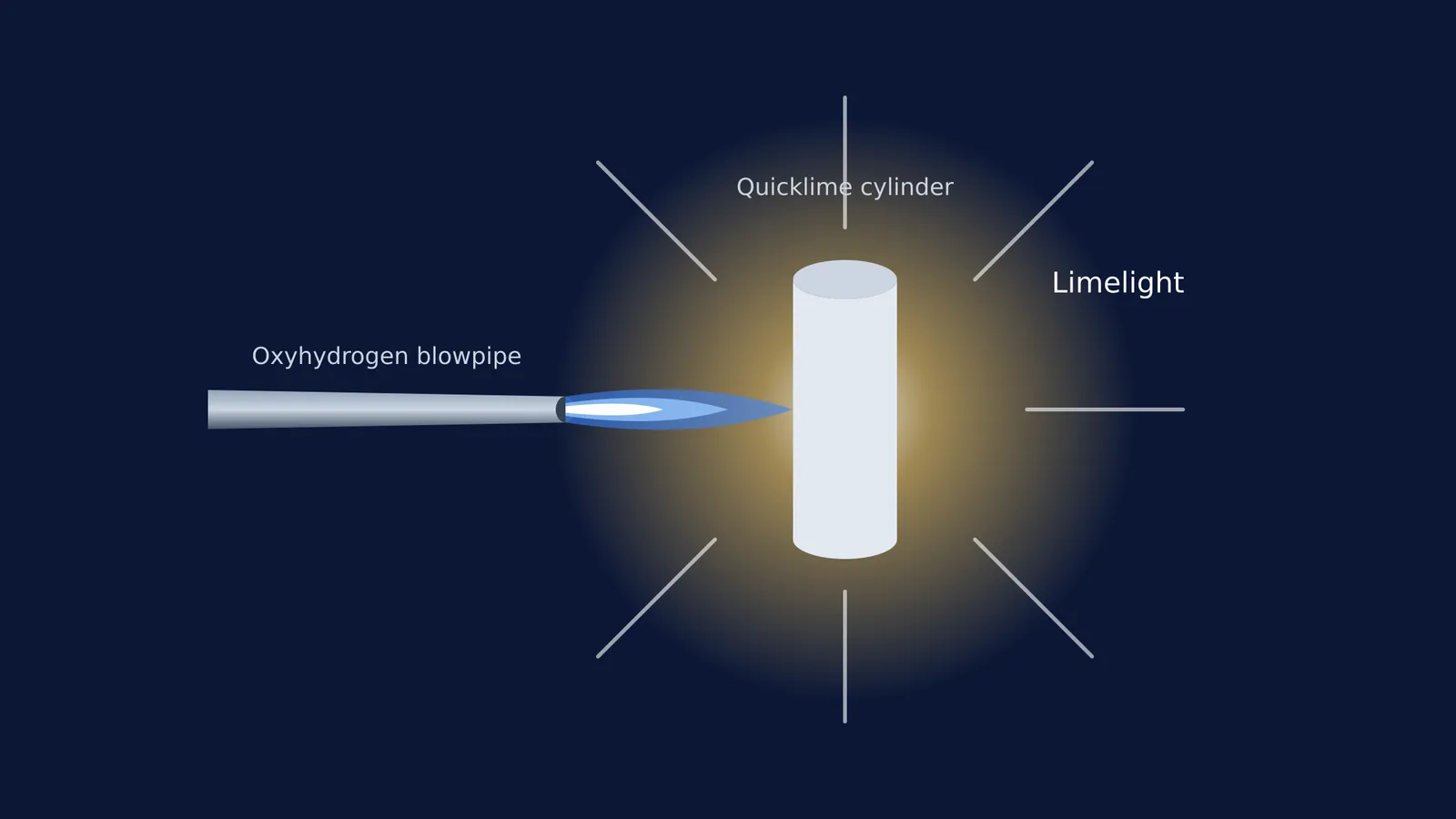
The Drummond light is produced by directing an oxyhydrogen flame—a dangerously hot flame fed by a pressurized mixture of oxygen and hydrogen gases—at a solid cylinder of quicklime.
Quicklime is the chemical compound calcium oxide (CaO). It has an exceptionally high melting point of 2,572 °C. Because it does not melt under the blowpipe flame, the quicklime absorbs the heat and reaches an extreme temperature without turning into a liquid. Instead of burning away or vaporising, the solid cylinder emits a brilliant, high-intensity white light.
This glow is a combination of two phenomena. The first is incandescence, the same principle behind the heating effect of current in a traditional tungsten light bulb filament, where heat directly produces visible light. As the quicklime gets hotter, its thermal radiation shifts into the visible spectrum, glowing intensely white. The second is candoluminescence, a rare effect where certain materials emit light at specific wavelengths at temperatures lower than classical physics would predict for pure heat radiation alone.
How did the Drummond light become theatrical limelight?
While Drummond invented the limelight to map the mountains of Ireland, the invention soon found a more glamorous application. The brilliant white light could be easily directed through lenses and mirrors to create a sharp, intense beam. By 1837, the light was being used indoors to create special effects at the Covent Garden Theatre in London.
The intense, focusable beam of the limelight made it an effective tool to highlight solo performers on a darkened stage, cutting through the dim gaslights that previously illuminated theatres. This was the birth of the modern theatrical spotlight. Operating a limelight was a dangerous job, requiring a skilled technician to manage the explosive mixture of oxygen and hydrogen cylinders while slowly turning the quicklime block so it did not pit or crack under the flame. Although safer electric arc lighting eventually replaced the hazardous oxyhydrogen flames by the late 19th century, the cultural impact remained. To this day, being the centre of public attention is universally known as being "in the limelight".
Worked example: How is quicklime made?
Quicklime is not just a piece of 19th-century history; it is a central compound in the Class 10 and 11 chemistry syllabi. It is manufactured industrially by the thermal decomposition of limestone (calcium carbonate) in large kilns. Understanding this reaction is a foundation for solving stoichiometry problems in competitive exams.
Question: What mass of quicklime is formed when 50 g of limestone (CaCO3) is strongly heated? (Atomic masses: Ca = 40, C = 12, O = 16)
Solution:
Write the balanced chemical equation for the thermal decomposition: CaCO3 → CaO + CO2
Calculate the molar mass of limestone (CaCO3): 40 + 12 + (3 × 16) = 100 g/mol
Calculate the molar mass of quicklime (CaO): 40 + 16 = 56 g/mol
From the equation, 1 mole (100 g) of CaCO3 produces 1 mole (56 g) of CaO.
Therefore, 50 g of CaCO3 (which is half a mole) produces 28 g of CaO.
This 28 g of quicklime can then be used to produce slaked lime (calcium hydroxide) by adding water, a highly exothermic reaction that was historically used to make plaster and mortar.
If you get stuck on stoichiometry calculations or need help balancing equations, the Fermi Problem Library has worked problems with a step-by-step solver that explains the reasoning rather than printing an answer.


