On this page
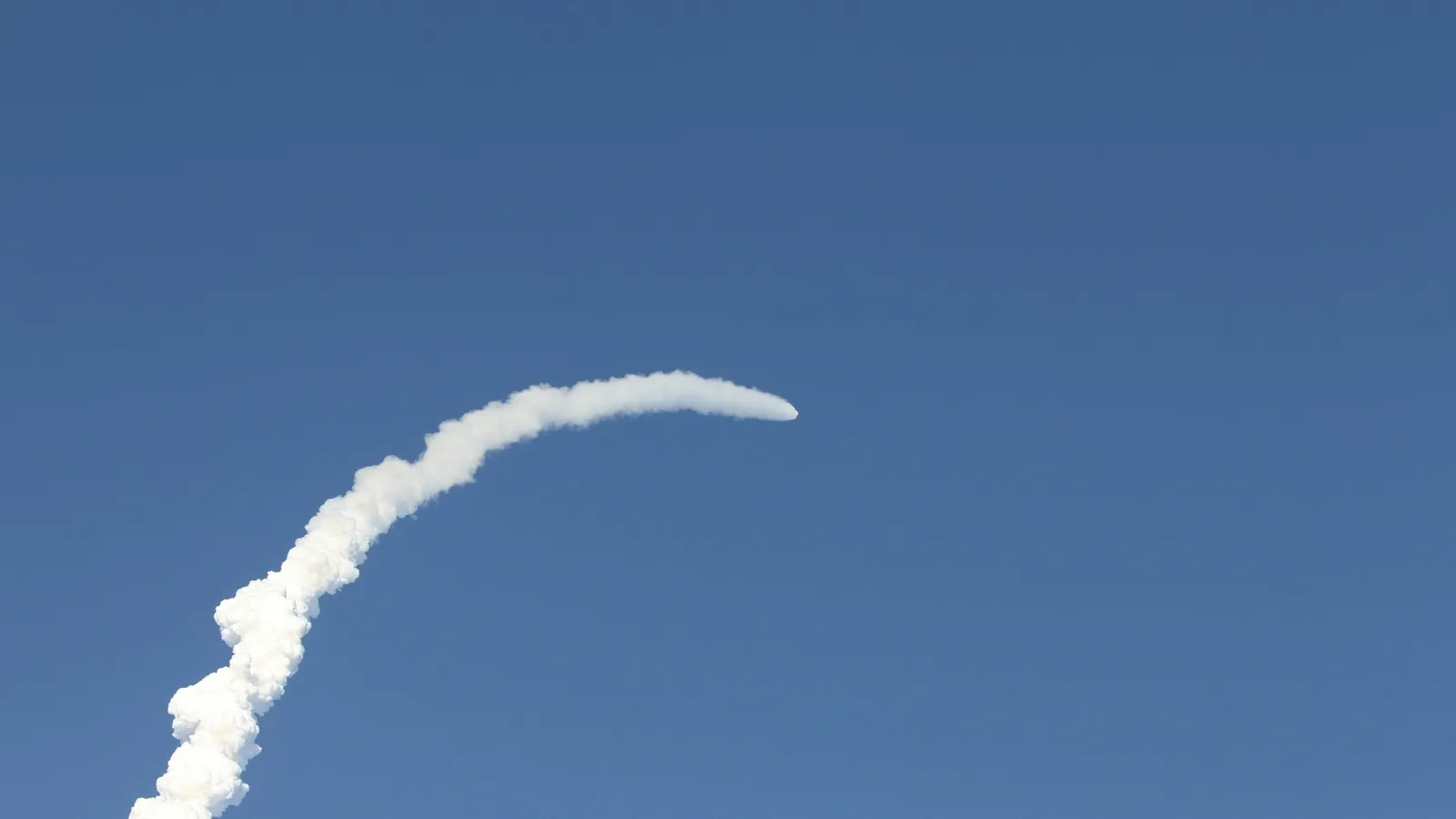
A long-range rocket is only guided for the first few minutes. After that it coasts, and wherever its speed and direction point at the moment the engine stops is where it will land. Tessy Thomas built a career on getting those first minutes right. This post covers her path at India's Defence Research and Development Organisation (DRDO), what her published research says guidance does, and a projectile-motion example that shows why small errors matter.
Who is Tessy Thomas?
A 2008 profile in the Indian Women Scientists' Association newsletter says she comes from Alappuzha in Kerala. After a B.Tech from Thrissur Engineering College she joined DRDO in 1985, then took an M.Tech in guided missiles at the Institute of Armament Technology in Pune, where she also taught. From 1988 she worked on missile development at the Defence Research and Development Laboratory in Hyderabad, where her main responsibility was the design of the guidance system.
The same profile says she was Assistant Project Director when Agni-III was launched successfully in May 2008, and that she analysed the cause of an earlier Agni-III failure, which helped DRDO fix the problems. She told the newsletter that when she joined DRDO "there were only four-five women."
Which Agni projects did she lead?
The Hindu BusinessLine reported in 2018 that she became the first woman to lead a missile project with the Agni-II Prime project, whose first test failed in 2010, and that she led Agni-IV to a successful test launch the following year. She has a doctorate in guidance systems, became Director of the Advanced Systems Laboratory in Hyderabad in July 2014, and in June 2018 took charge as Director-General, Aeronautical Systems, overseeing a cluster of DRDO aeronautics laboratories. The media called her "Agni Putri."
What does a guidance system do?
Her own papers answer this. In a 2005 paper in the Defence Science Journal, she explains that a long-range ballistic missile is guided only in the boost phase, a small fraction of its total flight time, and must be steered to the required position and velocity by the end of that phase. Drag and lift in the atmosphere make this harder, so she described an energy-management guidance scheme that corrects for them.
A 2013 paper she co-wrote in the same journal, on online trajectory reshaping, deals with what happens next: once the engine burns out, the vehicle follows an elliptical path, and any navigation or guidance error at burnout becomes an error at the far end. The paper tunes the burnout conditions so the end point falls within tolerance.
For context, a Press Information Bureau release of 19 April 2012 on the first Agni-V test credited a ring laser gyro inertial navigation system and a micro navigation system for the missile's accuracy, and gave its range as more than 5,000 km.
Worked example: how a small speed error grows
This is a classroom model with sample numbers, not real missile data: flat ground, no air, constant g = 9.8 m/s². The range of a projectile launched at speed v and angle θ is R = v² sin 2θ / g.
Baseline. v = 1,000 m/s at θ = 45°. sin 90° = 1, so R = 1,000,000 / 9.8 = 102,041 m, about 102 km.
Speed 1 m/s too high. v = 1,001 m/s gives R = 1,002,001 / 9.8 = 102,245 m. The error is 204 m.
Shortcut. Because R ∝ v², a small fractional error in v doubles in R: ΔR ≈ 2R (Δv / v) = 2 x 102,041 x 0.001 = 204 m. The two methods agree.
Angle error at 45°. At 45° the range is at its maximum, so a 1° error changes R only slightly: at 46°, sin 92° = 0.99939, which shortens R by just 62 m. At 30°, the same 1° error would change R by more than 1.7 km.
A 0.1 per cent error in speed at the end of the boost phase became a 0.2 per cent error in where the projectile lands. That is why guidance work focuses so hard on burnout conditions.
To see how range changes as you vary speed and angle, try our projectile motion simulation guide. When the doubling of a small error in a squared quantity is the step that confuses you, the Fermi Concept Library covers every concept in physics, chemistry, biology, mathematics and computing, so you can go back to the idea itself.
What can a student take from her way of working?
Learn from failure on purpose. Her analysis of a failed launch helped the next one succeed.
Go deep in one discipline. She stayed with guidance through an M.Tech, a doctorate and decades of projects.
Publish what you can. Even in defence work, she wrote up methods others could study.
Our post on A. P. J. Abdul Kalam covers the rocketry programme her generation joined.
Try it now: redo step 2 with v = 999 m/s and check that the range falls by about 204 m.