

On this page
Cancer is incredibly difficult to treat because it hides from our immune system. For decades, scientists searched for ways to boost our natural defences against tumours. They tried using bacteria or chemicals to wake up the immune system, but the results were unpredictable and often failed to save the patient. Then, a chance discovery in a Japanese laboratory fundamentally changed how we treat the disease.
How does the immune system tell friend from foe?
Our T cells—a type of white blood cell—are built to seek out and destroy anything that does not belong in the body, such as viruses, bacteria, or abnormal cells. However, they must not attack our own healthy tissues. If they do, the result is an autoimmune disease.
To prevent this friendly fire, T cells are equipped with "brakes" known as checkpoints. When these checkpoint proteins bind to matching signals on a healthy cell, the T cell stands down. This delicate balance, known as immune tolerance, is what stops the immune system from destroying the body itself.
What did Tasuku Honjo discover?
In 1992 at Kyoto University, Tasuku Honjo discovered a protein on the surface of T cells called Programmed Cell Death-1, or PD-1. Initially, it was not clear what this protein did.
Through years of careful animal experiments, his team mapped out its function. They revealed that PD-1 operates as a crucial immune brake. Without this brake, the immune system goes into overdrive. When Honjo's team bred mice that lacked the PD-1 gene, the animals developed severe autoimmune diseases because their T cells could no longer be told to stop attacking healthy organs.
How does cancer hijack the PD-1 brake?
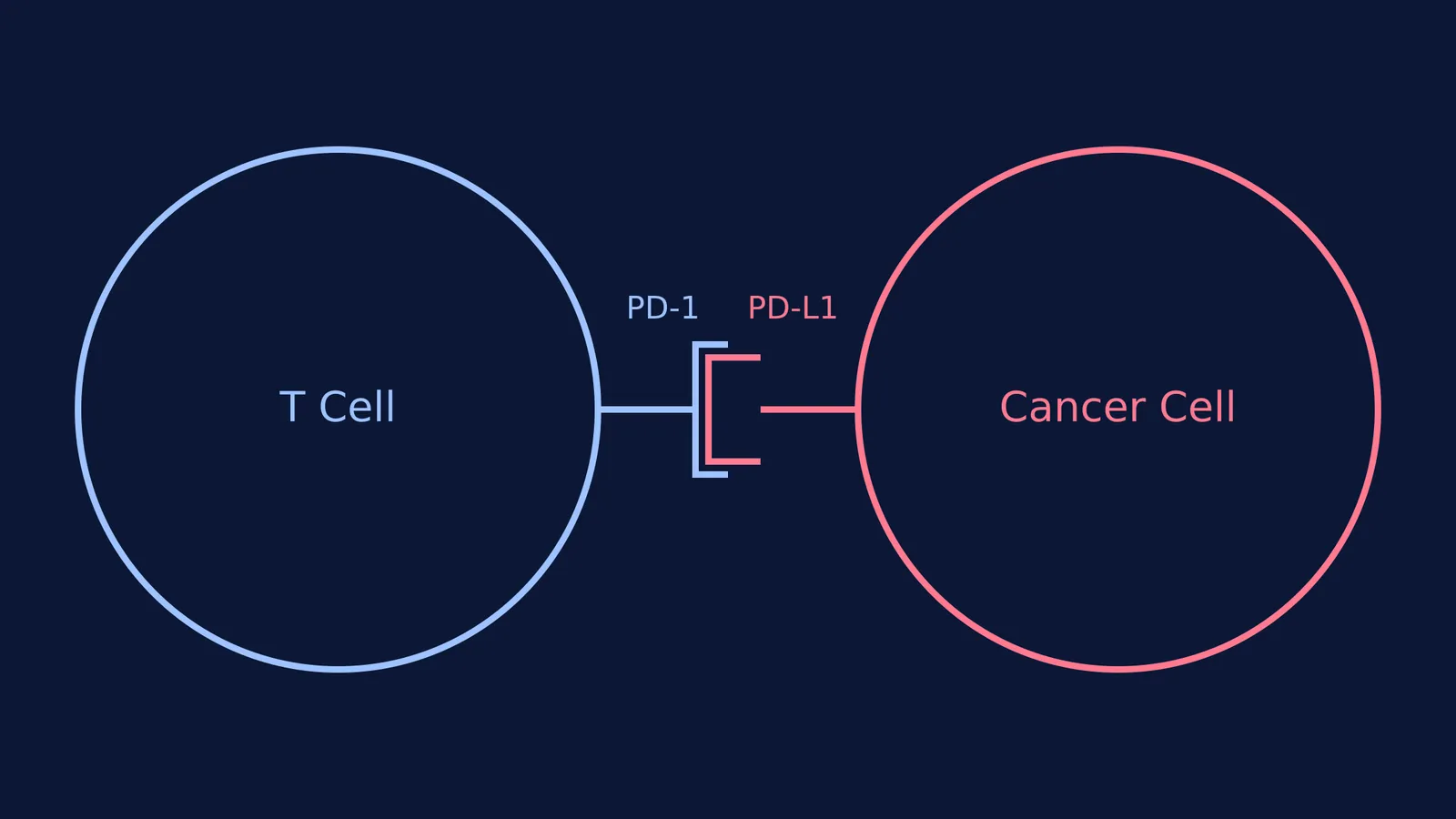
Tumours survive by tricking the immune system into thinking they belong there. Many cancer cells evolve to cover their surface in a ligand protein called PD-L1. This protein fits perfectly into the PD-1 brake on passing T cells.
When a T cell arrives at the tumour site, ready to destroy the abnormal cells, the cancer cell uses its PD-L1 to press the PD-1 brake. The T cell receives a strong chemical signal to stand down, and the cancer is left alone to grow and spread unchecked.
What is checkpoint inhibitor therapy?
Honjo realised that if we could block the PD-1 protein with a targeted drug, the cancer cell would no longer be able to press the brake. The T cell would then recognise the tumour as a threat and destroy it, using the body's own defences instead of toxic chemotherapy.
This idea led to a completely new class of medicines. In 2014, the FDA approved the first PD-1 inhibitor drugs, such as nivolumab and pembrolizumab, for patients with advanced melanoma. Today, this strategy, called immune checkpoint therapy, is used for lung cancer, renal cancer and lymphoma. It has led to long-term remission in patients who were previously considered untreatable.
How to learn biological pathways
Understanding how systems regulate themselves is often more important than simply memorising protein names. Immune checkpoints are a perfect example of biological regulation. Here is a framework to break down any new pathway when you study:
Find the trigger: What starts the biological process? (For a T cell, it is recognising a foreign antigen).
Find the brake: How does the body stop the process from going too far? (The PD-1 protein stops the T cell).
Trace the failure: What happens when the brake fails or is removed? (Without PD-1, the body attacks itself, causing autoimmunity).
Spot the hijack: How do pathogens or tumours exploit the system to survive? (Cancer cells use PD-L1 to hit the brake and hide).
If you are struggling to picture how these molecules interact across a cell membrane, Fermi's AI tutor can draw the cells, label the receptors and walk you through the pathway step by step. You can also explore how viruses and bacteria evade our internal defences in the Fermi Concept Library.
For more on how our bodies fight disease, read about Indira Nath and why some immune systems fail against leprosy, or see how Peter Medawar and how the body can learn to accept a graft discovered the rules of immune tolerance.


