On this page
In the early 1880s, beriberi was crippling Japan's navy. Takaki Kanehiro, a navy surgeon trained in London, believed the cause was food. In 1884 he tested that idea by sending a warship on a new diet over the same route where another crew had fallen ill. The result won over the navy's doubters, and within a few years beriberi had gone from its ships.
What was beriberi, and why did sailors get it?
Severe thiamine (vitamin B1) deficiency causes beriberi, "a disorder typically associated with a diet consisting largely of polished rice," according to the World Health Organization.
When Takaki returned from five years at St Thomas's Hospital Medical School in London, "one in every three members of the Navy suffered from it," write Yoshifumi Sugiyama and Akihiro Seita in a 2013 history in the Journal of the Royal Society of Medicine.
In his 1906 lectures in The Lancet, Takaki explains his reasoning. Heat, damp and hard work could not be the main cause, because Europeans and Americans in the same conditions did not get beriberi. Officers and well-fed men did not get it either. The navy's 1883 rations had about 1 part nitrogen to 28 of carbon: little protein, lots of carbohydrate. He concluded the diet lacked protein.
How did Takaki test his idea on the Tsukuba?
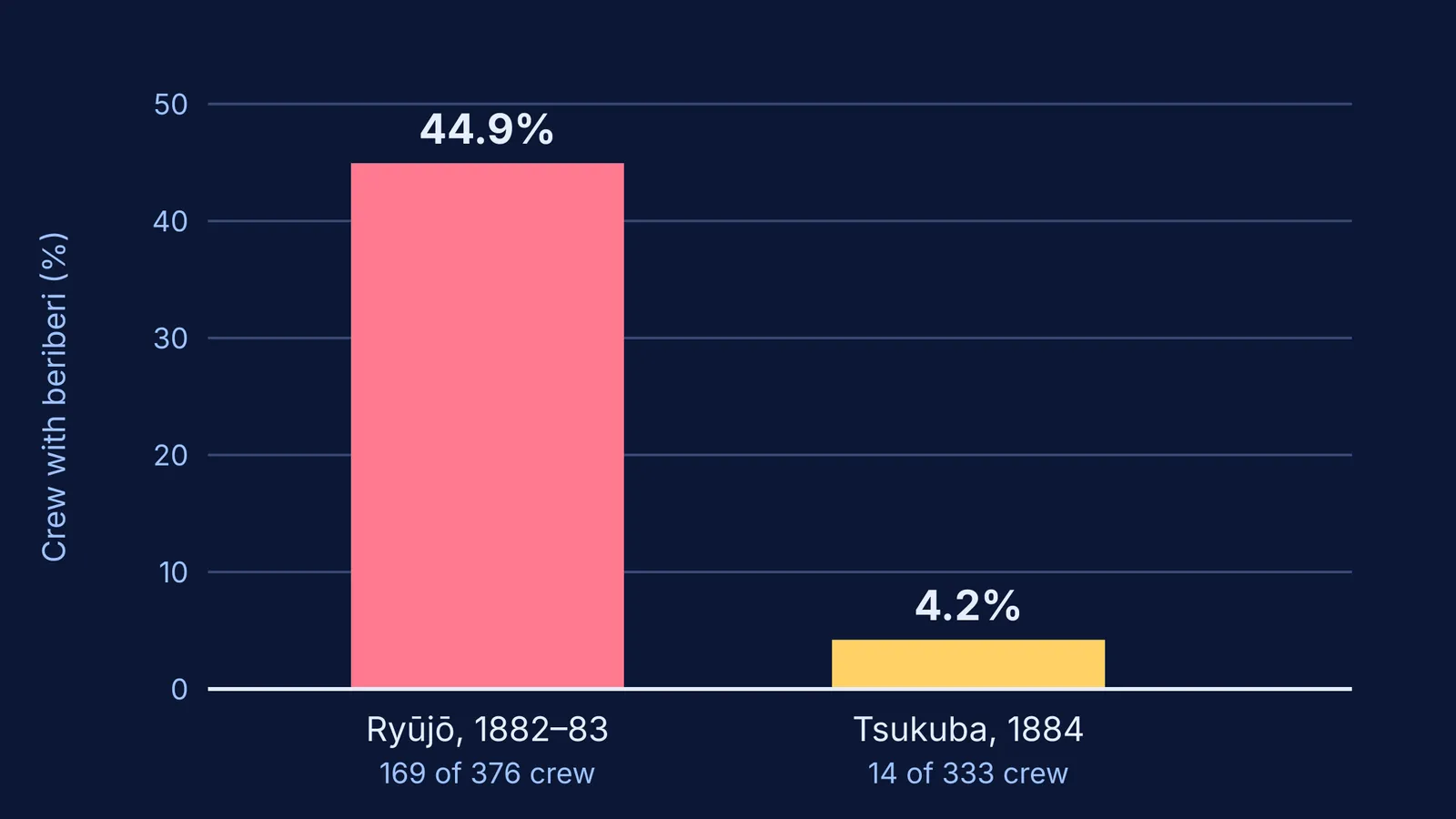
The training ship Ryūjō sailed from December 1882 to October 1883, via New Zealand, Chile, Peru and Hawaii. Of its 376 crew, 169 developed beriberi and 25 died (Sugiyama and Seita, 2013).
Takaki then arranged a repeat with one thing changed. In the same lecture, he says he made "a great effort" so that the training ship Tsukuba "should go over the same route as the Ryujo." Once opposition was overcome, a special Treasury grant of 60,000 yen paid for the voyage. An investigating committee sailed on board, and the food followed the navy's new ration, which added bread, meat, fish, vegetables, beans and milk to the rice.
The Tsukuba sailed in February 1884 and returned on 16 November. Only 14 of its 333 crew got beriberi, and none died. All 14 had not been eating the new menu (Sugiyama and Seita, 2013).
Was the Tsukuba voyage a controlled trial?
Not a modern one, but a deliberate fair comparison. The James Lind Library notes that Takaki matched the Ryūjō's course to keep other factors as similar as possible. Here is the arithmetic:
Ryūjō risk: 169 ÷ 376 = 44.9% of the crew.
Tsukuba risk: 14 ÷ 333 = 4.2% of the crew.
Expected cases with no change: 333 × 44.9% ≈ 150 sailors. The real number was 14.
Relative risk: 4.2 ÷ 44.9 ≈ 0.09, so the risk fell to about one-tenth.
Deaths: 25 against 0.
What made it fair:
the same route, a similar voyage length, two training ships with crews of similar size
one planned change: the food
a clear outcome to count: beriberi cases and deaths
What a modern trial would add:
both groups at sea at the same time, so a different year cannot explain the gap
sailors assigned to diets at random
a record of who actually ate the food, since every case came from sailors who did not
What happened after the voyage?
Takaki's lecture admits a snag: most of the men disliked meat as well as bread. So in 1885 the navy switched to rice mixed with barley, a grain most recruits had eaten since childhood. In an 1885 address to naval officers, Takaki said "there is nothing better than barley food for preventing beri-beri." By 1890, he reported, beriberi had been wiped out in the navy (Takaki, 1906).
The army kept its polished rice ration. Kunio Aoki's history of Japanese epidemiology reports over 27,800 beriberi deaths in the Russo-Japanese War of 1904-05, and that an army committee's human experiment in 1923-24 concluded that vitamin B1 deficiency was the main cause. Read how Umetaro Suzuki found vitamin B1 in rice bran, and compare how Joseph Goldberger proved pellagra was a diet disease.
How can you use Takaki's method in your own experiments?
Use it for a CBSE practical or a study habit. Before you start, write one line for each:
Baseline: what happens now, measured.
One change: the single thing you will alter.
Same conditions: everything you will keep the same.
Outcome: what you will count, decided before you look.
Check: did the change really reach each person or plant?
Doubt: what else could explain the result?
If vitamins, deficiency diseases or relative risk feel shaky, the Fermi Concept Library covers every concept in biology and mathematics, each with its own lesson. For percentage and ratio questions like the ones above, the Fermi Problem Library has worked problems with a step-by-step solver that explains the reasoning.
Next time a result surprises you, ask Takaki's question: what changed, and what stayed the same?