

On this page
In 1910, beriberi was a devastating disease in Japan, particularly affecting the military and the rapidly urbanising population. While most medical experts believed it was an infectious pathogen, agricultural chemist Umetaro Suzuki searched for answers in nutrition. He extracted a water-soluble complex from rice bran that cured the disease, marking one of the world's first vitamin isolations.
What did Umetaro Suzuki discover in 1910?
During the late 19th and early 20th centuries, beriberi caused severe nerve damage, muscle weakness, and heart failure across Asia. Because the disease spread rapidly in crowded cities and army camps, the prevailing medical theory was that a germ or bacteria caused it. Suzuki, however, approached the problem through the lens of agriculture and diet, suspecting that a missing element in the food supply was to blame.
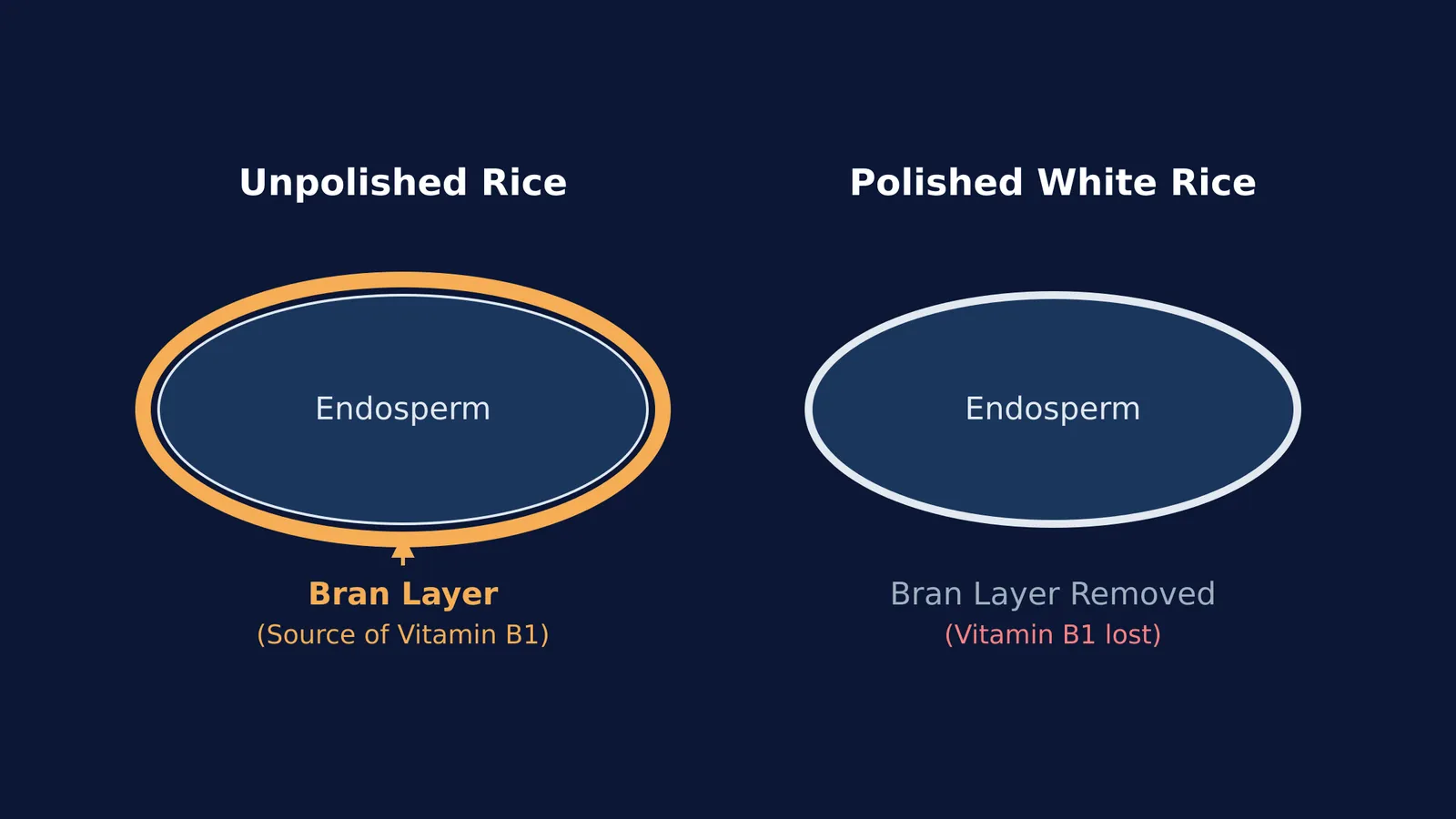
In 1910, Suzuki successfully extracted a water-soluble complex of micronutrients from rice bran that cured beriberi in patients. He initially named this life-saving substance "aberic acid" and later changed it to oryzanin, deriving the name from *Oryza sativa*, the scientific name for rice. He announced his findings to the Tokyo Chemical Society on December 13, 1910, effectively proving that beriberi was a dietary deficiency rather than an infection. (Related: Christiaan Eijkman, beriberi and the road to vitamins)
Why did Casimir Funk get credit for vitamins?
Despite being the first to isolate this crucial nutrient, Suzuki's discovery was largely overlooked by the international scientific community. In 1911, he published his findings in a Japanese scientific journal. However, when the article was translated into German for a European audience, the translator omitted Suzuki's central claim that his extract was a newly discovered nutrient.
Because of this critical translation error, the Western scientific establishment dismissed the paper as a minor agricultural note rather than a medical breakthrough. In 1912, Polish biochemist Kazimierz Funk isolated the same nutrient complex and proposed the name "vitamine" (vital amine). Because Funk's work was published in English and clearly claimed a new discovery, he was widely credited as the father of vitamins, while Suzuki's prior achievement faded from global textbooks. (Read more: Casimir Funk and the idea of vital amines, or vitamins) In 1934, the compound Suzuki had first isolated was structurally identified and named thiamine, or vitamin B1.
Tracing the complex history of scientific discoveries helps you remember the facts behind them. If you are learning the history of biology or nutrition, Fermi's AI tutor can teach the concepts by holding a line of reasoning across a session, checking your understanding as it goes rather than just giving you the answer.
How should you study scientific discoveries for exams?
When studying for biology or chemistry exams, understanding *why* an experiment was done is much more effective than just memorising a result or a scientist's name. A good study habit is to break down historical milestones into three distinct steps:
Find the problem: Ask what the scientist was trying to solve. In this case, Suzuki was trying to find a cure for beriberi, a disease that was baffling doctors.
Follow the method: Look at how they approached it differently from others. While doctors looked for a germ, Suzuki looked at the composition of the diet, specifically the rice bran that was being discarded.
Connect to the syllabus: Link the historical discovery to the concepts you need to know today. Suzuki's work is directly tied to your syllabus topics, such as the difference between fat-soluble and water-soluble vitamins. (See Vitamins in Class 12 chemistry: fat- and water-soluble types)
If you get stuck on a biological mechanism, such as how water-soluble vitamins are absorbed in the body, the Fermi Concept Library holds a lesson for every concept in chemistry and biology to help you map it out. Today, Umetaro Suzuki is fully recognised in Japan for his pioneering work. On April 18, 1985, the Japan Patent Office honoured him as one of the Ten Japanese Great Inventors, cementing his rightful legacy in the history of science.


