On this page
Vitamin C, or ascorbic acid, is an essential nutrient that humans cannot make themselves. Until the 1930s, the only way to get it was by extracting it from food sources like citrus fruits or paprika, making it too expensive to isolate in large quantities for medical use.
In 1933, the Polish-Swiss chemist Tadeusz Reichstein changed that. Working at the ETH Zürich, he developed a reliable, multi-step method to synthesize vitamin C from D-glucose, a simple and abundant sugar. This method, now known as the Reichstein process, uniquely combined pure chemical steps with microbiology. It became the global industrial standard, remaining the dominant method for over 60 years, and allowing the pharmaceutical company Hoffmann-La Roche to launch Redoxon in 1934 as the first mass-produced synthetic vitamin.
What is the Reichstein process for vitamin C synthesis?
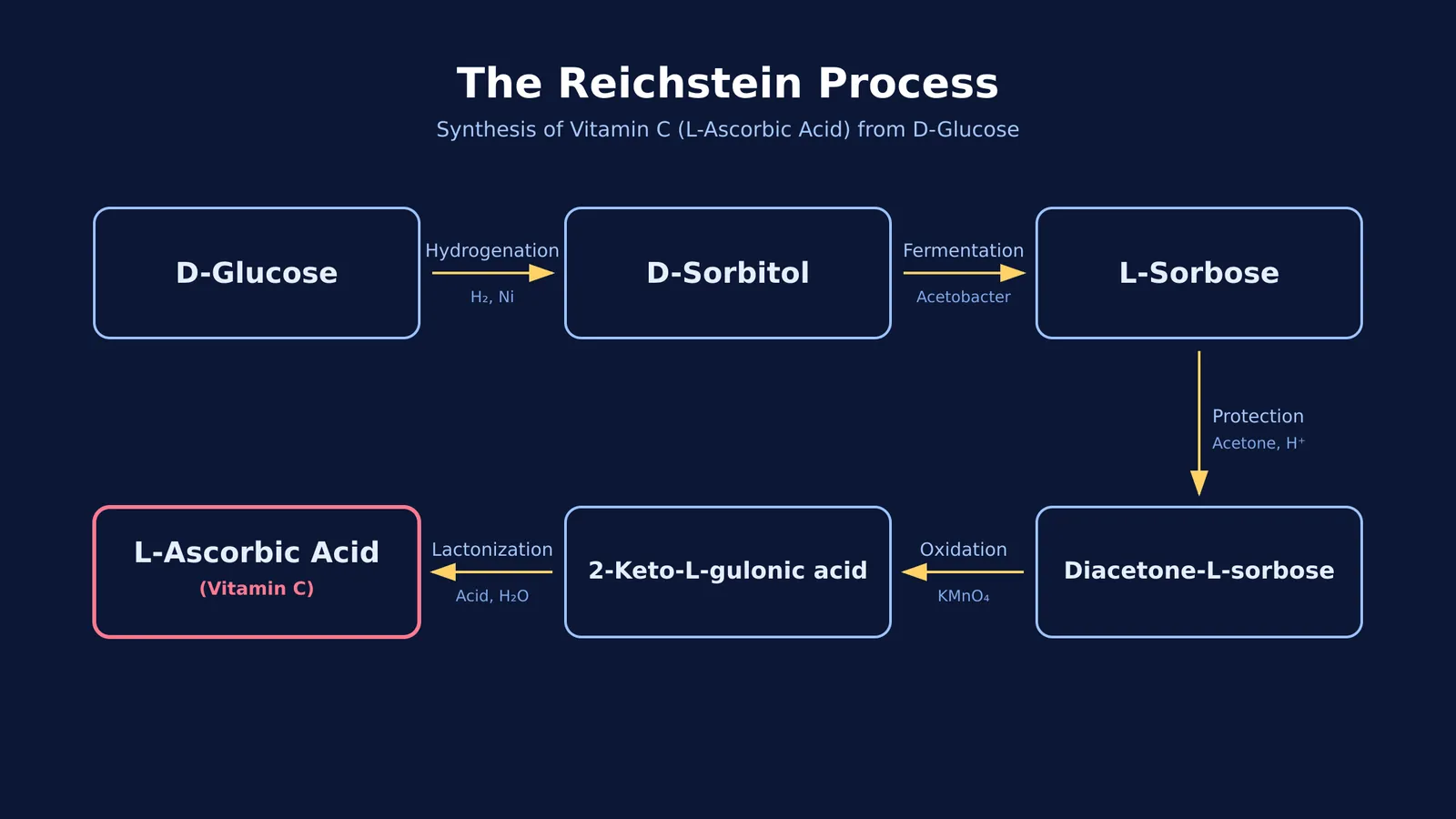
The Reichstein process produces ascorbic acid in five main stages, transitioning a naturally occurring sugar into a highly stable and usable vitamin:
Hydrogenation: The process begins with D-glucose. It is reduced to D-sorbitol using hydrogen gas and a nickel catalyst under high pressure and temperature.
Microbial fermentation: D-sorbitol is oxidized to L-sorbose. This is a biological step, typically carried out using the bacterium *Acetobacter suboxydans*. This step is crucial because the bacteria provide the precise stereochemistry (L-configuration) needed for the final vitamin to be biologically active in the human body.
Protection: L-sorbose is then reacted with acetone and an acid catalyst to form diacetone-L-sorbose. This step temporarily protects four of the specific hydroxyl groups on the molecule, ensuring that only the correct, unprotected part of the molecule reacts during the subsequent oxidation step.
Oxidation: The unprotected primary alcohol group on diacetone-L-sorbose is chemically oxidized, often using a strong agent like potassium permanganate, to form diacetone-2-keto-L-gulonic acid.
Hydrolysis and lactonization: Finally, acid hydrolysis is used to remove the protective acetone groups. The resulting 2-keto-L-gulonic acid undergoes a ring-closing reaction known as lactonization to yield the final product: L-ascorbic acid, or vitamin C.
Why did Tadeusz Reichstein win the Nobel Prize?
Though his vitamin C synthesis fundamentally changed the pharmaceutical industry and public health by making the vitamin widely affordable, Reichstein did not win the Nobel Prize for it. In 1937, Nobel Prizes for the discovery and structural mapping of vitamin C went to Albert Szent-Györgyi (Medicine) and Sir Norman Haworth (Chemistry).
Reichstein's Nobel recognition came more than a decade later for an entirely different breakthrough in biochemistry. Between the late 1930s and 1950, his team at the University of Basel successfully isolated several hormones from the adrenal cortex. He mapped their complex structures, proving that these essential substances were steroid derivatives, and he was instrumental in isolating cortisone.
For this rigorous and foundational work, he shared the 1950 Nobel Prize in Physiology or Medicine with American researchers Edward C. Kendall and Philip S. Hench. Their combined discoveries laid the chemical and clinical foundation for using cortisone to treat rheumatoid arthritis and various other severe inflammatory conditions. His research in this field continued, and in 1953, Reichstein also successfully isolated aldosterone, the vital hormone that controls salt and water balance in the body.
How to learn chemical synthesis pathways
Multi-step organic syntheses like the Reichstein process can seem overwhelming if you try to memorise them line by line from a textbook. Instead of rote learning, try using active study methods to break the pathway down:
Draw the skeleton: Map out just the core intermediates first (from glucose, to sorbitol, to sorbose, and so on).
Add the conditions: Write the specific reagents and biological catalysts over the arrows, such as the nickel catalyst or the *Acetobacter* fermentation step.
Understand the "why": Ask yourself why a particular step is necessary. In step 3 of the Reichstein process, for instance, acetone is not part of the final vitamin C product; it is added strictly to protect specific bonds from unwanted oxidation.
If you are studying chemical pathways and want to practise breaking them down step by step, the Fermi Problem Library has worked problems with a step-by-step solver that explains the reasoning rather than printing an answer. For a deeper look at the mechanisms of oxidation and reduction, you can explore the Fermi Concept Library, which has every concept in physics, chemistry, biology, mathematics and computing, each with its own lesson and its place in the map.
Knowing what a balanced chemical equation gives and its limitations is also helpful when studying industrial processes, as the overarching equation alone rarely shows the intermediate protection steps or biological catalysts.