On this page
Sujatha Ramdorai is an algebraic number theorist who received all her education in India and has been with the Tata Institute of Fundamental Research (TIFR) in Mumbai since 1985, according to the 2006 Ramanujan Prize press release. Her research helped create a new field, non-commutative Iwasawa theory.
Who is Sujatha Ramdorai?
According to The Tribune, she earned a BSc from St Joseph's College, Bengaluru in 1982, an MSc from Annamalai University in 1985, and a PhD from TIFR on quadratic forms and Witt rings. The same report lists the Shanti Swarup Bhatnagar Award in 2004, service on the National Knowledge Commission from 2007 to 2009, and the Padma Shri in 2023.
The Canadian Mathematical Society gave her its 2020 Krieger-Nelson Prize. Its release notes that she joined the mathematics department of the University of British Columbia as a Tier I Canada Research Chair.
What is Iwasawa theory, in plain words?
Iwasawa theory is the study of objects of arithmetic interest over infinite towers of number fields (Wikipedia: Iwasawa theory). The same article credits its start to Kenkichi Iwasawa's 1959 work on class groups.
To see what such an "object" can be, start with factorising. Whole numbers split into primes in one way only, but some larger number systems break that rule. In numbers of the form a + b√−5, with a and b whole numbers, you get 6 = 2 × 3 = (1 + √−5)(1 − √−5), two genuinely different factorisations. The class group is a measure of the extent to which unique factorisation fails (Wikipedia: ideal class group). Its size is the class number; for this system it is 2.
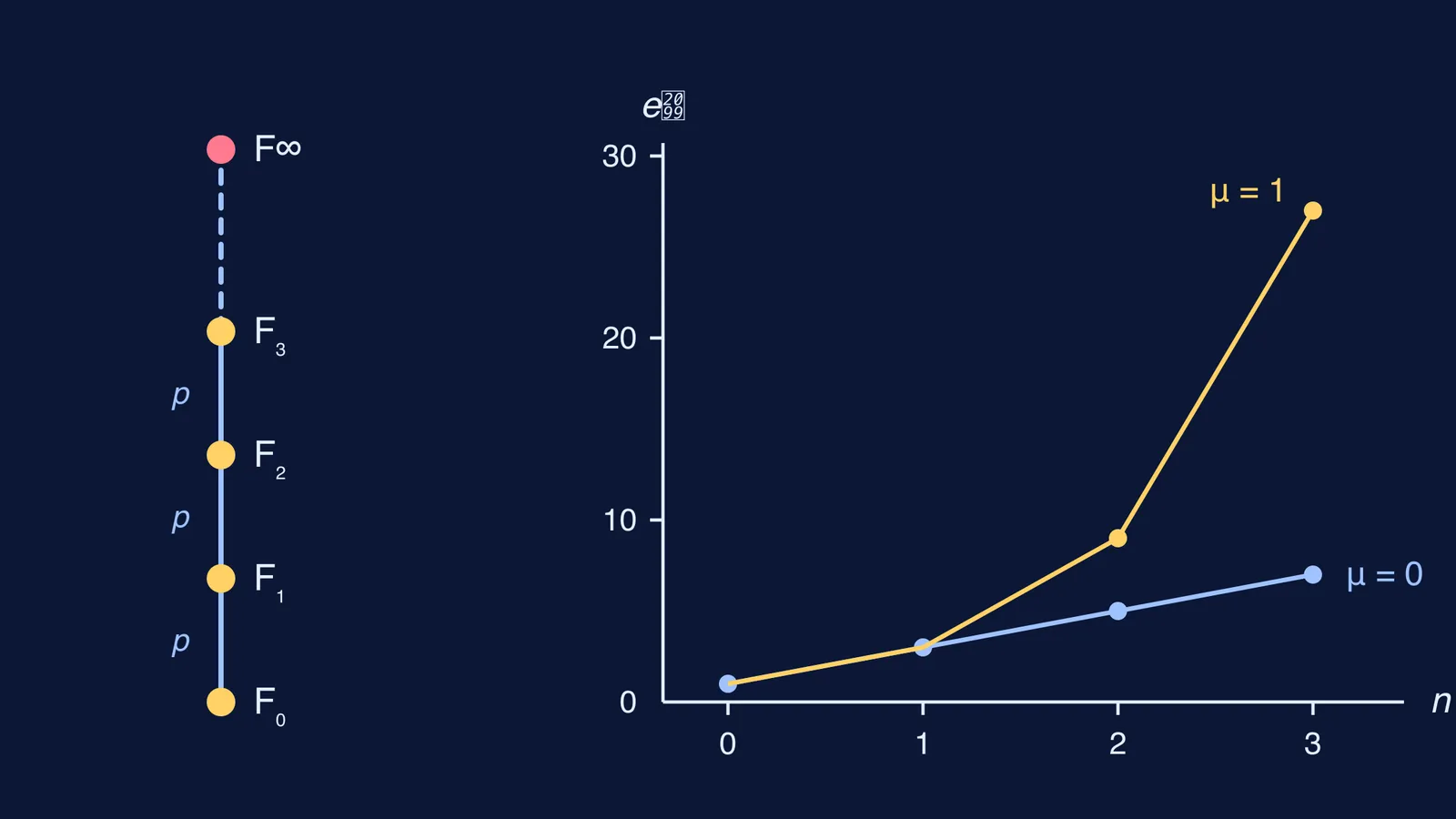
Now build a tower: a number field F₀, then a bigger field F₁ that is p times as large, then F₂, and so on forever. Iwasawa proved that if eₙ is the power of p in the class number of the n-th layer, then eₙ = μpⁿ + λn + ν for all large enough n, with three fixed whole numbers μ, λ and ν (Theorem A.3 in these lecture notes by Rodrigues Jacinto and Williams). Three numbers predict infinitely many layers.
What did she and her collaborators propose?
The "main conjecture" of Iwasawa theory links two worlds: a p-adic L-function from analysis and arithmetic invariants such as class groups. The lecture notes above record that Mazur and Wiles proved Iwasawa's original conjecture in full in 1984. You may know Wiles from how Andrew Wiles proved Fermat's last theorem.
Iwasawa's towers have a commutative symmetry group: the order in which you apply two symmetries does not matter. Many natural towers, such as those built from elliptic curves, have symmetry groups where order does matter. The CMS citation says her work with John Coates of Cambridge, begun in the mid-1990s on Euler characteristics of p-adic Galois representations, led to the new field of non-commutative Iwasawa theory and a precise formulation of its main conjecture.
That formulation appeared as "The GL₂ main conjecture for elliptic curves without complex multiplication" by Coates, Fukaya, Kato, Sujatha and Venjakob in Publications Mathématiques de l'IHÉS, volume 101 (DOI record). GL₂ is a group of invertible 2 × 2 matrices. You meet such matrices in Class 12, and matrix multiplication is not commutative.
Why did she win the 2006 ICTP Ramanujan Prize?
The press release says the prize was awarded "in recognition of her work on the arithmetic of algebraic varieties and her substantial contributions to non-commutative Iwasawa theory". It carried $10,000, and Lennart Carleson, the 2006 Abel laureate, was to present it at ICTP in Trieste on 18 December.
The prize goes to researchers under 45 who have done outstanding research in developing countries; it was first awarded in 2005 and now carries $15,000 (Wikipedia: ICTP Ramanujan Prize). The Tribune notes she was the first Indian to win it.
How can a student start on this kind of maths?
Start with the habits this field is built on. Try this four-week plan:
Week 1: modular arithmetic. Work through divisibility and remainder problems like these IOQM number theory questions.
Week 2: factorisation. Multiply (1 + √−5)(1 − √−5) by hand and confirm you get 6. Then ask why neither factor can be broken down further.
Week 3: non-commutativity. Take matrix A with rows (1, 1) and (0, 1), and matrix B with rows (1, 0) and (1, 1). AB has rows (2, 1) and (1, 1); BA has rows (1, 1) and (1, 2). They differ.
Week 4: patterns in towers. Pick your own μ, λ, ν and p, compute eₙ for n = 1 to 6, and see which term takes over.
If a base idea feels shaky, the Fermi Concept Library has a lesson for each concept in mathematics. For the matrix and remainder exercises, the Fermi Problem Library has a step-by-step solver that explains the reasoning rather than printing an answer.
If research itself appeals, read our guide on how to become a research mathematician in India.