

On this page
If your experience of mathematics comes from board exams or coaching sheets, you might imagine that mathematicians spend their days calculating numerical formulas at lightning speed. Real research is almost the opposite. In competitive tests, you solve predefined problems with guaranteed answers under strict time limits. In research mathematics, no one knows whether an answer exists, whether your conjecture is true, or whether the tools to prove it have been invented yet.
Which undergraduate degrees lead to mathematical research?
Standard advice in India often steers mathematically gifted students toward engineering, but dedicated undergraduate programmes provide direct routes into research.
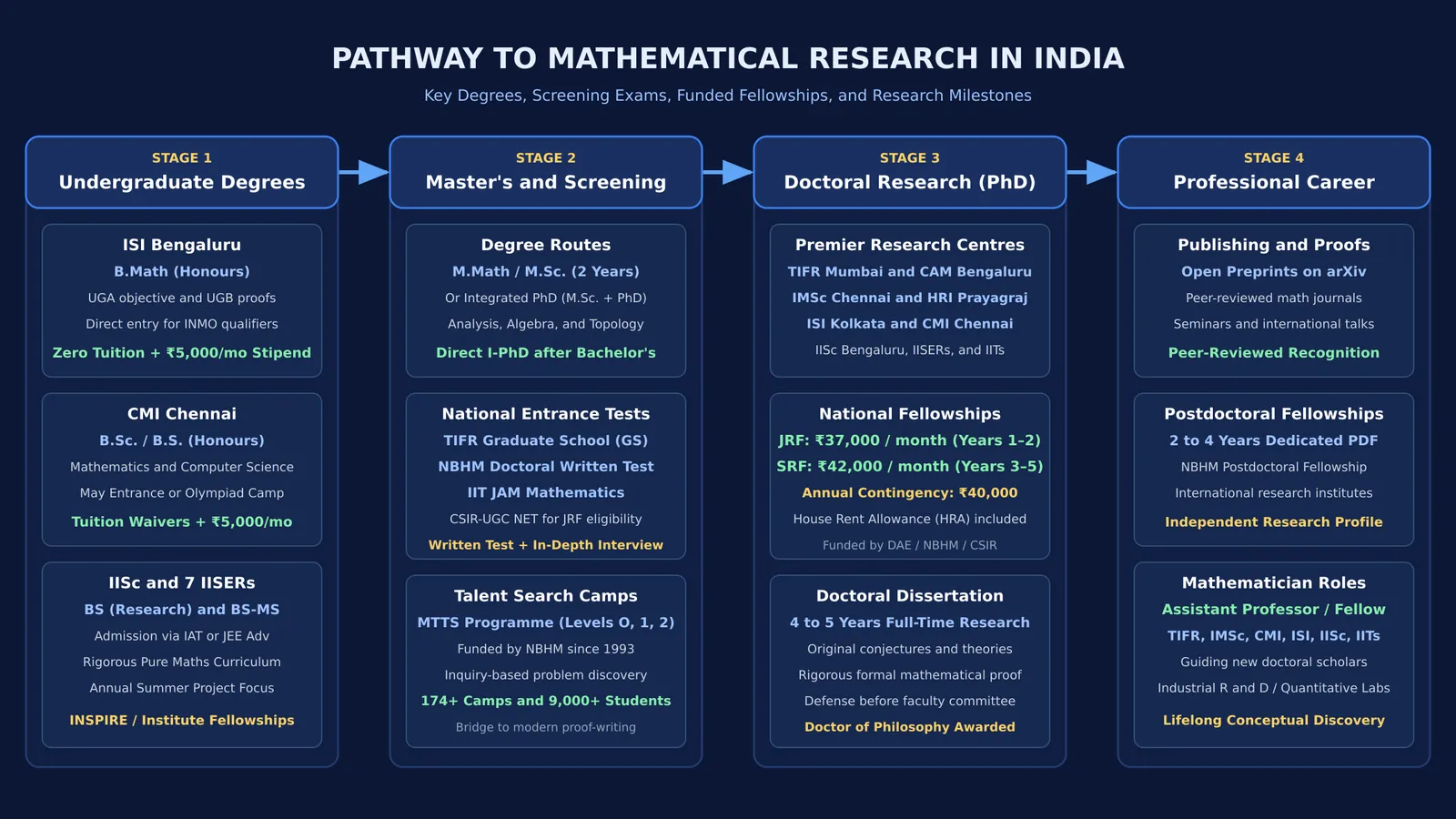
The Indian Statistical Institute offers the Bachelor of Mathematics (Honours) at its Bengaluru centre. Under ISI admission rules, admitted students pay zero tuition fees and receive a monthly stipend of ₹5,000 alongside an annual contingency grant of ₹5,000. Entry relies on a two-part test: the objective UGA paper and the descriptive UGB paper requiring written proofs.
Chennai Mathematical Institute provides four-year Bachelor of Science (Honours) degrees in Mathematics and Computer Science, Mathematics and Physics, and Mathematics. According to CMI admissions, top performers in its May entrance exam receive full tuition waivers and a monthly fellowship of ₹5,000, while olympiad camp qualifiers can secure direct entry. Our guide on ISI and CMI entrance exams outlines the syllabus and preparation strategy.
Additionally, the Indian Institute of Science admits students to its Bachelor of Science (Research) mathematics programme through JEE Advanced and the IISER Aptitude Test (IAT), as detailed by IISc Bengaluru. The seven IISERs also admit undergraduates through the IAT into five-year BS-MS dual degrees.
Where can you pursue a PhD in mathematics in India?
Following a bachelor's or master's degree, a research career requires completing a Doctor of Philosophy (PhD). India hosts several premier mathematics institutes.
The Tata Institute of Fundamental Research conducts graduate programmes through its School of Mathematics in Mumbai and CAM in Bengaluru. As detailed by the TIFR School of Mathematics, students enter direct PhD programmes after a master's or Integrated PhD programmes after a bachelor's via the nationwide Graduate School entrance examination.
Doctoral research across India is backed by national fellowships. Under NBHM fellowship regulations, doctoral scholars receive ₹37,000 per month as Junior Research Fellows (JRF) for the first two years, which rises to ₹42,000 per month as Senior Research Fellows (SRF), plus an annual contingency grant of ₹40,000. These test scores are also used for PhD shortlisting by the Institute of Mathematical Sciences (IMSc) in Chennai and Harish-Chandra Research Institute (HRI) in Prayagraj. To explore India's research heritage, read how mathematician Harish-Chandra shaped modern representation theory.
What does mathematical research actually look like?
School mathematics emphasizes calculation: solving differential equations, evaluating integrals, and manipulating trigonometric identities. Research mathematics centers on abstraction, structural connections, and logical proof.
In a landmark 1994 paper in the *Bulletin of the American Mathematical Society*, Fields Medallist William P. Thurston explained in On proof and progress in mathematics that mathematics is not merely a mechanism for generating formal proofs, but a human activity aimed at advancing conceptual understanding. A working mathematician spends months exploring literature, testing conjectures against examples, discussing ideas on chalkboards, and refining arguments before submitting a paper to peer review.
Indian undergraduates can experience this environment through summer programmes. The Mathematics Training and Talent Search (MTTS) programme, founded in 1993 by Prof. S. Kumaresan and funded by the NBHM, has conducted over 174 camps and trained more than 9,000 students, as recorded by the MTTS Trust. In these interactive camps, students discover concepts through inquiry and practice writing rigorous mathematical proofs.
A four-stage roadmap from school to research
If you are planning a future in mathematics research, here is a practical roadmap:
Class 11 and 12: Move beyond routine formulas. Tackle non-routine problems from olympiads and past ISI or CMI entrance papers to build proof-writing skills.
Undergraduate foundations: Study real analysis, abstract algebra, and topology. Apply for summer training like MTTS Level O in your second year to experience research-style thinking.
Master's and entrance exams: Prepare for IIT JAM, TIFR GS, or the NBHM examination to enter an M.Sc., M.Math, or Integrated PhD programme.
Doctoral dissertation: Select a research domain, formulate your thesis topic, publish preprints on repositories like arXiv, and prepare for postdoctoral research fellowships.
When transitioning from school procedures to abstract concepts, the Fermi Concept Library organizes every concept in mathematics with its place in the subject map. For complex multi-step problems, the Fermi Problem Library provides worked problems with a step-by-step solver that explains the reasoning rather than printing an answer. If you need a structured study routine for entrance examinations, Fermi's AI tutor works out what you already know and builds a plan for the session.


