On this page
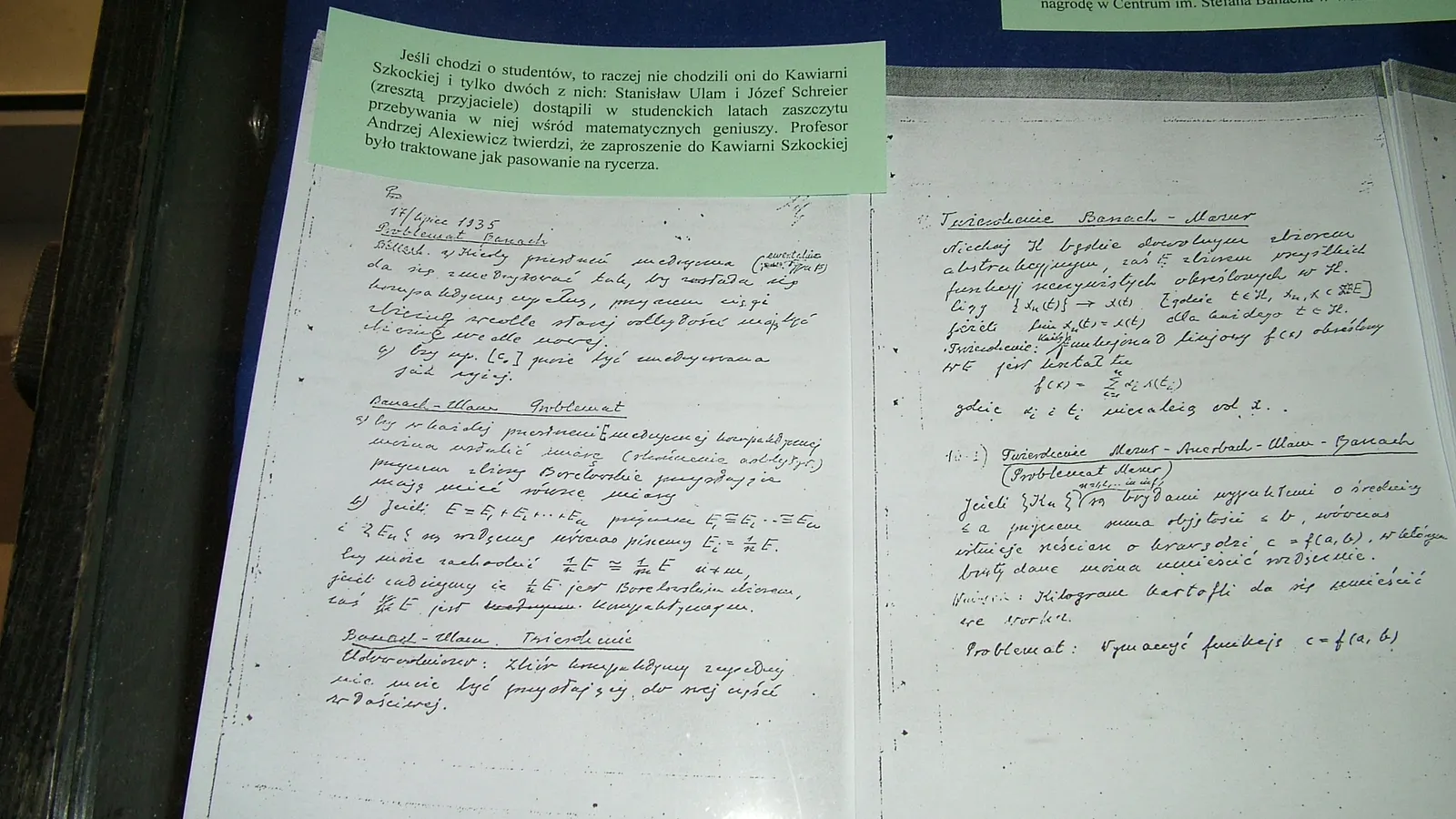
In 1935, a group of mathematicians in Lwów (now Lviv, Ukraine) started writing their open questions into one shared notebook. Stanisław Ulam, one of the group, later wrote that, as far as he remembered, Stefan Banach suggested it. Banach bought a large notebook, and it was “deposited with the headwaiter of the Scottish Coffee House”, who brought it to the table on request and hid it again after the guests left (Ulam's preface, Los Alamos, 1977). That notebook became the Scottish Book.
What is the Scottish Book?
The Scottish Book is a collection of 193 mathematics problems written between 1935 and 1941 by mathematicians who met at the Scottish Café in Lwów (Scottish Book, Wikipedia). The last entry, Item 193, is signed by Hugo Steinhaus, and the last date in the book is 31 May 1941. That summer German troops occupied the city, and in Ulam's words, “the inscriptions ceased” (MacTutor, University of St Andrews).
Ulam wrote that the problems were “discussed a great deal” before being written into the book in ink, and that most were supposed to have had considerable attention first (Ulam, 1977). The authors included Banach, Steinhaus, Stanisław Mazur and Ulam himself, and John von Neumann posed Problem 163.
Born in Kraków in 1892, Banach studied engineering and had no university mathematics qualifications when he submitted his doctoral thesis in 1920. Steinhaus met him in 1916 after overhearing the words “Lebesgue measure” on an evening walk and approaching a park bench (MacTutor biography of Banach). Ulam recalled that after long café sessions, “the next day Banach was likely to appear with several small sheets of paper containing outlines of proofs he had completed.”
What prizes did the Lwów mathematicians offer?
Many entries end with a prize in brackets. Here are some from Ulam's English translation (Los Alamos, 1977):
Problem 153 (Mazur, 6 November 1936): “A live goose”.
Problem 152 (Steinhaus): 100 grammes of caviar for computing the frequency it asks about, a small beer for proving that the frequency exists, and a demitasse (a small coffee) for a counterexample.
Problem 163 (von Neumann): “A bottle of whiskey of measure >0”. This is a joke, because “measure” is a technical term.
Problem 165 (Ulam): two bottles of wine.
Who won the live goose for Problem 153?
In plain words, Problem 153 asks this. Take any continuous function on a square. Can you always approximate it as closely as you like by a finite sum of products built from slices of the same function? Mazur noted that the answer is yes if the function has a continuous first derivative in x or y. The open question was whether continuity alone is enough (Ulam, 1977).
The answer arrived 36 years after the problem was set, and it was no. The Swedish mathematician Per Enflo built a counterexample, published as “A counterexample to the approximation problem in Banach spaces” in Acta Mathematica, volume 130 (Enflo, 1973). In 1972 Mazur presented Enflo with the live goose (Domoradzki, Stawiska and Zarichnyi, 2026), in a ceremony that was broadcast throughout Poland (Scottish Book, Wikipedia).
How can you start your own Scottish Book?
You need a notebook and three or four friends preparing for the same exam or olympiad. Then borrow a few rules from the original:
Earn your entry. Like the Lwów group, discuss a problem properly before it goes in. The book is for problems that beat you, not ones you skipped.
Sign and date it. Later you can see how long a problem stayed open and who cracked it.
Attach a small prize. A cutting chai, a samosa, or the right to pick next week's topic.
Use tiered prizes. Copy Steinhaus: one prize for the full answer, a smaller one for real progress.
Review once a week. Ten minutes on what is still open and what you learned from the problems you closed.
Here is a sample entry:
Problem 7. Asha, 12 August. Is n² + n + 41 prime for every whole number n? Prize: one cutting chai for the smallest n where it fails, with a reason. Partial prize: a biscuit for checking the first ten values.
(Spoiler: n = 40 gives 1681, which is 41 × 41.)
If the group is stuck between meetings, the Fermi Problem Library has worked problems with a step-by-step solver that explains the reasoning rather than printing an answer. If the gap is a concept, the Fermi Concept Library has a lesson for every concept in physics, chemistry, biology, mathematics and computing.
This week, pick up a notebook, write down the first problem that beats you, and put a chai on it.