

On this page
In the summer of 1908, the slums of New York City were among the most dangerous places on Earth for a newborn. In densely packed tenement districts like Hell's Kitchen, as many as 1,500 infants died every week from preventable diseases like dysentery.
Enter Dr. Sara Josephine Baker. Appointed that year as the first director of the city's new Bureau of Child Hygiene, she faced a crisis of immense proportions. But rather than building more hospitals, Baker did something unprecedented: she shifted the entire focus of the health department from treating the sick to educating the healthy.
Why was infant mortality so high in New York?
At the turn of the 20th century, medical authorities largely waited for patients to fall ill before intervening. In the crowded tenements of New York, this approach was failing. Immigrant mothers, dealing with language barriers and extreme poverty, lacked access to basic information about infant hygiene. Many relied on contaminated commercial milk or dressed their babies in heavy woollen clothing during sweltering summers, leading to fatal cases of overheating and diarrheal diseases.
Dr. Baker realised that this reactive model was flawed. In her autobiography, she noted that the way to keep people from dying was simply to keep them from falling ill. Her focus on prevention over cure was a startling idea for the time. By 1917, the scale of the crisis prompted her to tell a reporter that it was "six times safer to be a soldier in the trenches of France than to be a baby born in the United States".
How did Sara Josephine Baker reduce infant mortality?
Instead of waiting for sick infants to arrive at clinics, Baker took the clinic to the homes. In the summer of 1908, she dispatched a team of 30 nurses to the Lower East Side. Their mission was purely educational.
These nurses visited the homes of every new mother. They taught them how to ensure proper ventilation, the importance of breastfeeding, and how to bathe infants and clothe them lightly in hot weather. To solve the problem of contaminated milk, Baker established milk stations across the city that provided clean, pasteurised milk. She also developed a simple infant formula using water, lactose, calcium carbonate, and cow's milk for working mothers who could not breastfeed.
Recognising that many older children served as primary caregivers while their parents worked, she created the "Little Mothers' Leagues". These groups trained school-age girls in infant care, empowering them to keep their younger siblings safe and well-fed. This peer-to-peer education proved highly effective in bridging cultural divides.
What can education learn from Baker's approach?
Baker understood that distributing pamphlets was not enough. To change behaviour, she needed to provide direct, one-to-one instruction where the learner actually lived and worked. The nurses observed each mother's specific situation, identified the exact gaps in her knowledge, and offered targeted guidance.
This model of diagnosing the specific point of failure and providing immediate, tailored feedback remains one of the most effective ways to teach any subject. When a student is stuck on a physics problem, simply handing them a textbook or a printed solution rarely resolves the underlying confusion. They need instruction that meets them where they are. This is exactly how the Fermi Problem Library approaches learning. Instead of just printing an answer, it provides a step-by-step solver that explains the reasoning. If a student is lost on where to begin, Fermi's AI tutor works out what they already know and builds a plan for the session, holding a line of reasoning to teach the concept rather than just handing over the final calculation.
What were the results of her preventative care?
The impact of Baker's educational campaign was immediate and profound. During that first summer of home visits by nurses, the infant death rate in the targeted district dropped significantly.
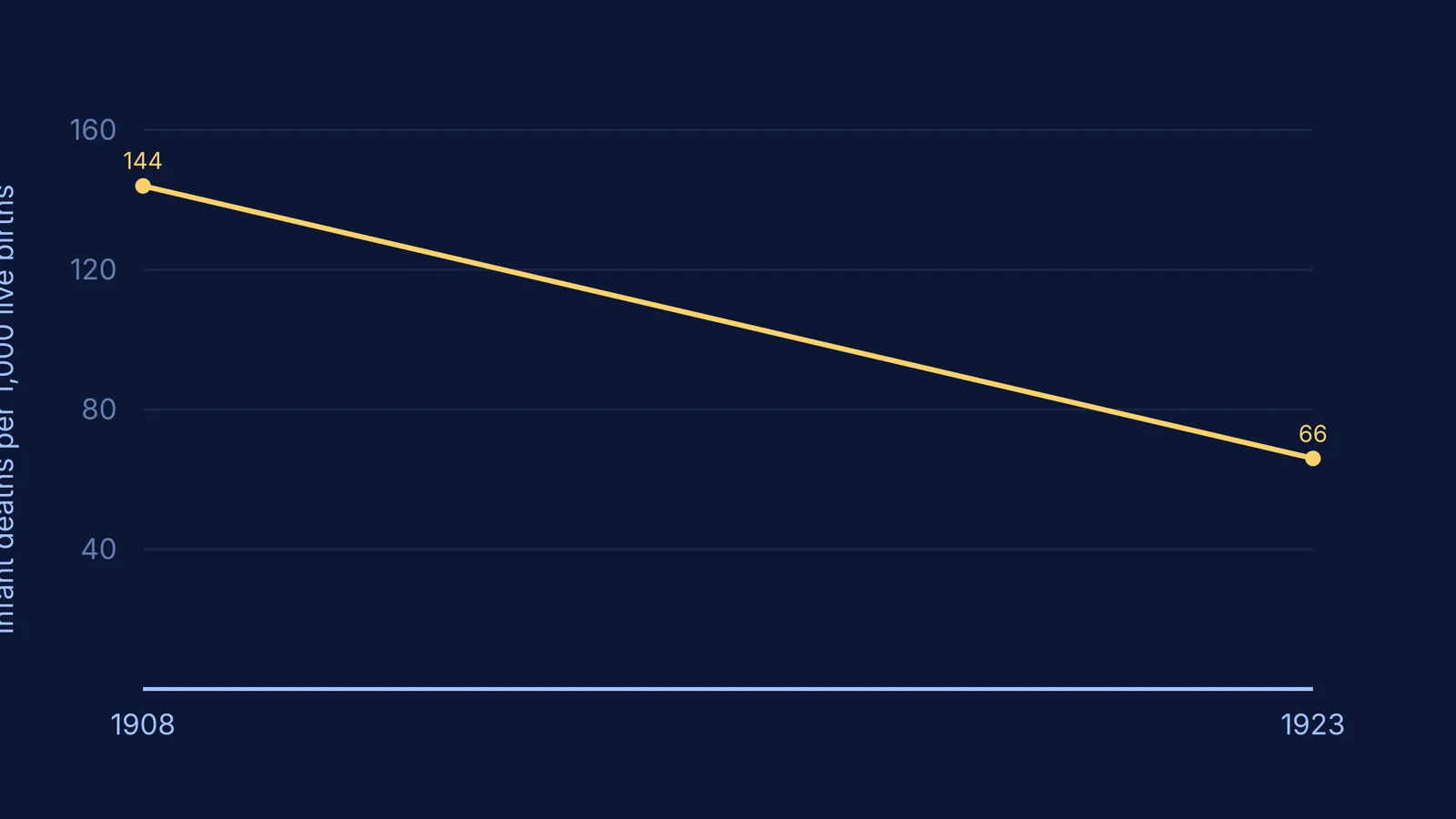
Over her 15-year tenure, the citywide numbers transformed. New York City's infant mortality rate fell from 144 deaths per 1,000 live births in 1908 to 66 per 1,000 by the time she retired in 1923. This made New York the safest major city in the world for infants. It is estimated that her initiatives saved more than 90,000 lives.
Her pioneering work set a new standard for public health. In 1917, she became the first woman to earn a doctorate in public health, and her Bureau of Child Hygiene became a model copied by 35 states. Much like Edward Mellanby and the puppy diets that explained rickets or Leonard Rogers and the stronger saline that cut cholera deaths, Baker proved that observing the environment and applying a specific, targeted intervention could solve a massive crisis. Her legacy demonstrates that sometimes the most powerful medical intervention is a well-delivered lesson. Max Theiler and the vaccine against yellow fever further shows how public health breakthroughs change the world, but Baker's focus was always on the simple act of teaching.


