

On this page
In 1800, William Herschel's discovery of infrared light showed that solar radiation extends past the visible red edge of the spectrum. For decades afterwards, physicists measured radiant heat with the thermopile, an arrangement of alternating bismuth and antimony wires that generated a tiny thermoelectric voltage when warmed. While thermopiles detected broad heat sources, they lacked the speed and spatial precision needed to map individual spectral lines.
Why was the thermopile not enough for solar spectroscopy?
The thermopile had two fatal limitations for high-resolution spectroscopy. First, its metallic junctions carried substantial thermal mass, taking tens of seconds to reach thermal equilibrium and preventing continuous spectral scanning. Second, its physical sensor was wide, spanning several millimetres of the dispersed spectrum and blurring fine absorption lines together.
At the Allegheny Observatory in Pennsylvania, director Samuel Pierpont Langley discovered that dispersing sunlight into a fine diffraction spectrum spread incident heat so thinly that narrow wavelength bands deposited almost undetectable energy. In 1878, Langley set out to build an instrument that replaced thermoelectric voltages with an ultra-thin metallic resistor whose electrical resistance changed with temperature.
How does Langley's bolometer detect radiant heat?
Langley described the construction and operation of his new instrument in an 1881 paper in the Proceedings of the American Academy of Arts and Sciences. The bolometer relies on the temperature coefficient of resistance, which causes a pure metal's electrical resistance to increase predictably as absorbed thermal energy warms its crystal lattice.
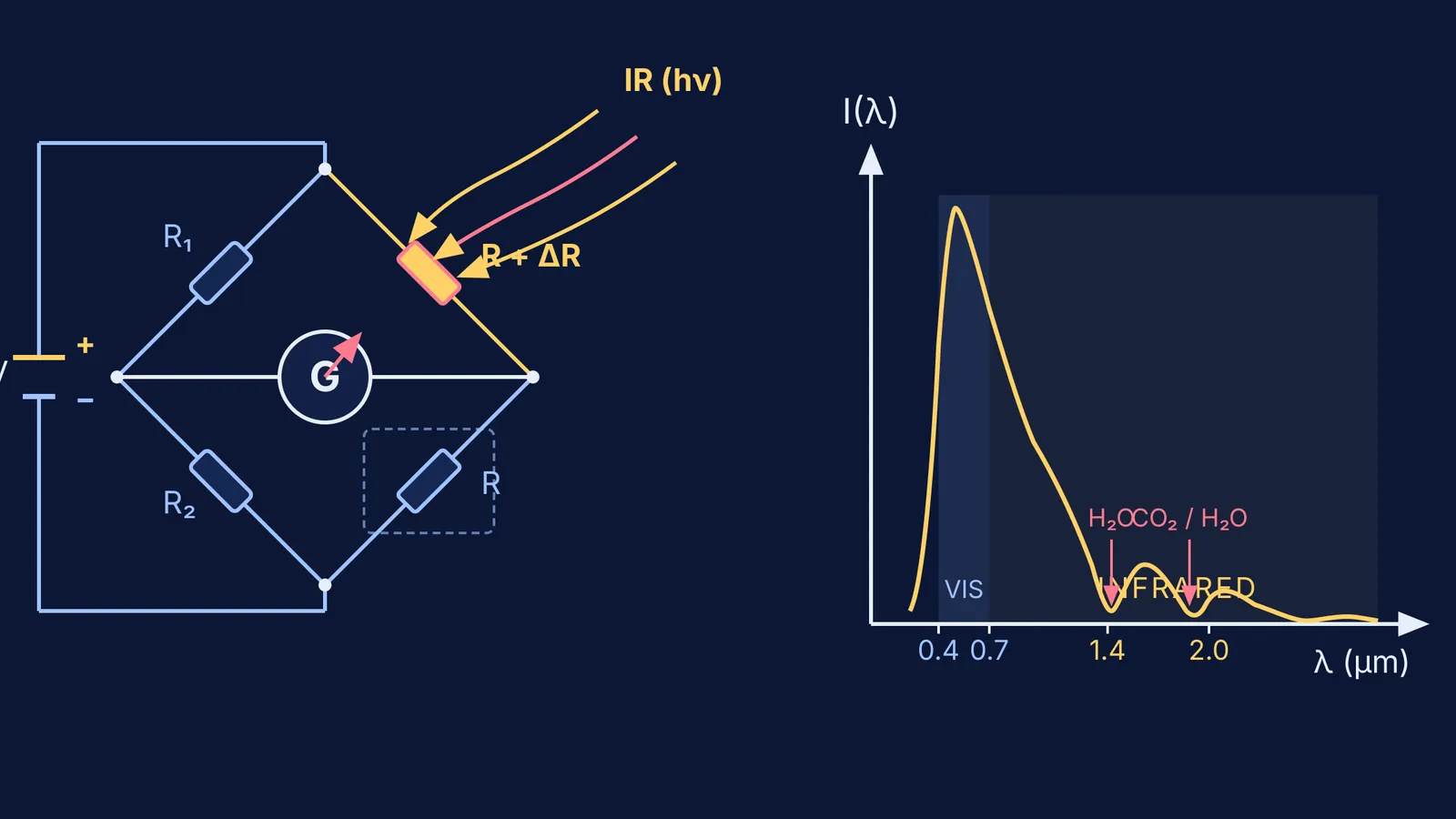
The instrument used two identical strips of platinum foil, each roughly 10 mm long, 0.5 mm wide, and less than 0.01 mm thick, rolled down until their heat capacity was negligible. Langley coated both strips with lampblack soot for complete blackbody absorption across all wavelengths. He connected the strips as two adjacent arms of Charles Wheatstone's bridge circuit, balanced against two fixed resistors and wired to a Thomson reflecting galvanometer.
One platinum strip was exposed through a slit to the solar spectrum, while the second remained shielded inside a heavy copper casing. When infrared rays struck the exposed strip, its temperature rose, increasing its electrical resistance. Because the shielded strip experienced the identical ambient temperature, environmental thermal drift cancelled out automatically. This resistance imbalance deflected the galvanometer needle. Langley showed that the bolometer responded in under 1 second and could register temperature differences of 0.00001 °C, easily detecting the radiant warmth of a cow 400 metres away.
Worked example: how sensitive was Langley's bridge circuit?
To understand how a minute temperature rise creates a measurable electrical deflection, consider an idealised bolometer bridge based on Langley's 1881 paper:
Identify sensor parameters: A blackened platinum strip has a baseline resistance R = 1.0 Ω and a temperature coefficient of resistance α = 0.00392 / °C.
Calculate resistance change from heating: If focused infrared radiation warms the exposed strip by ΔT = 0.001 °C, its resistance increases by:
ΔR = R × α × ΔT = 1.0 Ω × (0.00392 / °C) × 0.001 °C = 3.92 × 10⁻⁶ Ω.
Determine bridge off-balance voltage: Under a supply voltage V = 2.0 V, the open-circuit voltage across an initially balanced equal-arm bridge is:
ΔV = (V / 4) × (ΔR / R) = (2.0 V / 4) × (3.92 × 10⁻⁶ Ω / 1.0 Ω) = 1.96 × 10⁻⁶ V.
Calculate galvanometer deflection: In a galvanometer circuit with 20 Ω total resistance, the current is I = ΔV / 20 Ω ≈ 9.8 × 10⁻⁸ A. On a reflecting galvanometer with a sensitivity of 10⁻⁸ A per division, this 0.001 °C warming produces nearly 10 scale divisions of deflection.
This direct conversion of absorbed heat into an electrical imbalance gave Langley unprecedented resolving power.
What did the bolometer reveal about the infrared solar spectrum?
Because ordinary glass prisms absorb infrared rays beyond 2.5 micrometres, Langley substituted prisms made of rock salt (sodium chloride), which remains transparent deep into the infrared. In 1881, he led an expedition to Mount Whitney in California to take measurements at altitudes up to 4,400 metres, as documented in the American Journal of Science.
Operating above the densest atmospheric water vapour, Langley mapped solar radiation from 0.76 micrometres out beyond 5 micrometres. His measurements proved that solar energy extends far into the invisible infrared, punctuated by distinct absorption troughs from solar atmospheric gases as well as terrestrial water vapour and carbon dioxide.
These measurements became foundational for climate physics. In 1896, Swedish physical chemist Svante Arrhenius used Langley's infrared absorption tables in The Philosophical Magazine to publish the first quantitative model calculating how atmospheric carbon dioxide regulates Earth's surface temperature.
How do bolometer principles help physics students today?
The ideas Langley combined in 1878—blackbody absorption, temperature coefficients of resistance, and bridge null measurements—remain core topics in physics curricula and competitive exams like JEE Advanced.
When solving bridge balance and thermal resistance numericals, students often struggle to connect algebraic formulas with physical instruments. For students seeking step-by-step guidance on these problems, the Fermi Problem Library provides worked problems with a step-by-step solver that explains the reasoning rather than printing an answer.
Visualising how thermal changes redistribute current across bridge arms is equally vital. In the Fermi Simulation Lab, you can explore interactive simulations for the ideas that are easier to see than to read, testing how small resistance shifts deflect a galvanometer. To see how thermal physics and circuit laws connect across the syllabus, the Fermi Concept Library maps every concept in physics with its own lesson and its place in the map.


