On this page
Rosalind Franklin is famous for her X-ray work on DNA and Photo 51. Her first major research was on coal: how much empty space hides inside a lump of it, and which molecules can get in. The answer helped classify fuels, and you can follow the idea behind her method with school density and a calculator.
What did Rosalind Franklin study before DNA?
In 1942, during the Second World War, Franklin joined the British Coal Utilisation Research Association (BCURA) as an assistant research officer (Rosalind Franklin, Wikipedia). BCURA was a non-profit association of industrial companies, incorporated on 23 April 1938 (BCURA, Wikipedia).
The coal work became her PhD thesis, The physical chemistry of solid organic colloids with special reference to coal, and the University of Cambridge awarded her the degree in 1945 (Wikipedia). Coal was no side project: Rosalind Franklin University counts 19 papers on coals and carbons in her career, against five on DNA and 21 on viruses (Rosalind Franklin University).
How did Rosalind Franklin measure the pores in coal?
Coal looks solid, but it is threaded with tiny pores. Franklin got at them by comparing two densities:
Apparent density: the mass divided by the whole volume of the lump, pores included.
True density: the mass divided by the volume of the solid alone.
True density needs a fluid that fills the pores but not the solid, so Franklin used helium (Wikipedia). Her true densities came from a helium-displacement technique that corrected for air-containing pores in the sample, and she compared them with apparent "lump" densities from classical displacement studies (Bluestocking Oxford). The same source calls the comparison the first documented proof of molecular sieve activity in carbon compounds, with large solvent molecules shut out by the finest pores.
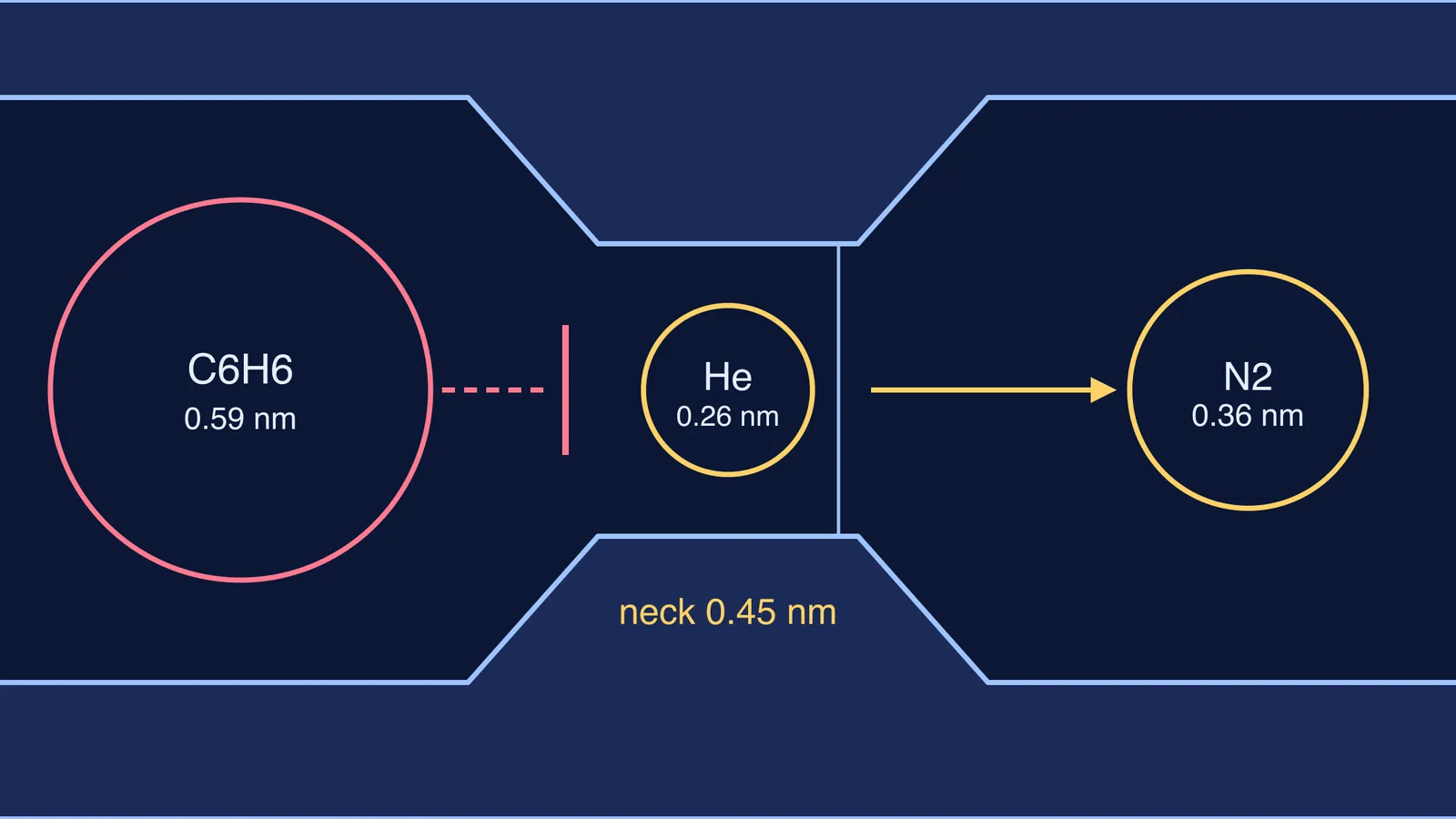
Size is part of why helium works. A helium atom has a kinetic diameter of about 260 picometres (0.26 nm), against 364 pm for nitrogen and 585 pm for benzene (kinetic diameter table).
She published the results in two 1949 papers in the Transactions of the Faraday Society, one on coals (doi:10.1039/TF9494500274) and one on carbonised coals (doi:10.1039/TF9494500668).
Why did coal porosity matter for fuel?
Franklin found a relationship between the fine constrictions in coal's pores and how permeable the pore space is, and this helped classify coals and predict how they would perform as fuel and in wartime devices such as gas masks (Wikipedia). Many of the tunnels in coal are about the same diameter as gas molecules, so coal can act as a molecular sieve (Famous Scientists).
Gas sticking to the inner walls of a porous solid is adsorption; for the maths, see the Freundlich adsorption isotherm.
How do you calculate porosity from density?
Porosity is the fraction of a material's volume that is empty space, a number between 0 and 1 (Porosity, Wikipedia). When the pores hold air, porosity = 1 − (apparent density ÷ true density), from the same source.
Here is the idea with made-up numbers (these are not Franklin's data):
A coal sample has an apparent density of 1.30 g/cm³ and a helium density of 1.45 g/cm³.
Porosity = 1 − 1.30 ÷ 1.45 = 1 − 0.897 = 0.103. About 10% of the lump is pore space that helium can reach.
Pore volume per gram = 1/1.30 − 1/1.45 = 0.769 − 0.690 = 0.080 cm³/g.
Measure again with benzene and get 1.38 g/cm³. Pore volume benzene reaches = 1/1.30 − 1/1.38 = 0.769 − 0.725 = 0.045 cm³/g.
Benzene reaches 0.045 ÷ 0.080, about 56%, of the pore volume. The other 44% sits behind necks too narrow for benzene.
Step 5 is the molecular sieve in numbers. Three habits keep this kind of problem clean:
Write down which volume each density divides by before you calculate.
Turn densities into volumes per gram (1/ρ) before comparing pores. Volumes subtract; densities do not.
Ask what the probe can reach. In a rigid solid, a bigger molecule cannot find more pore volume than a smaller one.
If density, volume and porosity still blur together, the Fermi Concept Library has a lesson for every concept in physics, chemistry, biology, mathematics and computing, so you can go back to the one that is missing.
What did Franklin's coal work lead to?
In 1947 Franklin moved to Paris to work with Jacques Mering, applying X-ray methods to coal and other carbons and to how they change into graphite. She coined the terms graphitising and non-graphitising carbon (Wikipedia).
Her 1951 paper in the Proceedings of the Royal Society studied carbons heated between 1000 and 3000 °C and found that graphitising and non-graphitising carbons form two distinct, well-defined classes. It traced the difference mainly to strong cross-linking that holds non-graphitising carbons in a rigid, finely porous mass (doi:10.1098/rspa.1951.0197). Peter Harris and Irene Suarez-Martinez reviewed this carbon research in their paper Rosalind Franklin, carbon scientist (doi:10.1016/j.carbon.2020.09.022).
Read also how Marie Stopes studied coal balls and plant fossils.
If small molecules squeezing through narrow necks is hard to picture, the Fermi Simulation Lab has interactive simulations for ideas that are easier to see than to read.