

On this page
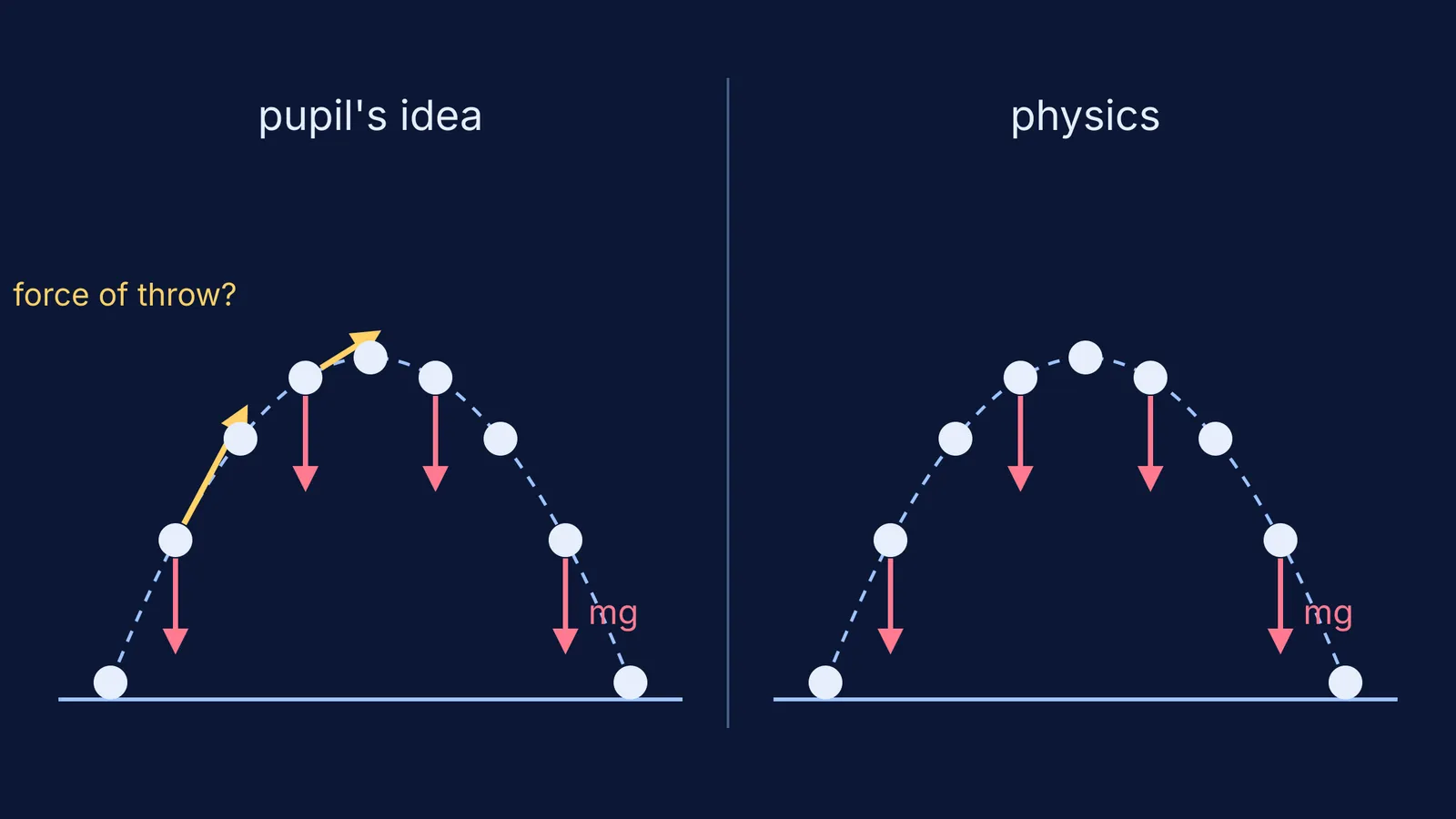
Ask a student why a thrown ball keeps rising and you may hear something like this, quoted in a 1989 review by Rosalind Driver: "when you throw a ball up your force goes into it. This wears off as the ball goes up, and gravity takes over pulling the ball down." Driver used it to show the "compelling reasonableness" of children's ideas, and she spent her career taking ideas like it seriously.
Who was Rosalind Driver?
Rosalind Driver (1941-1997) was a science education researcher, remembered in an obituary in Studies in Science Education. She was Professor of Science Education at the University of Leeds, where she directed the Children's Learning in Science Project, according to her Routledge author note.
In 1981 she published a paper called "Pupils' alternative frameworks in science". The title describes students' ideas as alternative frameworks rather than simple errors. In 1985 she co-edited *Children's Ideas in Science* with Edith Guesne and Andrée Tiberghien, with chapters including light, electricity in simple circuits, heat and temperature, and force and motion (Wellcome Collection catalogue).
What did Rosalind Driver find about children's ideas in science?
Her 1989 review in the International Journal of Science Education summed up nearly two decades of research. Children come to science classes with prior conceptions that may differ substantially from the ideas to be taught, these conceptions influence further learning, and they may be resistant to change.
Three points from that review are worth knowing:
The same ideas turn up in many places. Conceptions first described for heat, light and mechanics reappeared in many replication studies, backed by cross-country work such as a study of electricity in five European countries.
Ideas grow in steps. In a study by Joseph Nussbaum that the review cites, children's picture of the Earth moved from a flat Earth, to a round Earth with a fixed "up and down", to "up" and "down" meaning away from or towards the Earth.
Surprise alone is not enough. Students can avoid seeing a result that contradicts them, and even when they notice it, that does not by itself give them a better idea.
The review also reports that in the Children's Learning in Science Project, different teachers using the same teaching schemes found their classes followed similar paths, with similar conceptual problems and helpful experiences. If you know the common ideas, you can plan for them.
Why does teaching work better when it starts from students' ideas?
A 1994 paper by Driver and four colleagues describes the core commitment of this constructivist view: knowledge "is not transmitted directly from one knower to another, but is actively built up by the learner." The paper adds that ideas such as fields or genes are unlikely to be discovered by students alone, so the teacher's job is to help them make personal sense of the scientific view. The 1989 review describes lessons that let students make their ideas explicit and then challenge, extend, develop or replace them. It also cites a model by Posner and colleagues: a student must first be dissatisfied with the old idea, and the new one must be understandable, fit their experience and be useful for interpreting and predicting events.
How can you use Driver's idea at home or in self-study?
Here is a five-step plan, worked through with the thrown ball and following the pattern in the 1989 review.
Say it first. Before opening the chapter, finish this line in writing: "While the ball is going up, the forces on it are...". A parent can ask, "What do you think, and why?" and then wait.
Predict. If the force of the throw is still in the ball, what follows? For example: "It should only start slowing down once that force runs out."
Test. Throw a ball, or film it in slow motion on a phone. It slows down from the moment it leaves the hand.
Compare. In physics, once the ball leaves your hand the only force on it (ignoring air) is gravity, pulling down all the way. Ask: which explanation fits what you saw?
Use it. Try the new idea on a fresh case, such as a ball rolling up a ramp.
For more on this habit, read about why a wrong idea can seem right and how to predict first and then test with a simulation. Teachers may like using AI to explain common misconceptions.
What if you cannot run the experiment yourself?
Step 3 is the hard one when the idea is about circuits, orbits or fields. The Fermi Simulation Lab has interactive simulations for ideas that are easier to see than to read, so you can write your prediction first and then watch. And because Fermi's AI tutor works out what you already know and builds a plan for the session, it can begin from your idea rather than from page one.
Next time someone gives a "wrong" answer in science, ask why they think it. That answer is where the lesson starts.


