On this page
In 1962, researchers from Roger Sperry's lab at Caltech watched an epilepsy patient known as W.J., a 48-year-old man, try to arrange painted blocks to match a pattern. His left hand did it easily. His right hand fumbled, and the left hand even tried to jump in and help, as a 2014 PNAS profile of the research describes. W.J. had recently had the bridge between his brain's two halves cut. Sperry's lab used patients like him to ask a question that had been almost impossible to test: what does each half of the brain do on its own?
Who was Roger Sperry?
Roger W. Sperry was an American neuroscientist, born on 20 August 1913 in Hartford, Connecticut, who died on 17 April 1994 in Pasadena, according to his Nobel Prize facts page. He worked at Caltech.
Sperry received half of the 1981 Nobel Prize in Physiology or Medicine "for his discoveries concerning the functional specialization of the cerebral hemispheres", says the Nobel press release. In the 1950s Sperry cut the connections between the hemispheres in monkeys. Each half could still learn, but what one half learned was not available to the other.
What did the split-brain experiments show?
The two hemispheres are joined by the cerebral commissure, which the Nobel press release describes as hundreds of millions of nerve fibres. Surgeons had already cut it in some patients with severe, hard-to-treat epilepsy. Most had fewer seizures afterwards, and day to day they seemed unchanged. Ordinary psychological tests found nothing wrong.
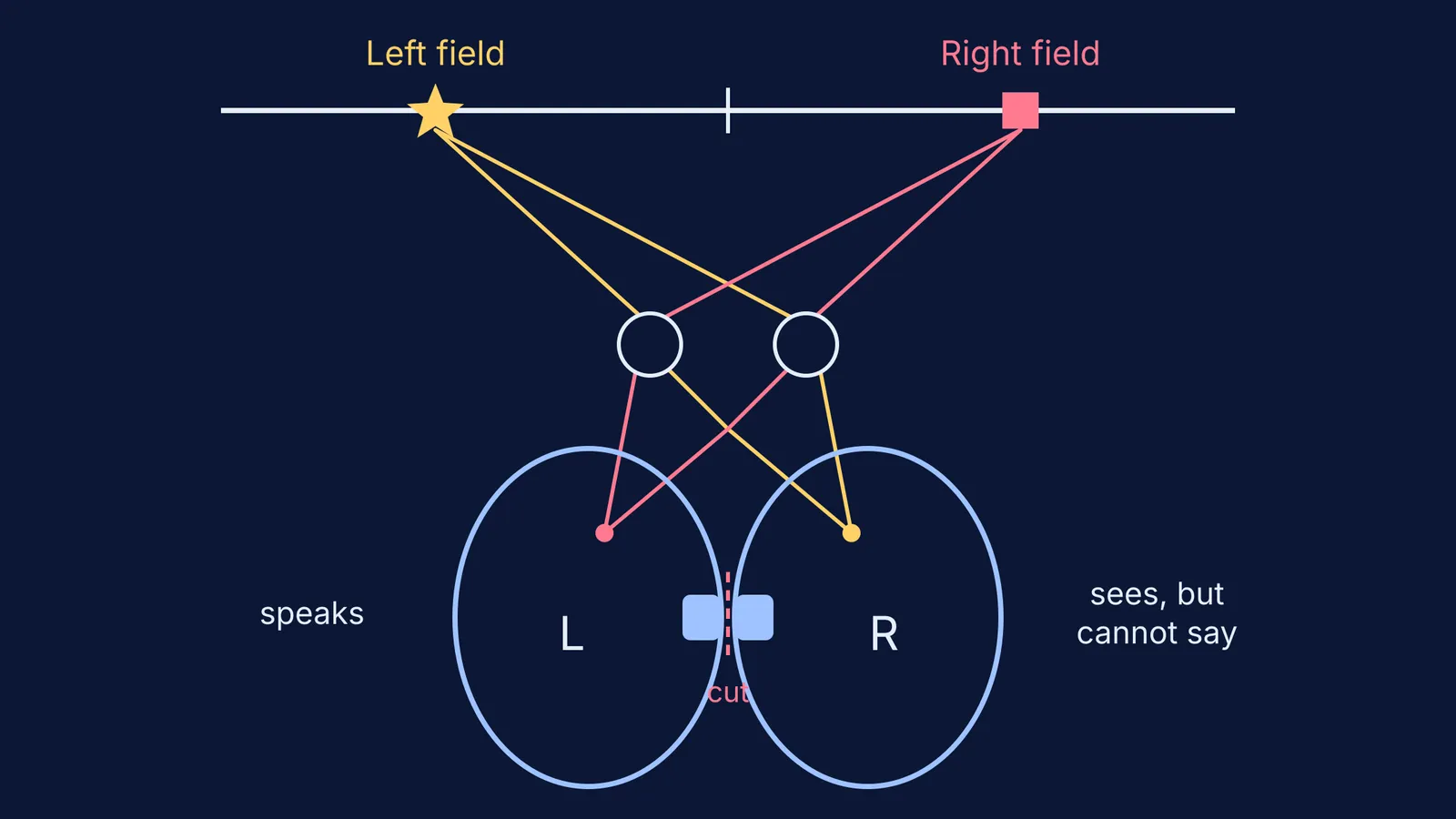
Sperry's tests were cleverer. Each hemisphere handles what you see on the opposite side of where you are looking. So the team flashed shapes and everyday objects to the left or right of the point a patient was looking at, as the PNAS profile explains. When a picture appeared on W.J.'s left, he said he had seen nothing. Yet his left hand, run by his right hemisphere, could point to a picture of what he had seen. The first report on W.J., by Michael Gazzaniga, Joseph Bogen and Sperry, appeared in PNAS in 1962.
How did a split-brain trial work, step by step?
Take a trial like W.J.'s, with an imagined spoon:
The patient looks at a dot in the centre of a screen.
A spoon flashes on the left, so only the right hemisphere sees it.
The cut bridge means the right hemisphere cannot pass the image across.
Asked "What did you see?", the talking left hemisphere truthfully answers "Nothing."
Asked to point with the left hand to a matching picture, the right hemisphere picks the spoon.
The lesson: the patient was not lying or confused. Two halves held two different pieces of knowledge, and only one of them could talk.
What does each hemisphere do on its own?
The 1981 Nobel press release summed up what the separated halves did:
The left hemisphere could speak, write and do maths, and was the more analytical side.
The right hemisphere was mute but better at concrete thinking, spatial awareness, recognising melodies and telling voices apart.
The right hemisphere could read simple one-syllable nouns, but it could only do simple additions up to 20.
One right-handed patient could hardly copy a cross and a cube with his right hand, but did it fairly well with his left.
Sperry discussed what this means for the mind in his 1968 paper Hemisphere deconnection and unity in conscious awareness. The press release adds a striking idea: in these patients each half seemed to have its own perceptions, emotions, thoughts and memories.
Are people left-brained or right-brained?
No. A 2013 study in PLOS ONE looked at brain scans from 1,011 people aged 7 to 29. Its finding: some brain connections lean to one side, but the data do not show people having an overall "left-brained" or "right-brained" brain.
Charles Gross, a cognitive neuroscientist and historian of neuroscience at Princeton, told PNAS that the popular version "became exaggerated and simplified to the point of being incorrect", adding: "For almost all cognitive activities, you need both." Split-brain results describe halves that cannot talk to each other. In your brain, the bridge is intact and busy. For more, read why left-brain and right-brain personality labels are wrong.
How can you use this in biology class?
Use split-brain questions to test your understanding:
Can you explain why W.J. said "nothing" in one sentence?
Can you say which hemisphere controls each hand?
Can you spot study advice built on the left-brain/right-brain myth?
If a step in the wiring keeps slipping, the Fermi Concept Library has a lesson for every biology concept, each with its place in the map. Then compare Sperry's methods with another classic mind experiment, Wilhelm Wundt's 1879 psychology laboratory. For how nerve signals travel in the first place, read neurotransmitters vs hormones.