

On this page
Vitamin B12 (cyanocobalamin) has the formula C63H88CoN14O14P, according to PubChem. That is a cobalt atom held inside a large ring of four smaller rings, with a crowded edge of side chains. Making it from scratch was a huge challenge for organic chemists in the 1960s.
Robert Burns Woodward (1917 to 1979) took it on anyway. The Science History Institute records that he won the 1965 Nobel Prize in Chemistry for "outstanding achievements in the art of organic synthesis", after making cholesterol, cortisone, lysergic acid, strychnine, reserpine and chlorophyll. It calls B12 his most complex synthesis, and he did not do it alone.
Who synthesised vitamin B12, and when?
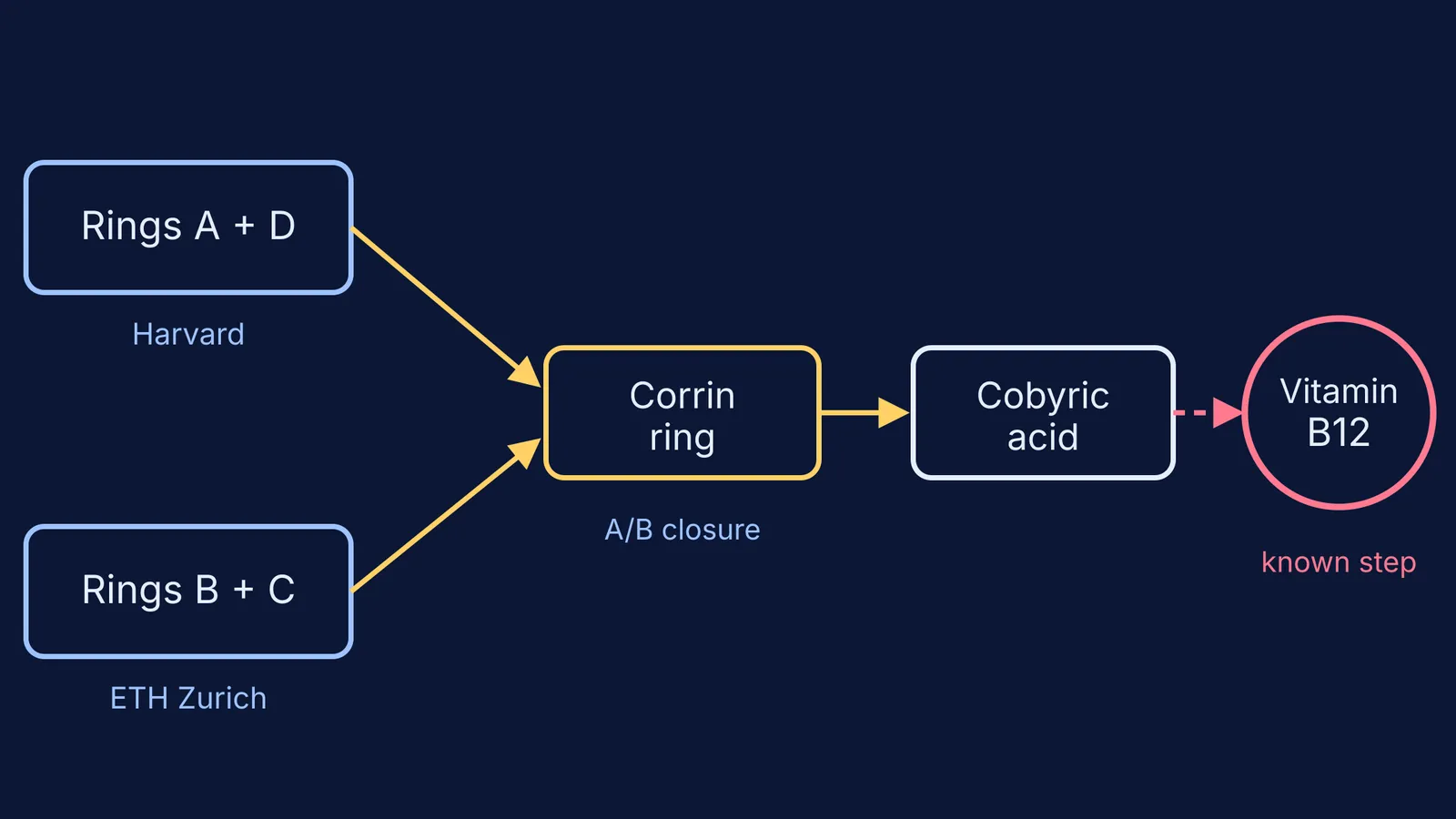
The B12 synthesis was a collaboration between Woodward's group at Harvard and Albert Eschenmoser's group at ETH Zurich. It took more than a dozen years and about 100 people from 20 nations, according to the Science History Institute. The ETH group began model studies in December 1959, the Harvard group started in August 1961, and both finished in 1972, as summarised in the history of the B12 total synthesis. That account counts 91 postdoctoral researchers (77 at Harvard, 14 at ETH) and 12 PhD students.
Woodward described the work in a 1973 lecture paper, The total synthesis of vitamin B12 in Pure and Applied Chemistry. Eschenmoser and Claude Wintner reviewed it in Science in 1977, with a subtitle saying the synthesis provided a framework for exploration in several areas of organic chemistry.
How did the B12 route actually work?
The trick was not to build the molecule one atom at a time from one end. The teams split it.
Pick a target you can finish. Konrad Bernhauer's group had reconstituted vitamin B12 from cobyric acid in 1960, so the teams aimed for cobyric acid instead (B12 synthesis history).
Cut the target into halves. In the Harvard/ETH route, Harvard made a piece carrying rings A and D, and ETH made a piece carrying rings B and C.
Join, then close the big ring. The two halves were coupled and the corrin ring was closed between rings A and B.
Control the shape. The corrin edge has nine stereocentres, so each step had to give the right 3D arrangement, not just the right atoms.
Eschenmoser's group also built a second route that closed the ring between rings A and D using light, a photochemical step. So the project ended with two routes to the same target.
What did the B12 work teach chemistry?
During the synthesis, a key reaction went in a way Woodward had not predicted. The Science History Institute notes that this result, with other puzzling reactions, led to the Woodward-Hoffmann rules, which predict which product forms when a reaction is driven by heat or by light. Woodward and Roald Hoffmann published the first paper, Stereochemistry of electrocyclic reactions, in 1965. Hoffmann shared the 1981 Nobel Prize in Chemistry with Kenichi Fukui; Woodward had died in 1979.
So a project to make one vitamin also produced general rules of organic chemistry.
How can you plan an organic conversion like Woodward?
You will never make B12 in a board exam. But a JEE Main or Class 12 conversion question uses the same habit: start from the target and work backwards. Here is a worked example.
Target: 2-phenylpropan-2-ol, from benzene.
Look at the target. A carbon carrying OH, a phenyl group and two methyl groups. That is a tertiary alcohol.
Ask which bond to make. A tertiary alcohol comes from a Grignard reagent adding to a ketone. Cut the phenyl-to-carbon bond: phenylmagnesium bromide plus acetone.
Ask where each piece comes from. Acetone is a starting reagent. Phenylmagnesium bromide comes from bromobenzene and magnesium in dry ether. Bromobenzene comes from benzene with bromine and FeBr3.
Write it forwards. Benzene to bromobenzene (Br2, FeBr3); bromobenzene to PhMgBr (Mg, dry ether); PhMgBr plus acetone, then dilute acid, to 2-phenylpropan-2-ol.
Check every step. Is water kept away from the Grignard reagent? Does the carbon count match?
If choosing the right Grignard and carbonyl pair is your weak spot, our guide on which Grignard reagent and carbonyl make a given alcohol works through more cases. For longer chains, see how to practise organic conversion questions with an AI.
When a conversion stalls because you picked the wrong reagent or skipped a condition, the Fermi Problem Library has worked problems with a step-by-step solver that explains the reasoning rather than printing an answer. If you are unsure why a named reaction works at all, start with asking the why behind named organic reactions.


