On this page
The Bell Rock is a reef in the North Sea off the east coast of Scotland, and the sea covers it at every high tide. Between 1807 and 1810 the Scottish engineer Robert Stevenson built a stone lighthouse on it, and its lamps were first lit on 1 February 1811, according to the Linda Hall Library's profile of Stevenson. More than 200 years later it is still working, thanks to patience plus geometry: work timed to the tides, and stone blocks cut so that no single stone could move on its own.
Where is the Bell Rock, and why was it so hard to build on?
Stevenson told the story himself in An Account of the Bell Rock Light-house, published in 1824. He gives the site as 12 miles from the shore. At high water of spring tides, the part of the rock where the tower stands is about 12 feet below the surface, and at low water of neap tides "hardly any part of the rock is visible".
So the masons could work only in the short gap around low tide, sometimes knee-deep in water. By his count, the workmen were on the rock for about 180 hours in the whole of 1807 and about 265 hours in 1808. The crew also built a timber Beacon-house on the rock, and by August 1809 24 workmen were living in it. For the physics of the tides themselves, see why there are two high tides a day.
How did dovetailed stone hold the Bell Rock Lighthouse together?
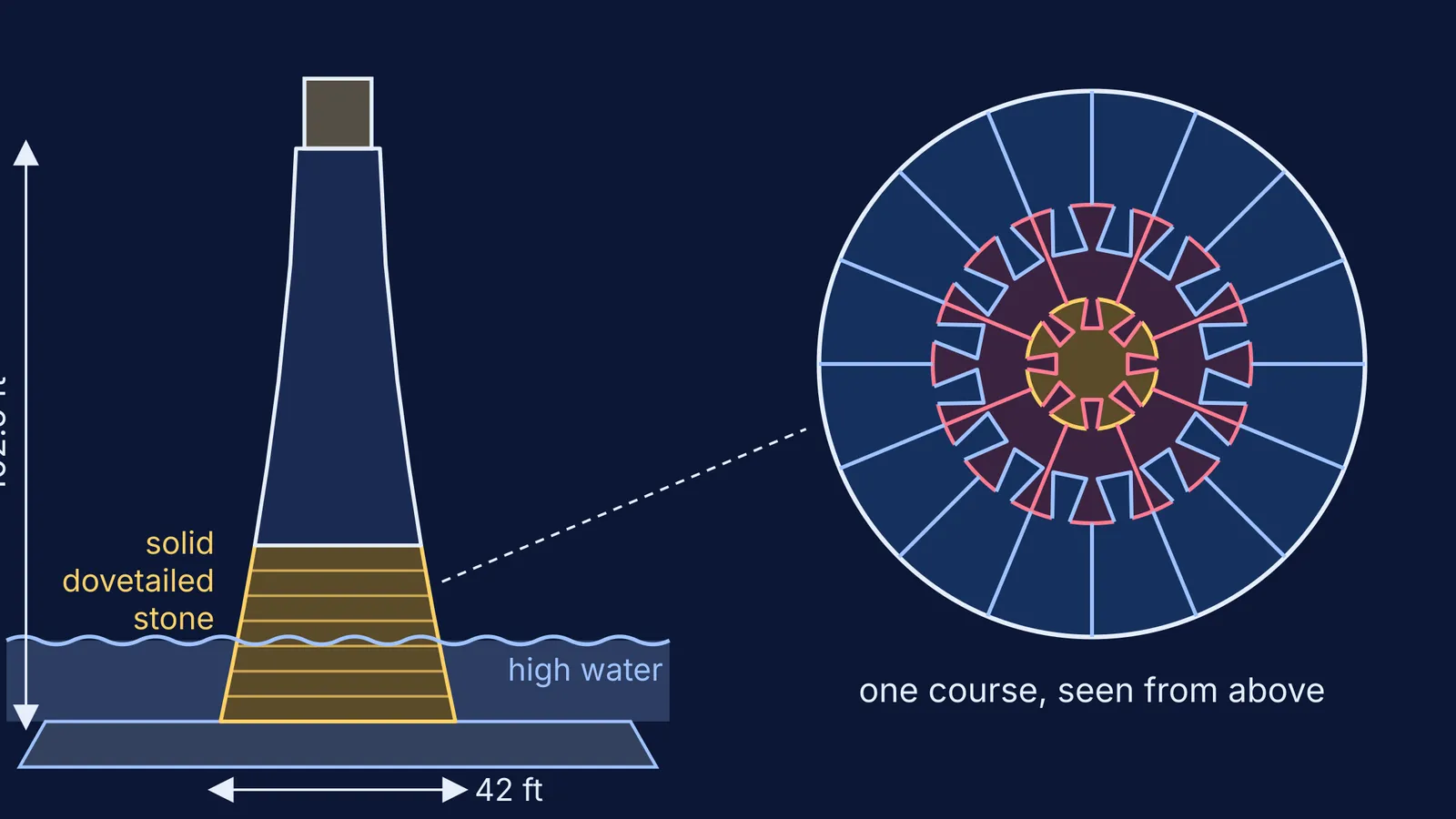
A dovetail is a joint in which a tail is wider at its end than at its neck, so it cannot be pulled straight out of its socket. In his Account, Stevenson wrote that the stones of each course "were connected or let into one another, by a system of dovetails, diverging from the centre to the circumference, after the manner of the Edystone Light-house". He was building on John Smeaton's work, which we covered in John Smeaton, the Eddystone lighthouse and a lime that set underwater.
The locking worked at three levels:
Within a course: each stone dovetailed into its neighbours, so a wave pushing one outer block was resisted by the whole ring.
Between courses: square stone joggles sat in holes cut into the stones, and oak trenails (wooden pins) and pairs of oak wedges held each block until the mortar set.
By weight: every new course pressed down on the ones below.
By the end of the 1808 season, the Account records about 388 tons of stone in 400 blocks, connected with 738 oak trenails and 1,215 pairs of oak wedges. Parts of each course were drawn full size on a floor 70 feet long and 25 feet wide, and a wooden mould was made for every stone so it could be cut ashore.
How tall is the Bell Rock Lighthouse, and is it still working?
The Northern Lighthouse Board, which runs it, gives the tower's height as 115 feet, with a base 42 feet across tapering to 15 feet at the top. The board describes the lower 30 feet as solid dovetailed masonry, topped by five chambers and the lightroom. Bell Rock is, in the board's words, the world's oldest working sea-washed lighthouse; its keepers left on 26 October 1988 and it is now monitored remotely from Edinburgh.
Stevenson's Account puts the top of the solid granite casing at 31 feet 6 inches above the rock, about 17 feet above high water of spring tides, when it was finished on 25 August 1809. The 90th and last course, laid in 1810, brought the masonry to 102 feet 6 inches.
Worked example: why can't a wave pull out a dovetailed block?
Treat one outer stone in a low course as a physics problem.
List the forces. Weight acts down, the course below pushes up (the normal force), friction acts along the joint, and a breaking wave shoves the stone sideways while the backwash can drag it outward.
List the ways it could move. Outward, away from the centre; sideways, around the ring; or up.
Ask what stops each one. Outward: the dovetail, because the tail would have to pass through a neck narrower than itself. Sideways: its neighbours, locked the same way. Up: the weight of the courses above, plus the joggles and trenails.
Compare with a plain block. With straight joints, only friction resists sliding, and friction can be at most μN. Anything that reduces N, such as water pressure lifting from below, also reduces the grip. A dovetail's hold against outward sliding does not depend on N: to slide straight out, the tail would have to break through the neck.
Stevenson made the shape do the work: the sea would have to move a whole course at once.
If free-body diagrams still feel slippery, the Fermi Concept Library has a lesson for every concept in physics, so you can revisit friction and normal force on their own, and the Fermi Simulation Lab has interactive simulations for ideas that are easier to see than to read.
For what happened to the light itself, read Augustin Fresnel: diffraction theory and the lighthouse lens.