

On this page
Every biology student learns the famous Latin phrase *Omnis cellula e cellula*—every cell comes from a cell. Today, this principle is the bedrock of modern cell theory. But the man who actually discovered it, Robert Remak (1815–1865), spent much of his career unrecognised, while another scientist took the credit for his life's work (Wikipedia).
Remak, a pioneering Polish-German embryologist and neurologist, was the first to establish that the origin of new cells is through the division of pre-existing cells. In the early 1850s, the scientific establishment still believed in spontaneous generation or "free cell formation," an idea that cells crystallised out of a fluid called a blastema.
Born in 1815 in Posen, Prussia (now Poznań, Poland), Remak studied at the University of Berlin. He was a student of the legendary physiologist Johannes Peter Müller, who also mentored other great scientists of the 19th century. From the start of his medical studies, Remak focused on the microscopic structure of living tissues.
How did Remak prove cell division?
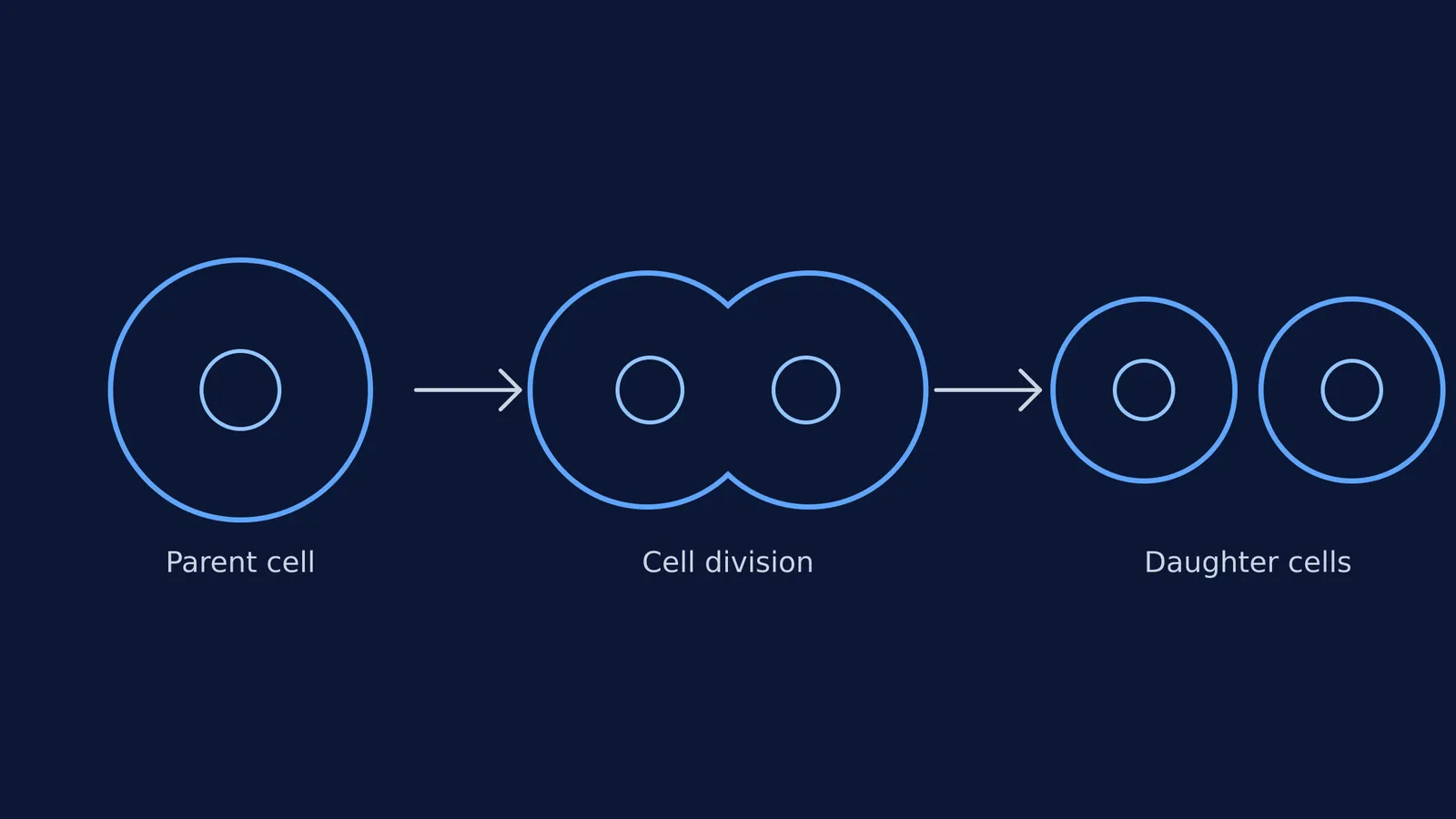
Remak focused his microscope on the earliest stages of life. He first concluded that cells originate from division after observing red blood cells from chicken embryos in various stages of division (Wikipedia). He did not just look at static cells; he tracked the process of one cell pinching to become two.
To prove that this was not just a quirk of blood cells, he needed to observe a developing animal from the very beginning. He confirmed the phenomenon by observing the cells of frog eggs immediately after fertilization. Through these observations, Remak demonstrated that a single fertilised egg divides to become two cells, which divide to become four, and so on, proving that cell division is a universal biological process. He published these definitive findings in his 1855 book, *Untersuchungen über die Entwickelung der Wirbelthiere* (Investigations on the Development of Vertebrates).
If you need to picture how a single fertilised egg divides to build an embryo, Fermi's AI tutor can draw the figure and test your understanding as you go.
Did Virchow plagiarise Remak's discovery?
Despite Remak's meticulous evidence, the idea that cells come from cells was famously popularised by his colleague, Rudolf Virchow. In 1855, Virchow published an essay containing the phrase *Omnis cellula e cellula*, presenting the concept as a central tenet of biology but failing to cite Remak's earlier, foundational work (OpenStax).
Historians, including Paul Weindling, point out that Virchow essentially plagiarised Remak's work. Virchow was initially skeptical of Remak's ideas but eventually adopted them as his own. When Remak confronted him about the missing credit, Virchow was dismissive. He defended his lack of citations by claiming his 1855 piece was merely an "editorial" rather than a formal scientific paper.
Remak's lack of recognition was also exacerbated by the severe antisemitism of 19th-century Prussia. Because he was Jewish, Remak was repeatedly denied full professor status. It was only late in his life that he was appointed as an assistant professor, making him the first Jewish person to teach at the University of Berlin. Virchow, by contrast, was a highly influential and politically powerful figure.
What else did Remak discover?
Remak's legacy goes far beyond cell division. He obtained his medical degree in 1838 with a specialization in neurology, and he made several major discoveries that are still taught today. He is famous for:
Defining the germ layers: He refined Karl Ernst von Baer's work, reducing the layers of an embryo to the three we study today: the ectoderm, mesoderm, and endoderm (Wikipedia).
Finding Remak cells: He discovered the unmyelinated Schwann cells that surround peripheral nerve fibres, which are now known as Remak cells.
Locating Remak's ganglia: He discovered nerve cells within the heart, which are referred to as Remak's ganglia.
Describing the axon: He was the first to characterise the axis cylinder (the axon) of a nerve fibre, showing that it was a continuous extension of the nerve cell body.
Today, science historians and modern textbooks increasingly credit Remak alongside Schwann, Schleiden and how cell theory was first put together. Rudolf Virchow and why every cell comes from a cell is still taught, but the original discovery belongs to Remak.
If you are revising the history of biology for your exams, the Fermi Concept Library explains mitosis, meiosis and Walther Flemming and the words we use for cell division step by step.


