On this page
In the 1950s, a team at the Institute of Nutrition of Central America and Panama (INCAP) in Guatemala City set out to make a protein food that poor families could afford for young children. Guatemalan food scientist Ricardo Bressani was central to that work. The result, Incaparina, rests on an idea you already use every time you eat dal with rice: two cheap plant foods can cover each other's weak spots.
Who was Ricardo Bressani?
Bressani was born in Guatemala City on 28 September 1926 and died on 30 January 2015, according to his Wikipedia biography. He studied chemical engineering at the University of Dayton, did a master's at Iowa State and earned a PhD in biochemistry from Purdue in 1956. He joined INCAP in 1951, headed its Division of Agricultural Sciences and Food until 1993, and wrote more than 300 publications.
What was Incaparina made of?
In his own account in Food and Nutrition Bulletin (2010), Bressani describes INCAP's goal as “a relatively low-cost vegetable protein mixture suitable as a complementary food for infants and young children”. It became popular with older children and adults too.
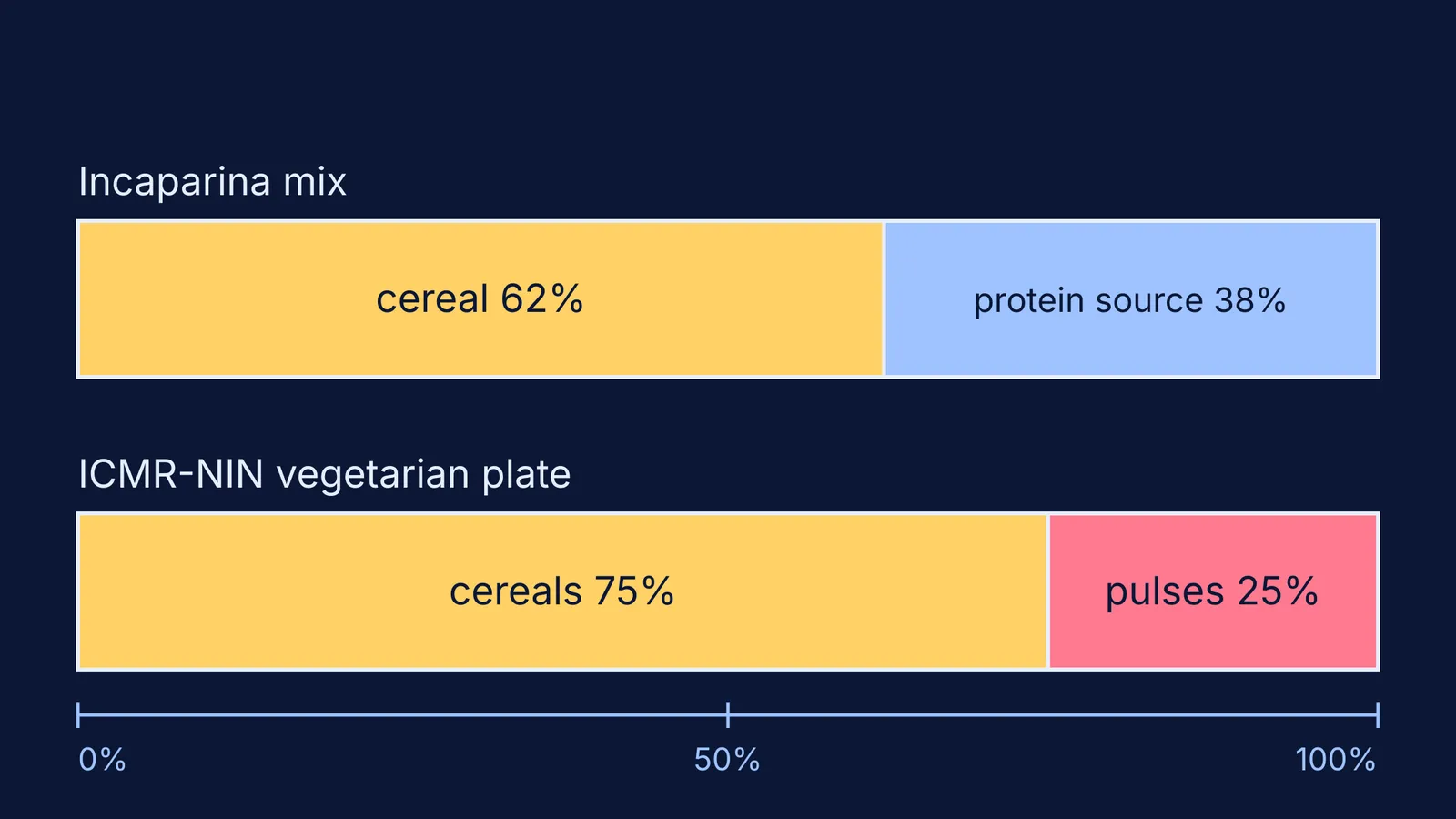
In a 1994 interview indexed in PubMed, Bressani explained that the team tested soybeans, cottonseed and various cereals before arriving at a mix of 62% cereal and 38% protein source, with vitamins and lysine added.
The first commercial version used cottonseed flour as its protein source. A history of cereal-soy blends by William Shurtleff and Akiko Aoyagi records that INCAP began its high-protein food research in 1954, that the cottonseed-based Incaparina 9 was on the market from 1959, and that real commercialization began in May 1961. At the time, they note, cottonseed was much more abundant in the area than soybeans, which is why the soy versions were never widely sold. Cottonseed also contains gossypol, a toxic pigment, and a review by Richard Semba notes that Incaparina came only after a process was developed to remove a toxin from cottonseed flour.
Why mix maize with cottonseed or soy?
Maize protein makes up only about 8 to 11% of the kernel's weight, and common maize is short of two essential amino acids, lysine and tryptophan, according to the FAO's Maize in Human Nutrition. An oilseed flour adds a lot of protein and helps fill those gaps.
Shurtleff and Aoyagi's history reports that Incaparina contained 27.5% protein and cost less than one-third as much per gram of protein as nonfat dry milk. A soy version, INCAP Vegetable Mixture 14, was 58% corn flour, 38% soybean flour and 3% torula yeast, with about 27% protein. Its main limiting amino acid was methionine, but only when fed at a low level of protein, as reported by Bressani and Elías in 1966.
Our explainer on essential vs non-essential amino acids covers which nine the body cannot make.
What happened to Incaparina later?
In the 1994 interview, Bressani said demand peaked between 1976 and 1978 and that sales then ebbed, partly because commodity prices soared. Thinking about child malnutrition was also shifting. Semba's review records that in 1975 Waterlow and Payne concluded the idea of a worldwide protein gap was “no longer tenable”. The story of kwashiorkor, which helped start that protein focus, is told in our piece on Cicely Williams and the discovery of kwashiorkor.
Incaparina did not disappear. A 2000 article by INCAP's Florence Tartanac in Food and Nutrition Bulletin says the original formula was still sold commercially. A new version improved protein quality, cut vitamin A, raised iron, B vitamins, zinc and calcium, and stayed competitively priced.
How can you use Bressani's idea on an Indian plate?
The 2024 Dietary Guidelines for Indians from ICMR-NIN make the same point: cereals, millets and pulses complement each other to provide good-quality protein and essential amino acids. Its tables give a worked example:
Cereals average 9.3 g of protein per 100 g raw; pulses average 22.8 g.
The guidelines' vegetarian plate for 2,000 kcal has 250 g of cereals, giving about 25 g of protein.
It adds 85 g of pulses, giving about 20 g more.
By raw weight that plate is roughly 75% cereal and 25% pulse. Incaparina was 62% cereal and 38% protein source: the same plan, tilted further towards protein.
A quick check for any meal at home:
Is there a cereal or millet (rice, roti, jowar, maize)?
Is there a pulse, milk, curd, egg or other protein food beside it?
If a meal is cereal only, what small pulse or dairy item could be added?
If you are worried about a child's growth or weight, talk to a paediatrician or a registered dietitian.
If “limiting amino acid” or “protein quality” still feels fuzzy before a biology test, the Fermi Concept Library has a lesson for every concept in biology and chemistry, each with its place in the map. And if this has you curious about food science as a career, start with our guide to food technology after Class 12.