

On this page
Calcite, the calcium carbonate (CaCO3) in limestone (Wikipedia: Calcite), splits along flat, shining planes when it breaks. Some time before 1781, a French priest named René Just Haüy kept splitting one broken calcite crystal. From the pieces he built a theory: every crystal is a stack of identical tiny blocks, the ancestor of the unit cell in your chemistry textbook.
Did Haüy really drop the calcite crystal?
By his own account, no. In his Traité de minéralogie (1801), Haüy wrote that a collector, "the citizen Defrance", gave him a crystal "just after it had broken off from a group" that the collector was showing him. The passage is quoted in George F. Kunz's 1918 essay The life and work of Haüy in American Mineralogist. Kunz notes that Georges Cuvier, in his 1823 eulogy of Haüy, told the story with one change: in Cuvier's version, Haüy "by a fortunate awkwardness" let the group fall.
What he did next mattered more: "I tried to divide it in other directions, and I succeeded, after several attempts, in extracting its rhomboid nucleus."
What did Haüy see inside the broken calcite?
Calcite has perfect cleavage in three directions, as the Webmineral calcite data sheet lists. Those three cleavage planes meet at an angle of 74° 55' (Wikipedia, citing the Manual of Mineralogy). So however you split calcite, the pieces are rhombohedra: slanted boxes with six identical rhombus faces.
Back in his room, Kunz writes, Haüy broke a six-faced piece of calcite and a lens-shaped crystal; both gave rhomboid fragments. Different outer shapes, same core. He read his first paper, on garnets and calcite, to the Paris Academy of Sciences on 10 January 1781. A rival, Romé de l'Isle, is said to have mocked him as a "cristalloclaste": a breaker of crystals.
What are integrant molecules?
In his 1784 Essai d'une théorie sur la structure des crystaux, Haüy argued that each kind of crystal has a smallest building block that cannot be split further without changing what the substance is (Wikipedia: René Just Haüy). He called it the integrant molecule. In his model, a crystal is these blocks stacked in orderly layers.
But then why does calcite also grow as prisms and points? Haüy's answer was the law of decrements: each layer is a few blocks narrower than the one below, and the steps, too small to see, look like a smooth slanted face. The rise-to-run ratio of those steps is a simple fraction p/q of small whole numbers (Wikipedia: Law of rational indices). Haüy showed in 1784 that the measured angles between crystal faces could be explained this way. His law of decrements directly implies the law of rational indices, which you meet today as Miller indices.
How does a stack of blocks make a crystal face?
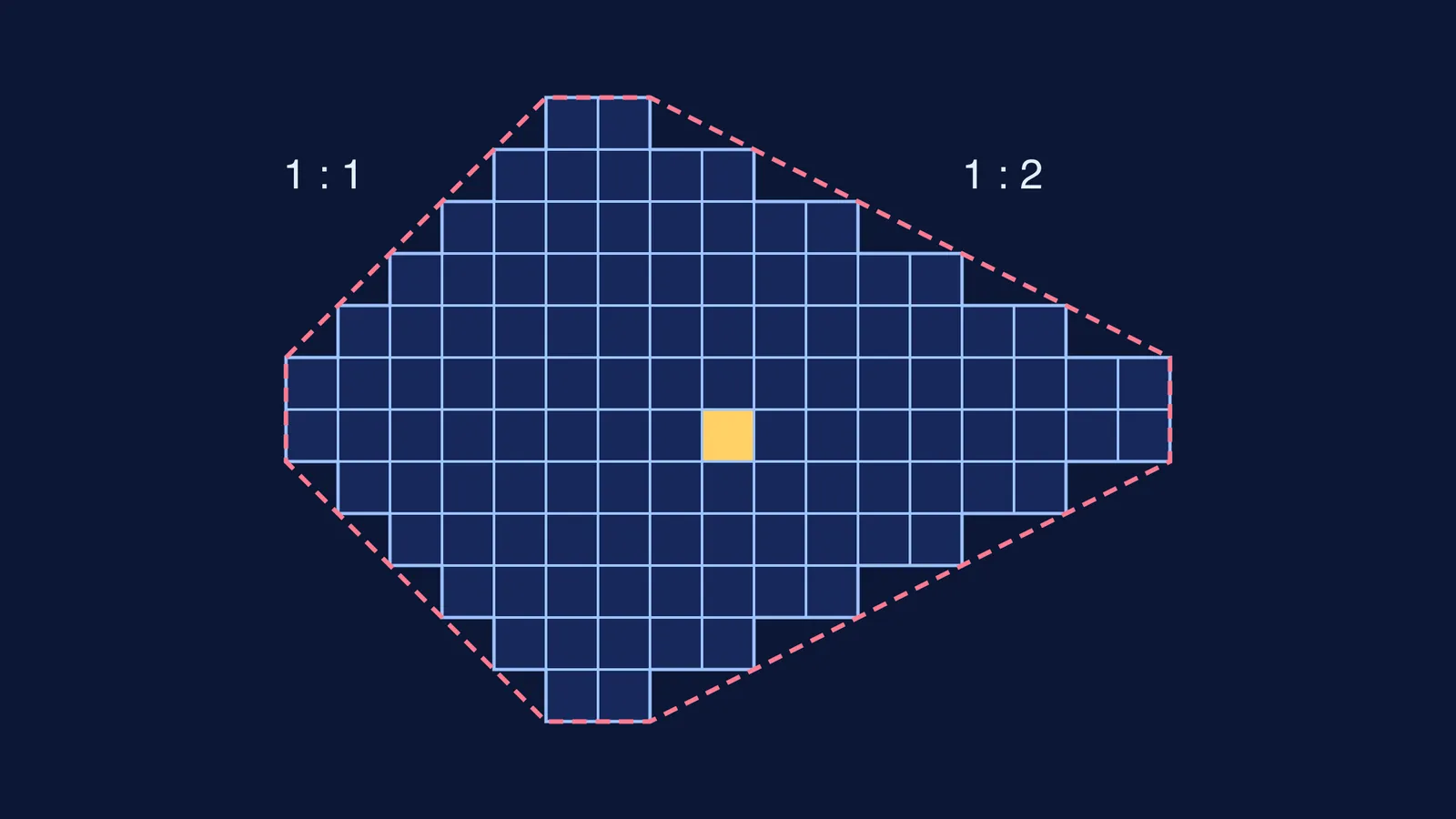
The diagram at the top of this page uses square blocks for simplicity. Try it on squared paper or with dice:
Lay a row of 17 blocks.
Stack a second row on top, one block shorter at the left end and two blocks shorter at the right end.
Repeat. Each row loses 1 block on the left and 2 on the right, so after six rows only 2 blocks are left on top.
Lay a ruler along the outer corners. The left face rises 1 for every 1 across, so it slopes at 45°. The right face rises 1 for every 2 across, which is tan⁻¹(1/2), about 26.6°.
Now try to make a 30° face. You would need rise/run = tan 30° = 1/√3, and that is not a ratio of whole numbers.
That is the key idea: if a crystal is built from identical blocks, only certain face angles are possible. If you find 3D stacking hard to picture, the Fermi Simulation Lab has interactive simulations for ideas that are easier to see than to read.
What did Haüy get right, and what did later scientists change?
Haüy worked only from shapes, cleavage and face angles measured with a goniometer; the structure inside his block could not be worked out until X-ray diffraction, long after his death. But he introduced the idea that a crystal repeats in three directions, and that idea became the basis of the crystal lattice (Wikipedia: René Just Haüy).
Before him, Nicolaus Steno noticed that crystal face angles stay constant. In 1866 Auguste Bravais showed that crystals cleave most easily parallel to the lattice planes densest in points (Wikipedia: Law of rational indices), which helps explain the flat planes along which Haüy's calcite split. Read more in how Auguste Bravais found the 14 crystal lattices.
Today's unit cell is not a solid brick but the smallest repeating box of atom positions. To see how those boxes fill space, try unit cell packing efficiency, from simple cubic to fcc, or review unit cells from the start in the Fermi Concept Library.
Next time you hold a piece of calcite, look at the flat faces: they are the outside of the stacks Haüy imagined.


