On this page
In 1972, the physicists Rashid Sunyaev and Yakov Zeldovich predicted that the hot gas filling clusters of galaxies should leave a faint mark on the cosmic microwave background (CMB), the leftover glow of the early universe. Astronomers now use that mark, the Sunyaev-Zeldovich (SZ) effect, to find clusters across the whole sky. Here is what it is, and how to estimate its size with school algebra.
What is the Sunyaev-Zeldovich effect?
The Sunyaev-Zeldovich effect is a small distortion of the CMB spectrum caused by inverse Compton scattering of CMB photons off hot electrons in clusters of galaxies, as a review by Yoel Rephaeli, Sharon Sadeh and Meir Shimon puts it. That review credits the effect to a 1972 paper by Sunyaev and Zeldovich in *Comments on Astrophysics and Space Physics*.
The CMB itself is very close to a perfect blackbody. Its temperature is 2.72548 ± 0.00057 K, from a 2009 analysis by D. J. Fixsen that combined published measurements. For the story of how that glow was first picked up, read our piece on Penzias, Wilson and the noise that turned out to be the Big Bang.
Who were Sunyaev and Zeldovich?
Rashid Sunyaev was born in 1943 in Tashkent, Uzbekistan, according to his Kyoto Prize profile. The prize citation says the SZ effect "is widely believed to serve as a key principle for the study of large-scale structure."
Yakov Zeldovich was born in Minsk in 1914 and died in 1987, according to Physics Today. He defended a doctoral thesis in 1939 without formal higher education and worked on combustion and Soviet nuclear weapons before turning to cosmology in the 1960s.
Why does the microwave background look dimmer at some frequencies and brighter at others?
Picture one CMB photon crossing a massive cluster. The gas there is extremely hot: cluster gas temperatures span 3 to 15 keV, according to the Rephaeli review. A photon passing through the centre of a massive cluster has only about a 1% chance of hitting one of these electrons, according to a review by John Carlstrom, Gilbert Holder and Erik Reese. When it does hit one, it gains energy, roughly by the fraction kTe/mec², the electron's thermal energy divided by its rest energy.
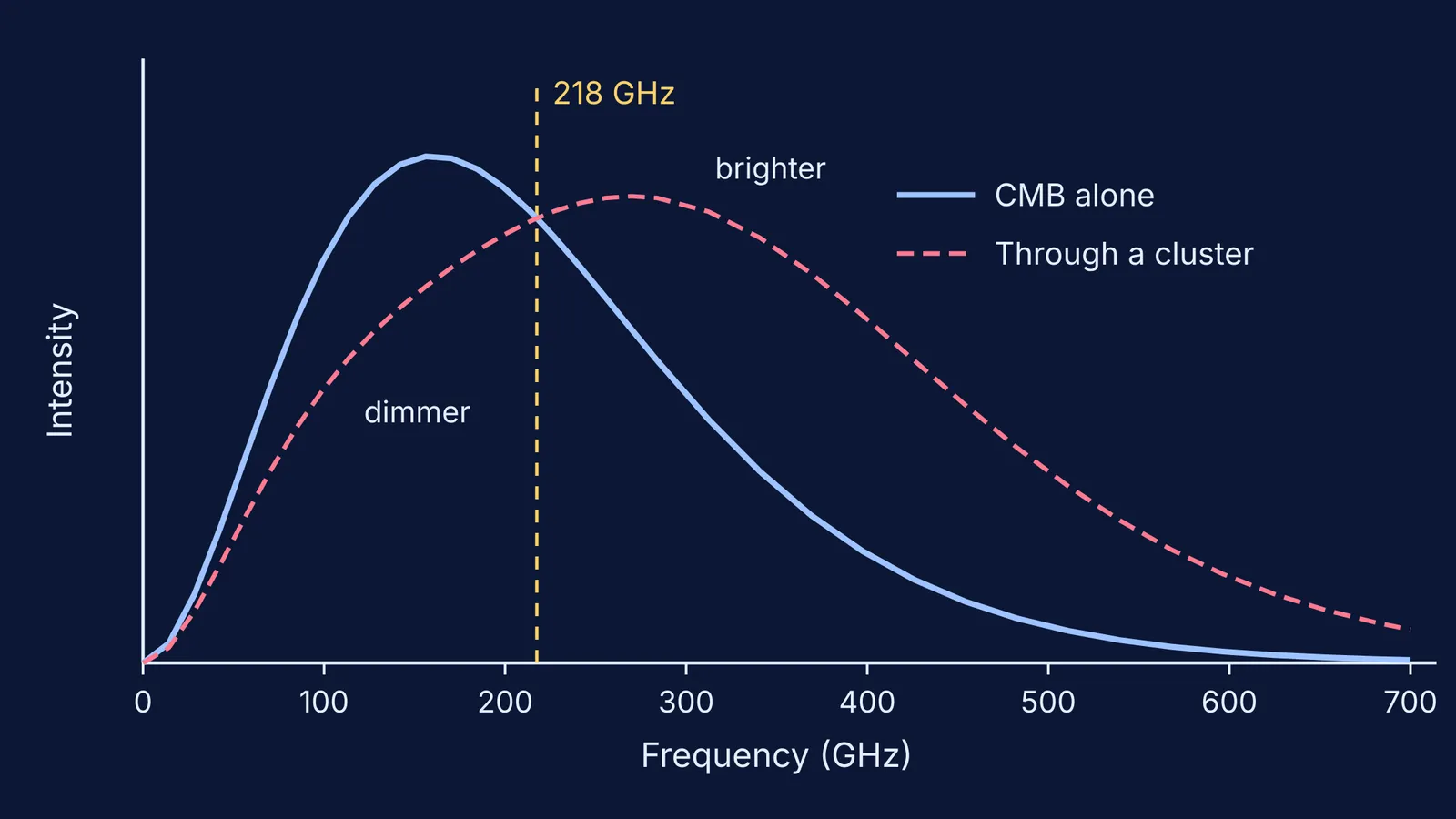
Scattering moves some photons from low frequencies to higher ones. At low frequencies, fewer photons are left than before, so the cluster looks like a cold spot. At high frequencies there are extra photons, so it looks like a hot spot. Carlstrom and colleagues put the crossover near 218 GHz: the SZ effect lowers the CMB intensity below about 218 GHz and raises it above.
This reverses Compton's experiment, where X-ray photons lost energy to electrons. Our article on Arthur Compton and the X-ray scattering that showed photon momentum covers the original.
How big is the SZ temperature shift?
Work through it with a pencil.
Strength of the scattering. The Rephaeli review gives a Compton parameter y of about 10^-4 along a line of sight through the centre of a rich cluster.
The rule. At low frequencies, the same review gives the relative temperature change as ΔT/T = -2y. So ΔT/T is about -2 × 10^-4.
Plug in the CMB temperature. With T = 2.7255 K from Fixsen, ΔT is about -2 × 10^-4 × 2.7255 K, which is -0.00055 K, or about -0.55 mK.
Check it. Carlstrom and colleagues describe the distortion as below about 1 mK. Our answer fits.
Energy gained per scattering. Take kTe of about 10 keV, the value Carlstrom and colleagues give for massive clusters, and the electron rest energy of 0.511 MeV from NIST. The ratio is 10/511, about 0.02, so a scattered photon gains roughly 2% in energy.
The diagram at the top of this page shows the shape of the change, with the effect made 1,000 times stronger so you can see it. If the blackbody curve underneath is still hazy, our blackbody radiation simulation guide asks you to predict the peak before you look. The Fermi Simulation Lab has interactive simulations for ideas like this that are easier to see than to read.
Why does the SZ effect matter for cosmology?
The size of ΔT/T does not depend on the cluster's redshift, so the signal from a distant cluster is as strong as from a nearby one of the same kind, according to Carlstrom and colleagues. That makes the SZ effect a useful way to find distant clusters, including those beyond redshift 1.
The Planck satellite turned that idea into a sky map. Its second SZ catalogue, built from 29 months of data, lists 1,653 detections, of which 1,203 are confirmed clusters, according to the Planck Collaboration. It was the first SZ-selected cluster survey with more than 1,000 confirmed clusters.
If inverse Compton scattering or blackbody spectra are new to you, the Fermi Concept Library has a lesson for every concept in physics, each with its place in the map, so you can fill the gap before coming back to clusters.