

On this page
In 1932 two teams saw something strange. P. Debye and F. W. Sears, writing from MIT, sent light through a liquid carrying high-frequency sound and found it broke into a fan of beams (Debye and Sears, PNAS, 1932). Lucas and Biquard in France saw the same effect that year. The explanation came from Bangalore.
What did Raman and Nath explain?
In October 1935, C. V. Raman and N. S. Nagendra Nath of the Department of Physics, Indian Institute of Science, Bangalore, published "The diffraction of light by high frequency sound waves: Part I" in the Proceedings of the Indian Academy of Sciences (Raman and Nagendra Nath, 1935). It gave a formula for the directions of the diffracted beams and one for how bright each beam is, and the authors reported that these explained the measurements of the physicist R. Bär. Part II followed in the same issue.
How does a sound wave act like a diffraction grating?
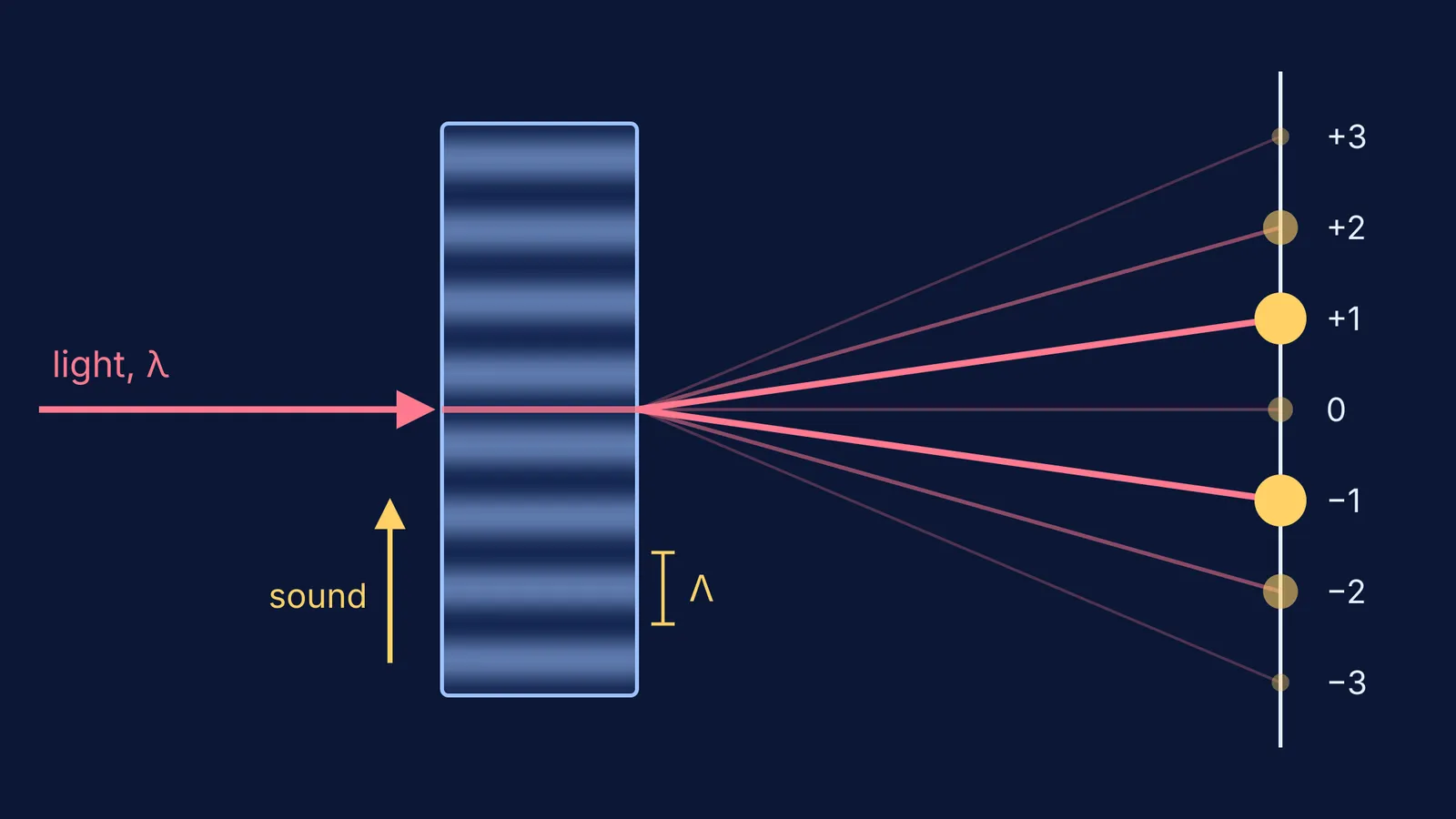
Sound in a liquid is a pressure wave. Layers squeezed together alternate with layers pulled apart. The squeezed layers are slightly denser, so their refractive index is slightly higher and light travels a little slower through them. The pattern repeats every sound wavelength, Λ (the 1935 paper writes λ*), which is exactly what a grating needs.
Unlike the slits you meet in school, nothing blocks the light. Some parts of the beam are simply delayed more than others, so a flat wavefront comes out wrinkled, and a wrinkled wavefront spreads into separate orders. (For how diffraction was first noticed, see Francesco Grimaldi and the discovery of diffraction.)
Raman and Nath's two results, as given in their 1935 summary (Part I):
Direction: sin θ = nλ/Λ, where n = 0, ±1, ±2 and so on, λ is the wavelength of the light and Λ is the wavelength of the sound.
Brightness: the intensity of order n goes as J_n²(2πμL/λ), where J_n is a Bessel function, μ is the largest change in refractive index caused by the sound and L is the distance the light travels through it.
Call 2πμL/λ, the largest extra phase delay, v. Louder sound means larger v, which moves light out of the straight-through beam into the side orders. At v = 2 the Bessel values give about 5% of the light in the zero order and about 33% in each first order. Near v = 2.4 the straight-through beam almost disappears, because J₀ has its first zero there.
Why does the diffracted light change frequency?
A travelling sound wave is a moving grating, and light scattered by something moving comes back Doppler-shifted. In January 1936 Raman and Nath showed that for a travelling sound wave, the nth order has frequency ν − nν*, where ν is the light's frequency and ν* is the sound's frequency (Part III, 1936). For a standing sound wave, even orders carry frequencies ν ± 2rν* and odd orders ν ± (2r + 1)ν*, which explained Bär's finding that an odd order and an even order do not cohere.
New to Doppler? Read Christian Doppler and the 1842 idea behind the Doppler effect.
Worked example: where do the spots land?
The speed of sound in fresh water at 20 °C is 1481 m/s (Engineering ToolBox). Suppose you drive the water at 5 MHz and shine red light of wavelength 650 nm through it.
Sound wavelength: Λ = 1481 ÷ 5,000,000 ≈ 2.96 × 10⁻⁴ m, about 0.3 mm.
First-order angle: sin θ₁ = 650 × 10⁻⁹ ÷ 2.96 × 10⁻⁴ ≈ 2.2 × 10⁻³, so θ₁ ≈ 0.13°.
On a wall 2 m away, neighbouring spots sit about 2 × 2.2 × 10⁻³ m ≈ 4.4 mm apart.
Frequency shift: light's frequency is about 3 × 10⁸ ÷ 650 × 10⁻⁹ ≈ 4.6 × 10¹⁴ Hz, so a 5 MHz shift is roughly 1 part in 100 million.
Where is Raman–Nath diffraction used today?
Their names now label a regime: researchers who measure ultrasound fields with light still check that they are in the "Raman–Nath regime" (Clement, arXiv, 2014). It typically appears at sound frequencies below about 10 MHz and interaction lengths under about 1 cm. Acousto-optic modulators and deflectors use the same light–sound interaction to control laser beams by changing the sound's strength or frequency (Wikipedia: Acousto-optics).
How should you study this for JEE and boards?
A quick checklist:
Match it to the grating formula d sin θ = nλ: the spacing d is now the sound wavelength Λ.
Keep the two wavelengths apart: light sets the λ in the numerator, sound sets the spacing.
Find Λ from v = fΛ before you touch any angle.
Remember the moving-grating picture: a travelling wave means Doppler-shifted orders.
If the wrinkled wavefront still won't settle in your head, the Fermi Simulation Lab has interactive simulations for ideas that are easier to see than to read. Every physics concept also has its own lesson in the Fermi Concept Library.
For Raman's best-known work on light, read C. V. Raman and the Raman effect, explained for students.


