On this page
For about two centuries, the shaking fevers we now call malaria were treated with the powdered bark of a South American tree. In 1820 two Paris pharmacists turned that bark into quinine, a pure substance you could weigh.
Who isolated quinine, and when?
Quinine was isolated in 1820 by Joseph Pelletier (often called Pierre-Joseph, born 1788) and Joseph Bienaimé Caventou (born 1795) in Paris, according to F. Chast's history in the Revue de Biologie Médicale (2020). They read their memoir, *Recherches chimiques sur les quinquinas*, to the Académie des sciences on 11 September and 16 October 1820, and it was printed in the *Annales de Chimie et de Physique* that December.
The pair had already isolated strychnine in 1818, Chast notes, following the path opened when Friedrich Sertürner isolated morphine from opium.
Why was cinchona bark not good enough?
Cinchona bark was used against malaria from as early as the 1600s, when it was called "Jesuits' bark", says a review of quinine by Achan and colleagues in Malaria Journal (2011). The trouble was consistency. The market was flooded with barks of varying strength, and even with useless or poisonous barks from other trees, notes the James Lind Library history of cinchona trials.
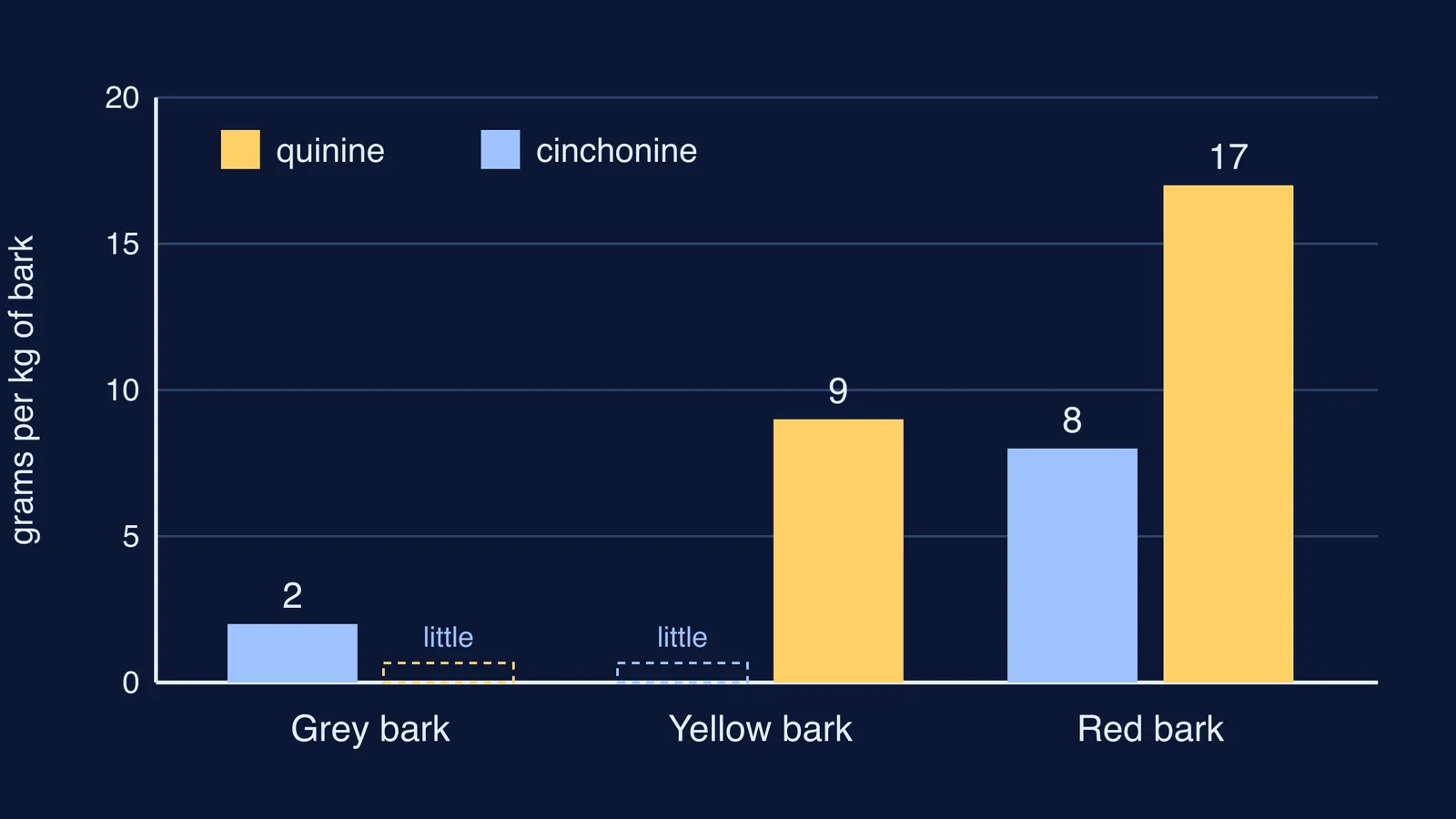
Pelletier and Caventou measured the problem themselves. Their yields, as reported by Chast, were:
Grey bark: 2 grams of cinchonine per kilogram, and little quinine.
Yellow bark: 9 grams of quinine per kilogram, and little cinchonine.
Red bark: 17 grams of quinine and 8 grams of cinchonine per kilogram.
How much bark held one gram of quinine?
Red bark: 1000 g ÷ 17 g = about 59 g of bark per gram of quinine.
Yellow bark: 1000 g ÷ 9 g = about 111 g of bark per gram of quinine.
Compare: 17 ÷ 9 = about 1.9, so the same spoonful of red bark carried nearly twice the quinine of yellow.
Grey bark: "little" quinine, so you cannot calculate a dose at all.
A doctor handing out bark could not know which of these a patient got. A pure salt removes the guesswork: one gram is one gram.
How did Pelletier and Caventou extract quinine?
Chast describes their method in five steps. The chemistry works because these compounds are bases, which form salts with acids.
Soak the crushed bark in ethanol to pull out the soluble material.
Treat the extract with potash (potassium hydroxide).
Dissolve the result in dilute hydrochloric acid, turning the bases into soluble salts.
Add magnesia (magnesium oxide) to precipitate the free bases.
Wash, dry and take the precipitate up again in alcohol.
Grey bark gave white crystals of cinchonine. Yellow bark gave a yellowish mass that would not crystallise but dissolved completely in ether, unlike cinchonine, so they concluded it was a new base and named it quinine. Its formula is C20H24N2O2 (PubChem).
They ended the memoir hoping that "some skilled practitioner" would test the cinchona alkalis therapeutically and "so give our work a medical use" (our translation, quoted in Chast).
The idea underneath steps 2 to 4 is the acid-base behaviour of amines. The Fermi Concept Library gives each concept in chemistry its own lesson, so you can see where salts and bases fit before you revise extraction.
What changed once doctors had a measured dose?
In 1821 the physiologist François Magendie argued that, in the same person, the effect of such pure substances varied only with how and how much they were given, Chast writes. The James Lind Library notes that the dose of quinine pills was set after the first wave of human trials between 1820 and 1822.
Pelletier and Caventou refused any rights to their process and published it, says Chast. Pelletier's factory at Neuilly soon made about 1,800 kg of quinine sulphate a year, and by 1826 his works used about 160 tonnes of bark a year. In 1827 the Académie gave the pair a Montyon prize of 10,000 francs.
Pure compounds also made fair comparisons possible, including in India. In 1866 the Madras Government appointed a commission to test different cinchona alkaloids; its report counted 2,472 fever cases, 2,445 recorded as cured, according to the James Lind Library.
Is quinine still used for malaria today?
Less than before. Achan and colleagues report that intravenous artesunate should be preferred to quinine for severe falciparum malaria, while quinine plus clindamycin was then still recommended in the first trimester of pregnancy (Malaria Journal, 2011). For the next chapter in malaria drugs, read about Tu Youyou and artemisinin.
Making quinine from scratch proved far harder than extracting it. In 1856, 18-year-old William Perkin tried to make quinine and got mauve dye instead, as the Science History Institute recounts. A review by Kaufman and Rúveda (2005) traces the route from Woodward and Doering's 1944 approach to Stork's stereocontrolled synthesis in 2001.
Try the worked example on another plant drug: find a yield, invert it, and see how much raw material one dose needs. If you get stuck on the ratio, the Fermi Problem Library has a step-by-step solver that explains the reasoning rather than printing an answer.