On this page
The smooth letters you are reading can be drawn with an idea worked out inside a French car company in the late 1950s. Its inventor, Paul de Casteljau, worked for a company that kept its methods secret, so for years few people outside Citroën knew his name. The idea is simple enough to do with a pencil.
Who was Paul de Casteljau?
Paul de Faget de Casteljau was born on 19 November 1930 and grew up in Besançon. He died in 2022, according to Andreas Müller's 2024 review of his work in Computer Aided Geometric Design.
He studied at the École Normale Supérieure in Paris, did military service, then answered an anonymous job advert and learned only from the reply that it was Citroën. He started there on 1 April 1958, in the tooling department, and later told his own story in "My time at Citroën", a four-page memoir published in 199900024-2).
What problem was he solving at Citroën?
Car bodies were first shaped by hand, as physical models. Müller's review says de Casteljau's task was "turning the handmade design models into a mathematical form" that a numerically controlled milling machine could cut (Müller, 2024).
His first approach was documented at the French patent office, INPI, only months after he joined. Instead of storing many measured points, you store a few control points, which Citroën called pôles, and let a rule fill in the curve. In the same review, de Casteljau is quoted looking back: "No one in 1958 could have foreseen that one day mathematicians would be looking for the equation of an artistic or aesthetic form."
How does the de Casteljau algorithm work?
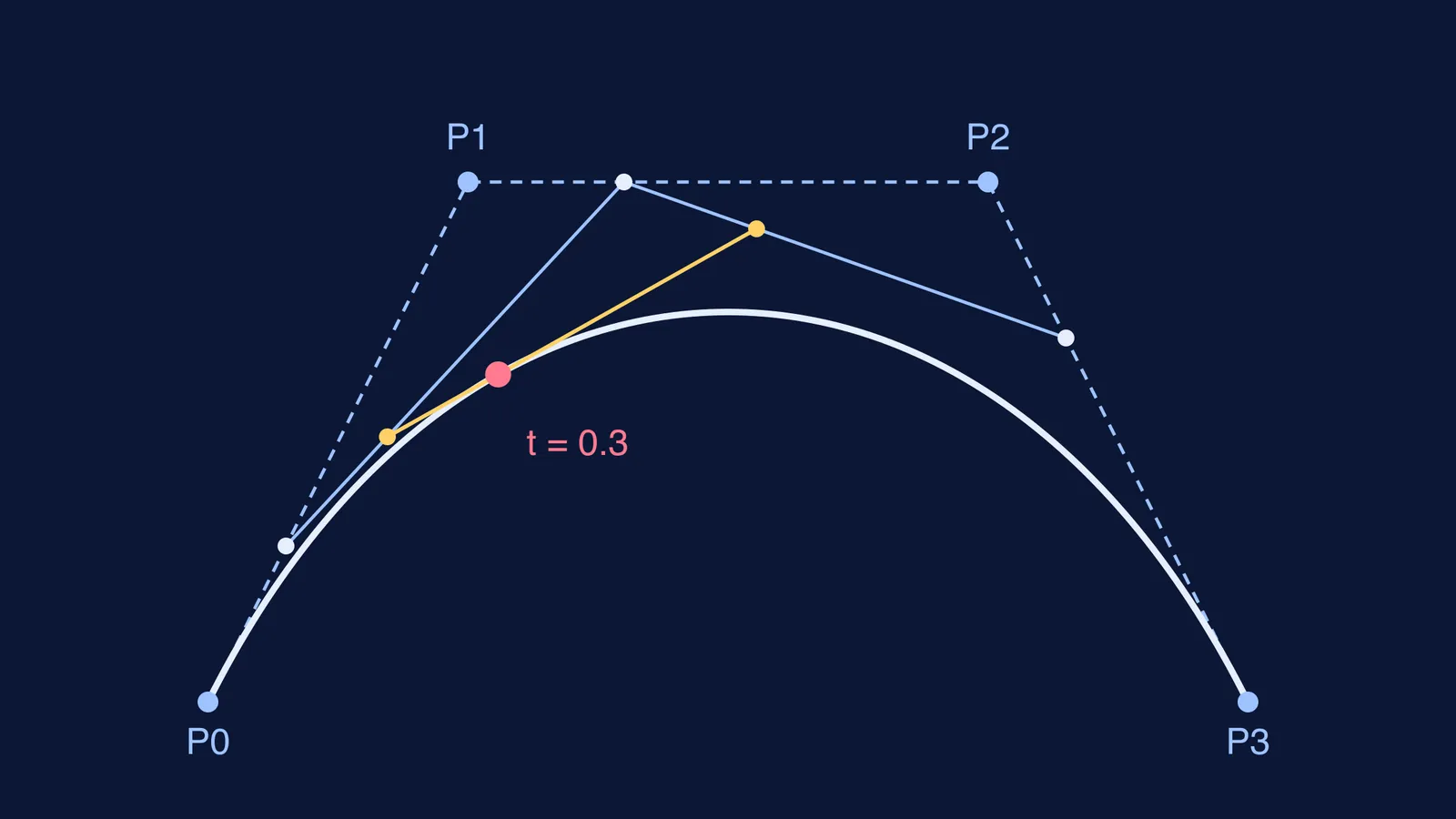
The de Casteljau algorithm is a recursive method for finding points on a Bézier curve by repeatedly dividing the lines of the control polygon in the ratio t : (1 − t), as described on Wikipedia's page on the algorithm. The number t runs from 0 to 1. When you are down to one point, that point lies on the curve.
If you have met the section formula in coordinate geometry, you already know the one step it uses: the point that divides AB in the ratio t : (1 − t) is A + t(B − A).
Round 1: take the midpoint of each side of the polygon. You get (0.5, 1), (2, 2) and (3.5, 1).
Round 2: take midpoints of the two new segments. You get (1.25, 1.5) and (2.75, 1.5).
Round 3: take the midpoint of that last segment. You get (2, 1.5). That is the point on the curve at t = 1/2.
Check with the cubic formula: x = 3(1 − t)²t + 9(1 − t)t² + 4t³ gives 2, and y = 6(1 − t)²t + 6(1 − t)t² gives 1.5. Same answer, and the rounds needed no powers.
Repeat with t = 0.3, dividing each segment 3 : 7. You should land on (1.116, 1.26), the pink point in the diagram above.
Two bonuses come free. The curve never leaves the convex hull of its control points (the smallest convex shape containing them). And the in-between points split the curve into two smaller Bézier curves: here the left half has control points (0, 0), (0.5, 1), (1.25, 1.5) and (2, 1.5). The same Wikipedia page notes the method is numerically stable compared with evaluating the polynomial directly.
Why are they called Bézier curves, not de Casteljau curves?
Because of secrecy. At Renault, the engineer Pierre Bézier was working on the same question at about the same time and reached the same curves by a different route. Müller explains that Bézier was free to publish and became known internationally through papers in the late 1960s, while de Casteljau's reports stayed inside Citroën (Müller, 2024).
The researcher W. Boehm discovered de Casteljau's work in 1975, and de Casteljau was recognised internationally only from 1977, by the same account. Today the field honours both: the Bézier form of a curve, and the de Casteljau algorithm for working with it.
Where do you see his curves today?
In fonts, for a start. The font-software maker FontLab explains that PostScript-style outlines use cubic Béziers with 4 control points per segment, while TrueType uses quadratic Béziers with 3 control points (FontLab blog).
How can you explore this yourself?
Draw four points on graph paper and run the rounds for t = 1/4, 1/2 and 3/4. Join the results and watch the curve appear.
Move one control point and redo it. Notice the curve bends towards that point but does not pass through it.
Try three points instead of four. That is a quadratic Bézier, the kind TrueType uses.
If the section formula or parametric equations still feel shaky, the Fermi Concept Library gives each mathematics concept its own lesson, and the Fermi Simulation Lab has interactive simulations for ideas that are easier to see than to read.
Next time you see a smooth letter, you know the three rounds of in-between points hiding underneath it.