On this page
When we learn mathematics in school, we are taught to see proofs as paths to a single, absolute truth. We start with a foundation of basic rules—axioms—and step logically to an undeniable conclusion. For decades, mathematicians believed every clear mathematical question could be definitively answered as either true or false.
Paul Cohen changed that assumption for one of the major questions in mathematics.
What is the continuum hypothesis?
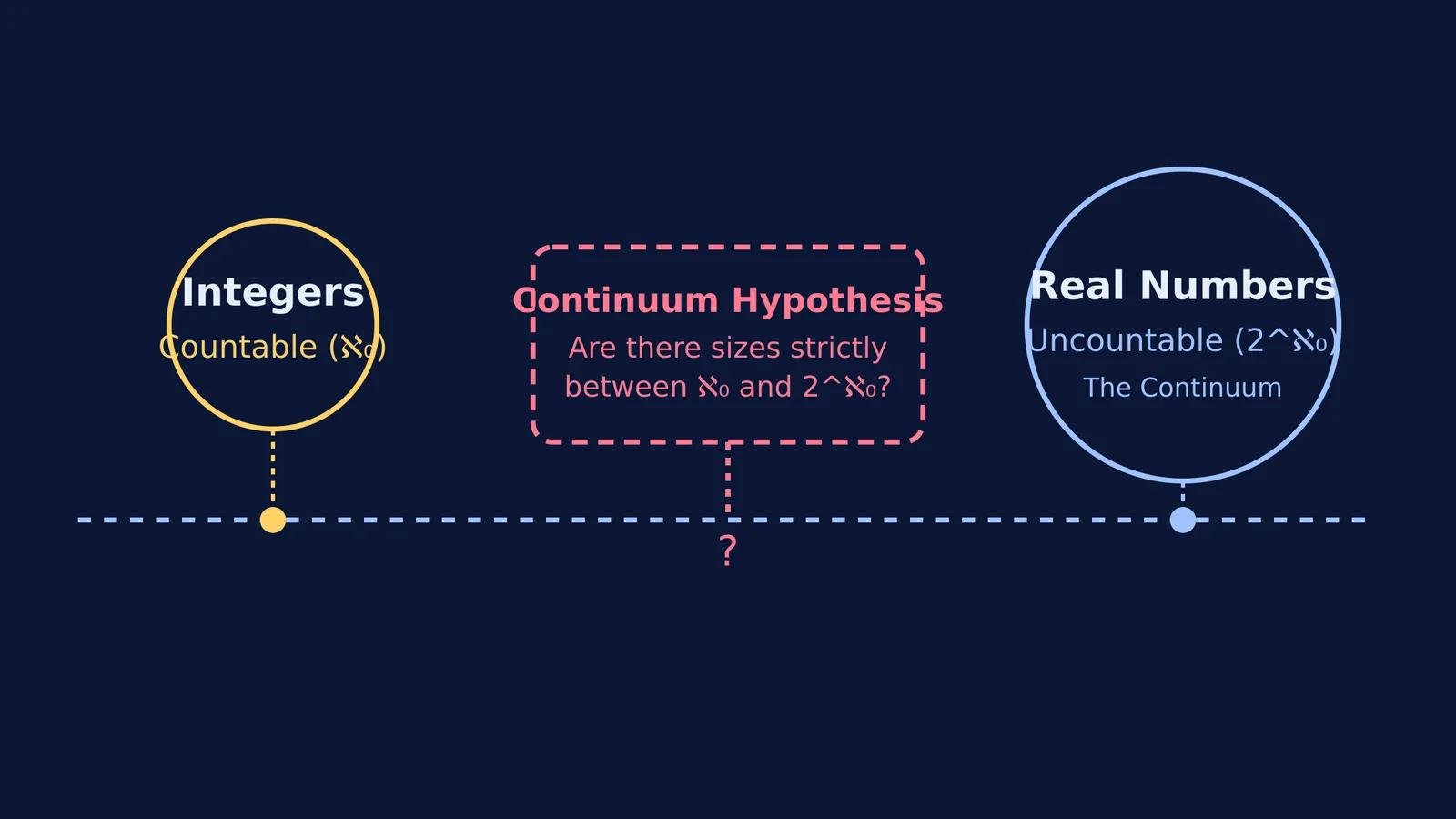
To understand the hypothesis, you first have to understand that infinity comes in different sizes. The integers (whole numbers) form the smallest type of infinity, known as a countable infinity. The real numbers (which include all decimals, like π) form a much larger, uncountable infinity known as the continuum.
Georg Cantor formulated the continuum hypothesis in 1878, stating there is no set whose cardinality is strictly between the integers and the real numbers.
For decades, mathematicians tried to prove or disprove Cantor's guess using the standard Zermelo-Fraenkel axioms of set theory with the Axiom of Choice (known as ZFC). No one succeeded in finding a definitive answer either way.
How did Paul Cohen prove the continuum hypothesis independent?
The first breakthrough came from Kurt Gödel. In 1940, Kurt Gödel proved that the continuum hypothesis cannot be disproved from the standard axioms of set theory. He created a model of the mathematical universe where Cantor's hypothesis was perfectly consistent with all existing rules.
But Gödel could not prove that the hypothesis was actually true. The question remained half-open until a young mathematician named Paul Cohen approached the problem in the early 1960s.
In 1963, Paul Cohen published a proof) demonstrating that the continuum hypothesis is mathematically independent, earning him the 1966 Fields Medal.
Because Gödel had already shown you cannot disprove it, and Cohen showed you cannot prove it, the result meant the continuum hypothesis is formally undecidable within standard mathematics. You can choose to believe it is true, or you can choose to believe it is false, and either choice will give you a valid, consistent mathematical system.
How does the forcing technique work?
Cohen achieved this by inventing a mathematical technique known as forcing).
Forcing allows a mathematician to start with a small universe of sets and systematically expand it by adding a carefully chosen, generic object. Cohen used forcing to add new mathematical sets of real numbers into the universe without accidentally breaking the rules of ZFC.
By precisely controlling what these new sets looked like, he constructed a universe where the real numbers were expanded so that a new, intermediate size of infinity could fit in between the integers and the continuum. This proved that a universe where the continuum hypothesis is false is mathematically valid.
What does mathematical independence mean?
The realization that some statements are independent was a major shift for the mathematical community. It meant that mathematicians can choose whether to assume the continuum hypothesis is true or false, leading to entirely different branches of set theory.
This is similar to how geometry split into Euclidean and non-Euclidean branches depending on whether one assumes parallel lines never meet. Today, set theorists actively explore these parallel mathematical universes, studying what happens when the continuum hypothesis is accepted and what happens when it is rejected. They investigate how different assumptions shape the structure of infinite sets and influence other areas of mathematics.
How to think about undecidable problems?
Cohen's discovery changed how we understand mathematical truth. It showed that mathematics is not a single, rigid structure, but a landscape of different universes defined by the axioms we choose to adopt.
When navigating advanced subjects, holding these abstract structures in your head can feel overwhelming. The Fermi Concept Library maps every concept in mathematics, each with its own lesson, helping you see where foundational ideas like set theory and infinity fit together. Just like learning to use the binomial theorem for any index or applying the Cayley-Hamilton theorem, mastering higher mathematics requires stepping back and looking at the rules you are allowed to use.
If you are facing a difficult, abstract problem, use this framework to clarify your thinking:
State your axioms: Before you solve anything, write down the absolute truths you are allowed to assume.
Search for counterexamples: Can you imagine a strange, extreme scenario where the rules still apply, but your expected outcome fails?
Question the question: If a problem seems impossible to prove, ask if the problem itself is actually a constraint of the rules you are using. Sometimes, as Cohen proved, the answer is neither true nor false—it simply depends on the universe you choose to work in.