

On this page
Until 1987, no known superconductor worked at the temperature of liquid nitrogen, and in practice they needed liquid helium, which is awkward and expensive to handle. Then a team from the University of Houston, led by Paul Chu, and a team from the University of Alabama in Huntsville, led by Maw-Kuen Wu, reported a ceramic that lost its resistance at temperatures liquid nitrogen can reach. Here is what they found and why 93 K mattered.
What did Paul Chu's team discover in 1987?
The result appeared in Physical Review Letters on 2 March 1987 under the title "Superconductivity at 93 K in a new mixed-phase Y-Ba-Cu-O compound system at ambient pressure", with nine authors, Wu first and C. W. Chu last. The abstract reports "a stable and reproducible superconductivity transition between 80 and 93 K", seen "both resistively and magnetically" at ordinary pressure (paper record, OSTI). Because they saw both effects, the authors could call the observation unambiguous.
The first sample was made in Huntsville. In his first-hand account, Jim Ashburn, then a graduate student working under Wu, dates the first measurement to 29 January 1987 and says C. J. Torng prepared the sample. He also argues that his own reasoning, not Chu's, led to the yttrium-barium recipe. So the credit is shared, and the details are still argued over. The superconducting compound was later identified as YBa2Cu3O7, now usually called YBCO (IEEE Milestone record).
Why does 93 K matter if it is still about −180 °C?
On the Celsius scale, 93 K is about −180 °C (subtract 273.15), which is still very cold. What matters is how you get there.
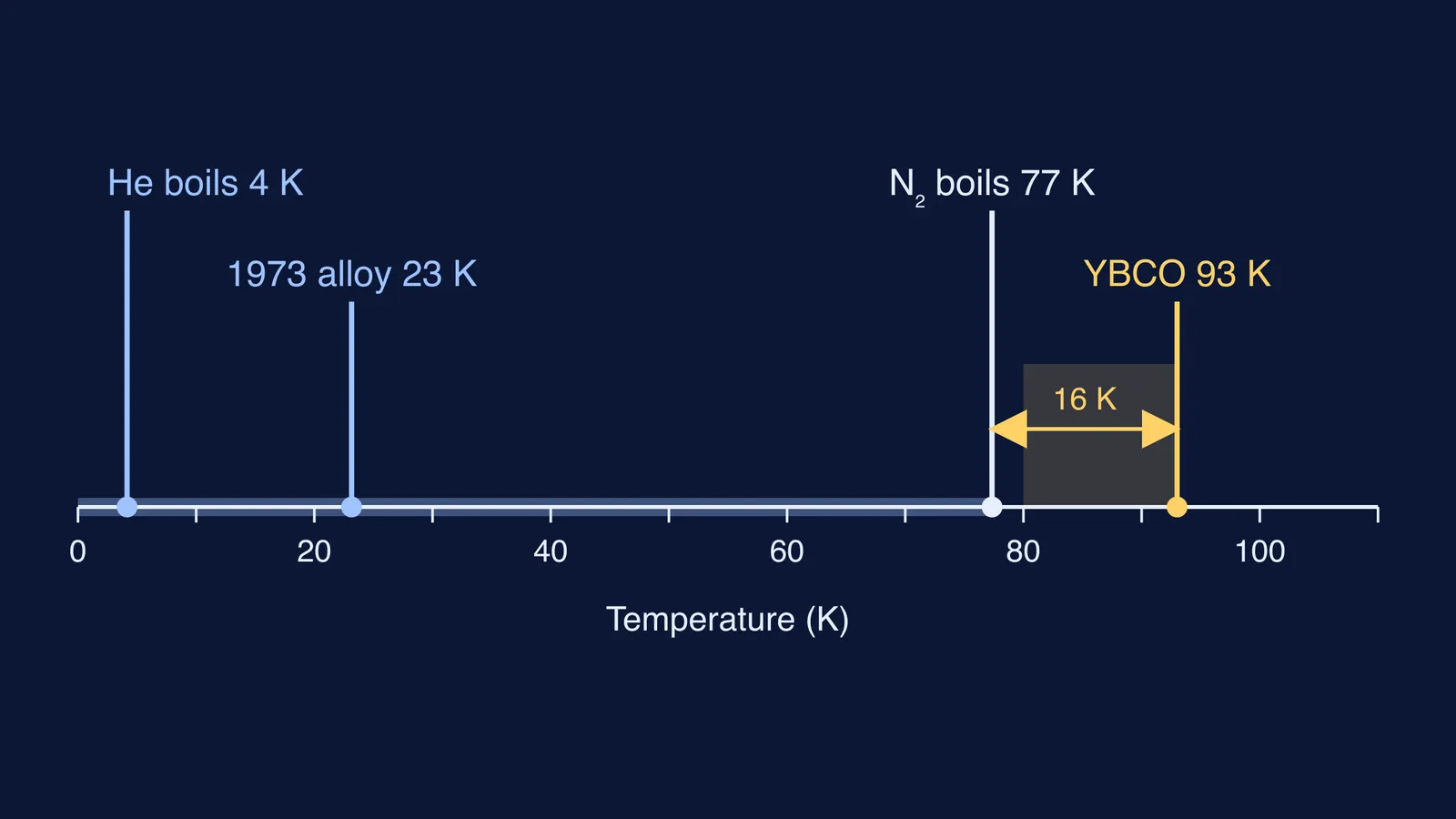
Liquid nitrogen boils at 77.34 K at normal pressure (NIST Chemistry WebBook). Liquid helium boils at −269 °C, about 4 K, and the 1987 Nobel Prize press release calls handling it "complicated and expensive". The same release says that, in spite of small advances, nothing had happened since 1973, when an alloy was made that superconducted at −250 °C, about 23 K. That is far too cold for liquid nitrogen.
The superconductivity story starts with Heike Kamerlingh Onnes and mercury in 1911. For 75 years the field stayed close to absolute zero, until Bednorz and Müller's copper-oxide ceramic in 1986 showed that copper oxides were worth exploring. YBCO was the first material to superconduct above liquid nitrogen's boiling point, according to the IEEE Milestone plaque at the University of Houston.
How can you check the 93 K claim yourself?
Here is the reasoning in four steps.
Put everything in kelvin. To go from °C to K, add 273.15. Using the Nobel press release figures, helium: −269 + 273.15 ≈ 4 K. The 1973 alloy: −250 + 273.15 ≈ 23 K.
Compare each one with the coolant. Liquid nitrogen sits at 77.34 K (NIST). A material only works in a nitrogen bath if it is still superconducting at 77 K, so the 23 K alloy fails and YBCO passes.
Work out the safety margin. 93 − 77.34 ≈ 16 K. Even the low end of the reported range, 80 K, is above 77 K, so the whole transition happens above the nitrogen bath's temperature.
Separate "onset" from "zero". In Ashburn's account, the first mixed sample's resistivity began to fall just below 90 K but did not reach zero until near 50 K. The published paper reports the whole transition between 80 and 93 K.
It is easy to blur step 4. When you read "superconducts at X K", ask whether X is where the resistance starts to fall or where it reaches zero. You can use the same test on any claim: convert to kelvin and subtract 77. If the answer is positive, liquid nitrogen can do the cooling.
What happened after the YBCO discovery?
Things moved quickly. The Nobel press release says that in the first few months of 1987, laboratories in the United States, China, Japan and Europe reached transition temperatures more than 90 degrees above absolute zero (Nobel press release). The same release calls liquid nitrogen "considerably cheaper, more efficient and easily-handled" than liquid helium.
Chu received the US National Medal of Science in 1988. The IEEE dedicated its milestone plaque on 17 November 2014, and its record notes that Chu's group reached a critical temperature of 164 K in a mercury-based copper oxide under pressure (IEEE Milestone record).
Zero resistance is only half the story. The other half is expelling magnetic fields; see our explainer on why a superconductor is a perfect diamagnet.
What should students take from Chu's 93 K result?
This story teaches two habits for physics and chemistry: convert to kelvin before you compare temperatures, and read a claim closely to see how it was measured and which temperature is being quoted.
If the kelvin scale, critical temperature or the Meissner effect still feels hazy, the Fermi Concept Library gives every concept in physics and chemistry its own lesson and shows where it sits in the map. For numerical practice, the Fermi Problem Library has worked problems with a step-by-step solver that explains the reasoning rather than printing an answer.


