

On this page
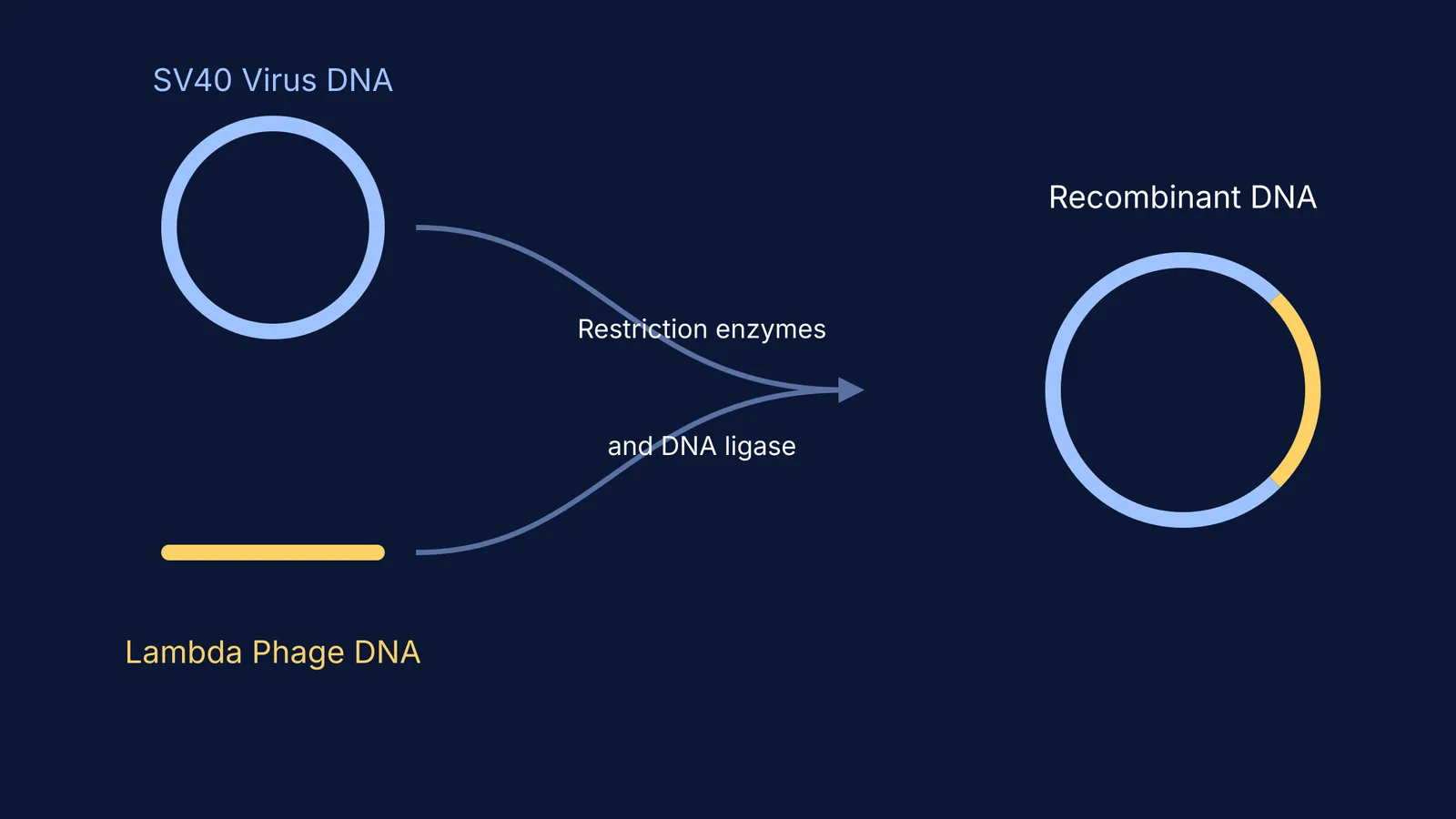
In 1972, Stanford biochemist Paul Berg performed an experiment that shaped modern biology. He took DNA from a monkey virus, cut it open, and spliced it together with DNA from a virus that infects *E. coli* bacteria.
This was the world's first recombinant DNA molecule. It proved that genes from entirely different species could be cut, mixed and stitched back together in a test tube.
However, Berg's breakthrough immediately raised a terrifying question. If this hybrid virus were placed inside *E. coli* — a bacterium that lives in the human intestine — could it escape the lab and spread cancer-causing genes to the public?
What Berg did next was just as significant as his experiment: he paused his own work and rallied scientists worldwide to do the same, leading to the 1975 Asilomar Conference.
How did Paul Berg make the first recombinant DNA?
Berg and his colleagues, David Jackson and Robert Symons, published their method in the *Proceedings of the National Academy of Sciences* in 1972 1. They wanted to see if the simian virus 40 (SV40) could act as a vehicle to carry foreign genes into mammalian cells.
To create the hybrid molecule, they relied on a series of specific proteins:
Restriction enzymes: They used a restriction enzyme to slice open the circular SV40 DNA at one specific location.
Terminal transferase: They added "sticky ends" (short tails of repeating nucleotides) to the ends of the cut SV40 DNA and the foreign lambda phage DNA.
DNA ligase: The matching sticky ends found each other and bonded, and the enzyme DNA ligase permanently sealed the joins.
The result was a single, closed loop of DNA containing genes from both viruses. This work in genetic engineering earned Paul Berg the 1980 Nobel Prize in Chemistry. (For more on genetic tools, read about The Ti plasmid of Agrobacterium tumefaciens as a vector, or test yourself on Assertion-reason traps on replication, genetic code and operons).
If you are studying genetics for your exams, keeping track of how ligases, polymerases and restriction enzymes work together can be difficult. Fermi Concept Library holds a map of every concept in biology. If you are stuck on a topic, Fermi's AI tutor can work out what you already know and build a plan for the session.
Why was the 1975 Asilomar Conference important?
To resolve the moratorium, Berg helped organise the Asilomar Conference on Recombinant DNA in California in February 1975. It gathered a group of molecular biologists, lawyers and journalists to debate the safety of genetic manipulation.
The conference concluded that research should proceed, but under strict, newly defined rules 3. They introduced two major safety strategies that remain the standard today:
Physical containment: Using specialised laboratory equipment, negative pressure rooms and filtered ventilation to ensure genetically modified organisms cannot escape.
Biological containment: Designing and using "crippled" strains of bacteria and vectors that have been genetically altered so they can only survive in the artificial conditions of the lab, dying instantly if they reach the outside world.
How can we ensure scientific research is safe?
Berg's decision to pause his research was a defining moment of scientific responsibility. When you are planning a science fair project or engineering a new software tool, you can apply a similar ethical framework to your work:
What is the worst-case scenario? Ask yourself what could happen if your experiment goes wrong, or if your tool is misused by someone else.
Is there a way to contain it? Decide how you will isolate your work. Can you run your code in a sandbox, or perform your biology experiment in a closed system?
Should we pause and ask others? If you are unsure about the safety of your project, stop. Discuss the risks with a teacher, a mentor, or an ethics board before moving forward.
Science does not happen in a vacuum. The Asilomar Conference proved that researchers can regulate themselves, balancing the drive for discovery with a profound duty to public safety.


