On this page
Most rules about spread assume the data is roughly bell-shaped. Chebyshev's inequality assumes nothing. Give it any list of numbers with a mean and a standard deviation, however lopsided, and it tells you the most that can lie far from the middle.
Who was Pafnuty Chebyshev?
Pafnuty Lvovich Chebyshev was born on 16 May 1821 in Okatovo, in Russia's Kaluga region, and died on 8 December 1894 in St Petersburg, according to the MacTutor History of Mathematics biography. His 1846 master's thesis was on probability theory, and the paper he published from it examined Poisson's weak law of large numbers. The same biography records that in 1850 he proved Bertrand's conjecture (that there is always at least one prime between n and 2n for n > 3), and that his 1854 work on mechanisms introduced Chebyshev polynomials.
What exactly did Chebyshev prove in 1867?
The inequality appears in a short paper, "Des valeurs moyennes" ("On mean values"), printed in Liouville's *Journal de mathématiques pures et appliquées*, 2nd series, volume 12 (1867), pages 177–184 (Numdam record of the paper). An English translation by Richard Pulskamp notes it was read on 17 December 1866.
Chebyshev stated it for a sum of random quantities x + y + z + ...: the probability that the sum stays within its expected value plus or minus α times its standard deviation "will be always greater than 1 − 1/α², whatever be α" (Pulskamp's translation). In today's notation, with mean μ and standard deviation σ, P(|X − μ| ≥ kσ) ≤ 1/k².
Why is it also called the Bienaymé–Chebyshev inequality?
The French mathematician Irénée-Jules Bienaymé (1796–1878) had already derived the inequality in an 1853 paper supporting Laplace's discovery about probability in the method of least squares, according to his MacTutor biography. The two were friends, first meeting in October 1852. When Chebyshev's paper came out in French, the editor reprinted Bienaymé's 1853 paper immediately before it, in the same volume at pages 158–176 (Numdam record of Bienaymé's paper).
The MacTutor Chebyshev biography says Chebyshev used the inequality to prove a generalised law of large numbers, the reason averages settle down over many trials, as in our post on 10,000 simulated coin tosses.
Why does the 1/k² rule work for every distribution?
The proof needs only the definition of variance: for n numbers with mean μ, the average squared distance from μ is σ² (refresher: our dot-plot guide to standard deviation).
Suppose a fraction f of the values lie at least kσ from the mean.
Each of those values adds at least k²σ² to the sum of squared distances.
Every other value adds at least 0, so the average squared distance is at least f × k²σ².
That average is σ², so σ² ≥ f k²σ², which gives f ≤ 1/k².
The bound cannot be improved in general. Put 1/8 of the data at μ − 2σ, 1/8 at μ + 2σ and the remaining 3/4 exactly at μ. The variance works out to exactly σ², and exactly a quarter of the data sits 2σ away: the limit is reached.
How tight is Chebyshev's bound compared with the bell curve?
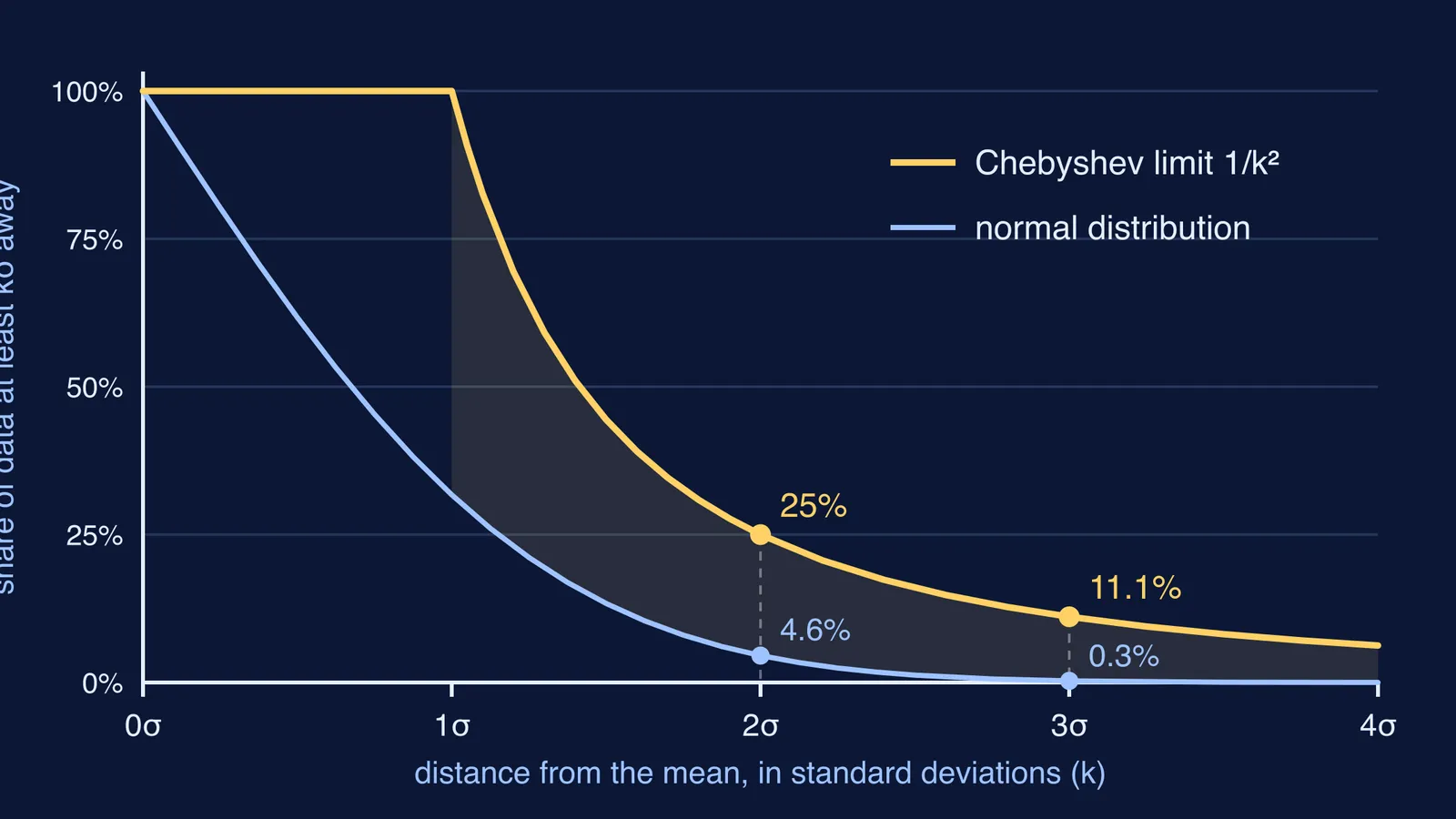
For a normal distribution, 95.45% of values fall within 2σ of the mean and 99.73% within 3σ, according to the NIST/SEMATECH e-Handbook of Statistical Methods. Chebyshev promises only 75% and 88.9%. That gap is the price of assuming nothing about shape. If your data is close to normal (see how mean and standard deviation change the normal curve), use the normal table; if it is skewed, has outliers or you don't know, Chebyshev still holds. For k of 1 or less it says nothing, because 1/k² is then at least 1.
How do you use Chebyshev's inequality on real marks?
A made-up class test: 40 students, mean 62, standard deviation 9, shape of the marks unknown.
How many students could have scored 35 or less, or 89 or more? Both are 27 marks from 62, and 27 ÷ 9 = 3, so k = 3. At most 1/9 of 40, which is 4.4, so at most 4 students.
At least how many scored strictly between 44 and 80? Those are 18 marks, or 2σ, either side. At most 1/4 can be 2σ or more away, so at least three quarters of 40, which is 30 students, are strictly inside.
The routine:
Find the distance from the mean.
Divide by σ to get k.
1/k² is the largest possible fraction that far out or further.
Multiply by the class size and round down.
Most slips come from mixing up "at most beyond" with "at least within". If that is where you get stuck, the Fermi Problem Library has worked problems with a step-by-step solver that explains the reasoning rather than printing an answer, and the Fermi Concept Library gives every concept in mathematics its own lesson.
Try it on your last test: compare how many marks Chebyshev allows beyond 2σ with how many there really were.