On this page
Otto Wallach (1847–1931) was a German chemist who won the 1910 Nobel Prize in Chemistry "in recognition of his services to organic chemistry and the chemical industry by his pioneer work in the field of alicyclic compounds". Put simply, he worked out what was really in the fragrant, confusing liquids chemists got from plants.
Who was Otto Wallach, and how did he start on essential oils?
According to his Nobel Prize biography, Wallach earned his Göttingen doctorate in 1869 after only five semesters. In 1870 he joined August Kekulé in Bonn, the chemist behind the ring structure of benzene. He returned to Bonn in 1872 and stayed there for 19 years.
His big project started almost by accident. The same biography says Kekulé drew his attention to "an old forgotten cupboard full of bottles containing essential oils" and invited him to study the contents. It became his main life's work.
Oils from many plants contained hydrocarbons with the same formula, C10H16. In Wallach's first paper, in 1884, they still went by a crowd of names "ranging from terpene to camphene, citrene, carvene, cinene, cajuputene, eucalyptine, hesperidine" (Nobel biography).
Using common reagents such as hydrogen chloride and hydrogen bromide, he characterised how their structures differed. A year later he could show that many of the "different" compounds were in fact identical. In 1889 he moved to Göttingen to take the chair Wöhler had once held, and in 1909 he gathered his results in *Terpene und Campher*, a 600-page book. The biography notes that, like Emil Fischer and Adolf von Baeyer, he "relied more on carefully performed experiments than on theoretical deliberations".
What is the isoprene rule for terpenes?
Isoprene is 2-methylbuta-1,3-diene, C5H8 (PubChem).
Terpenes are a large class of natural products with the general formula (C5H8)n, where n is 2 or more (Wikipedia: Terpene).
The isoprene rule says that a terpene's carbon skeleton can be cut into five-carbon isoprene units. Otto Wallach was the first to recognise this (Wikipedia: Isoprenregel). Later, chemists found natural products such as lanosterol that did not fit the simple version. So in 1953 Leopold Ružička restated it as the "biogenetic isoprene rule" (Ruzicka, Experientia, 1953).
A 2019 review in the Journal of Endocrinology sums up that rule: terpenoids are made when enzymes cyclise chains of C5 isoprene units joined head-to-tail. The number of units decides the class: 2 units make a monoterpene, 3 a sesquiterpene, 4 a diterpene, and for triterpenes 6 units combine into the C30 compound squalene. Natural rubber, from latex tapped from rubber trees, is made of very long polyisoprene chains (Wikipedia: Isoprene).
How do you count isoprene units in a terpene?
Use this four-step check on any structure in a board, JEE Main or NEET-UG question. The unit counts follow the classes in the 2019 review.
Count the carbon atoms only. Ignore hydrogen and oxygen for now.
Divide by 5. 10 carbons means two units (mono-), 15 means three (sesqui-), 20 means four (di-), 30 means six (tri-).
Find the branches. Each isoprene unit is a four-carbon chain with a methyl group on its second carbon, so look for methyl groups and isopropyl-type ends.
Check hydrogens last. Rings, C=C bonds and oxygen groups all change the formula, so it need not be an exact multiple of C5H8.
Worked examples, with formulas from PubChem:
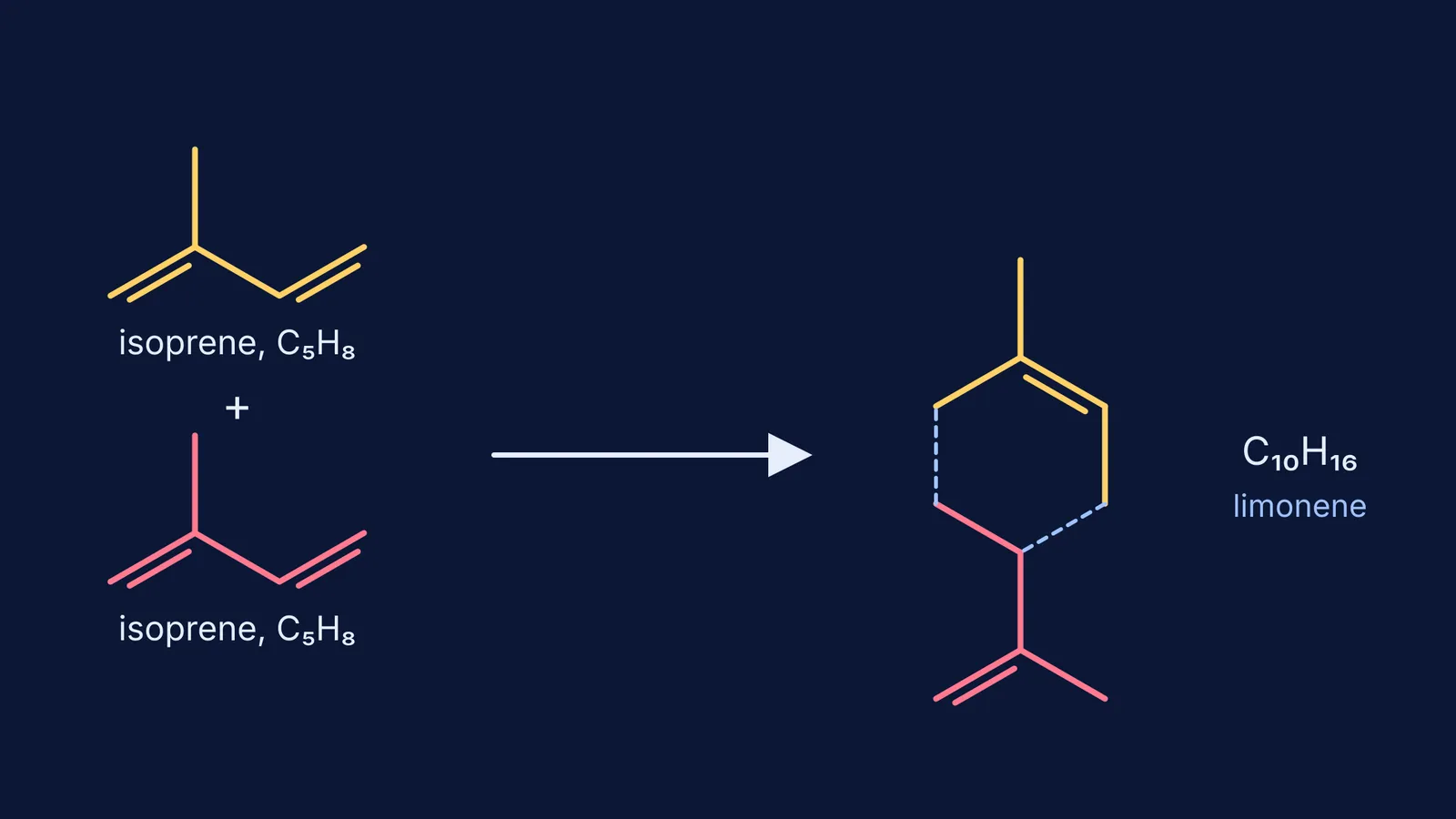
Limonene, C10H16: 10 ÷ 5 = 2 units, a monoterpene, exactly 2 × C5H8. One unit is the methyl-bearing ring carbon, its methyl and three more ring carbons; the other is the isopropenyl group plus the remaining two ring carbons (see the diagram above).
α-Pinene, C10H16: also 2 units and the same formula as limonene, but with two rings. This is the same-formula puzzle Wallach untangled.
Menthol, C10H20O: 10 carbons, so 2 units. It has a ring but no C=C double bonds, hence the extra hydrogens, and –OH adds the oxygen.
Camphor, C10H16O: 2 units with a ketone group.
Humulene, C15H24: 3 units, so it is a sesquiterpene.
Squalene, C30H50: 6 units, a triterpene. Six C5H8 units would give C30H48, which is why you count carbons, not the whole formula.
Why does Wallach's work still matter?
Limonene, menthol and pinene are terpene-family molecules that follow Wallach's pattern. If smell chemistry appeals to you, read our guide to a flavour and fragrance chemist career.
Wallach's habit is also worth copying: sort what you have first, notice when two names are really one thing, and only then look for the rule underneath.
If rings, branches and functional groups still blur together, the Fermi Concept Library gives every chemistry concept its own lesson and shows where it sits in the map. If you are stuck on a structure question, the Fermi Problem Library has worked problems with a step-by-step solver that explains the reasoning rather than printing an answer.
Next time you meet a terpene in a question, count the carbons and look for the isoprene units.