

On this page
On the evening of 23 March 1962, Neil Bartlett was working alone in the chemistry department at the University of British Columbia in Vancouver. That evening he mixed xenon with platinum hexafluoride and made the first compound of a noble gas, according to UBC Chemistry's account of the discovery. Bartlett was born in Newcastle-upon-Tyne on 15 September 1932, so he was 29 at the time (University of California memorial). His experiment rested on reasoning you can check with two numbers.
Why did chemists think noble gases were inert?
Helium, neon, argon, krypton, xenon and radon have filled outer shells, and that was widely taken as a sign that they could not bond. UBC Chemistry puts it plainly: until that day, "all chemistry textbooks were written with the fixed idea" that these elements were chemically inert. They were often simply called the inert gases.
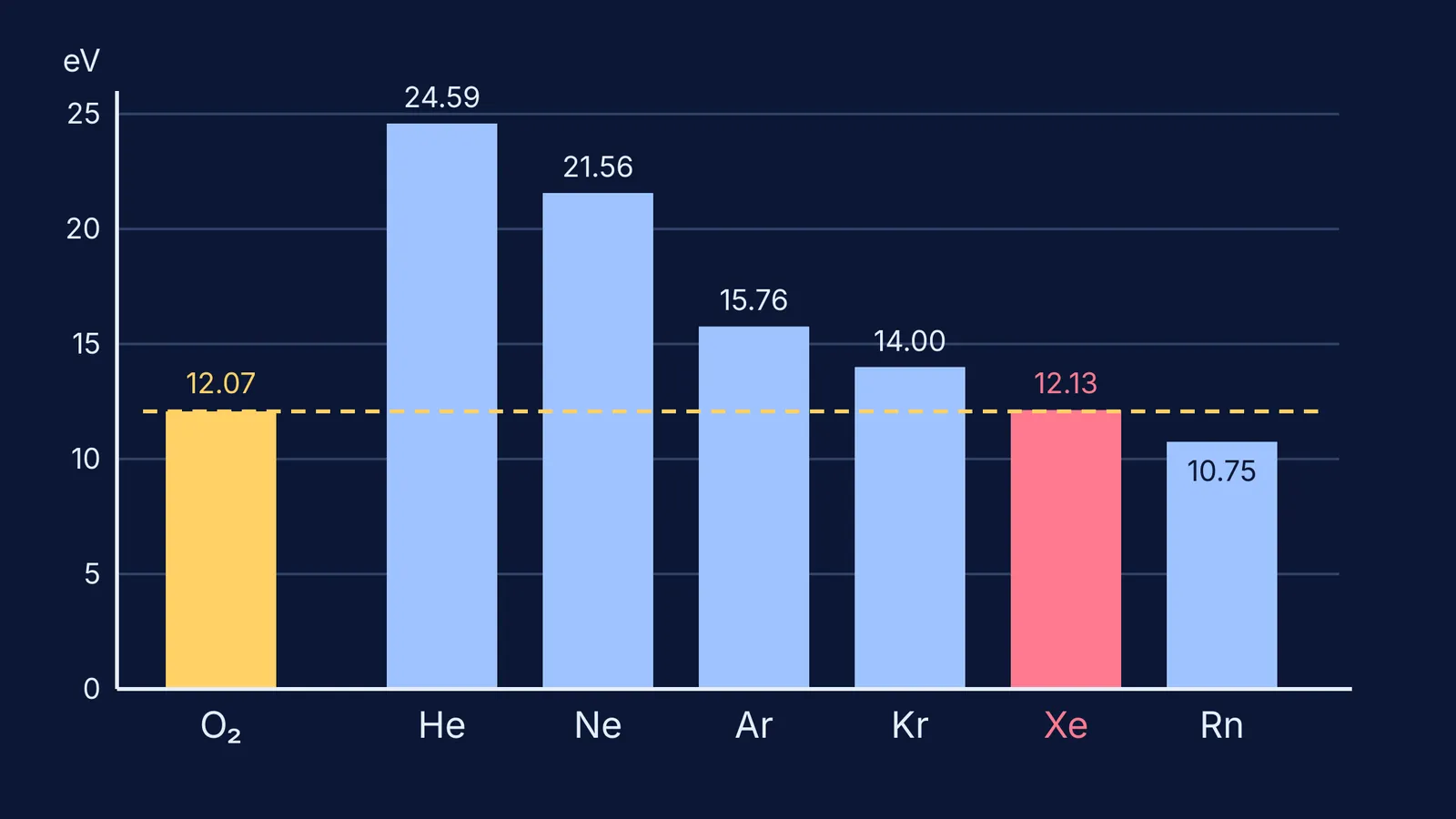
The numbers seemed to back this up. The first ionisation energy is the energy needed to remove one electron from a neutral atom in the gas phase. The NIST Atomic Spectra Database gives 24.59 eV for helium and 21.56 eV for neon, among the highest of any element. But the values fall steadily down the group: 15.76 eV for argon, 14.00 eV for krypton and 12.13 eV for xenon.
What clue did Bartlett find in oxygen?
Bartlett had been working with platinum hexafluoride, PtF6, a fierce oxidising agent. With D. H. Lohmann he reported in 1962 that PtF6 reacts with ordinary oxygen gas to give a salt, [dioxygenyl hexafluoroplatinate, O2+[PtF6]-](https://doi.org/10.1039/jr9620005253). In other words, PtF6 can remove an electron from an O2 molecule.
Then came the comparison. The NIST Chemistry WebBook lists the ionisation energy of the O2 molecule as 12.07 eV. Xenon's is 12.13 eV, a difference of 0.06 eV, or less than 1 per cent. Bartlett noticed that xenon's ionisation potential was close to oxygen's and predicted that PtF6 could oxidise xenon as it did O2, as his University of California memorial explains.
How did Bartlett make xenon react with PtF6?
He built a glass apparatus to mix colourless xenon gas with the red vapour of PtF6. Where the gas and the vapour met, in the words of the University of California memorial, "a bright yellow solid of composition XePtF6 formed". Bartlett wrote it up as a short note in the June 1962 issue of Proceedings of the Chemical Society, formulating the product as Xe+[PtF6]-.
The formula was not quite right. UBC Chemistry notes that the compound was later shown to be XeFPtF5, "but the outcome was unchanged": xenon had formed a chemical compound.
What happened after the first xenon compound?
Others moved fast. In September 1962, Howard Claassen, Henry Selig and John Malm reported xenon tetrafluoride, and the UC memorial notes that other workers soon showed noble gases can react directly with fluorine. A few weeks later, on 8 October 1962, Chemical and Engineering News ran the headline "Inert" Xenon Reacts with Fluorine. According to UBC Chemistry, textbooks had to be rewritten.
On 23 May 2006, the American Chemical Society and the Canadian Society for Chemistry named Bartlett's work an International Historic Chemical Landmark (UBC Chemistry). Bartlett joined the faculty at UC Berkeley in 1969 and died on 5 August 2008 (UC memorial). If you want to predict the shape of a xenon fluoride, that is where Gillespie and Nyholm's VSEPR theory comes in. For why xenon reacts but helium and neon still do not, see why xenon forms compounds but helium does not.
How can you reason like Bartlett in your own chemistry?
Bartlett's method works on any "will this react?" question. Try these four steps, using ionisation energies from the NIST Atomic Spectra Database and the NIST Chemistry WebBook:
Start from a reaction you know happens: PtF6 oxidises O2.
Name the property that made it possible: removing one electron, measured by the ionisation energy (12.07 eV for O2).
Look up the same property for your candidate: xenon, 12.13 eV.
Predict, then ask what else differs between the two cases before you trust the prediction.
Now test yourself with the NIST values. Krypton needs 14.00 eV, about 1.9 eV more than O2, so the oxygen comparison gives you little reason to expect PtF6 to oxidise it as easily. Radon needs only 10.75 eV, so the same argument says it should be easier to oxidise than xenon. The method gives you a prediction worth testing, not a proof. Bartlett still had to do the experiment.
If ionisation energy or oxidising agents still feel hazy, the Fermi Concept Library has a lesson for every concept in chemistry, each with its place in the map, so you can see what an idea depends on. To practise the reasoning, the Fermi Problem Library has worked problems with a step-by-step solver that explains the reasoning rather than printing an answer.


