

On this page
For decades, chemistry textbooks taught that the noble gases were completely unreactive. They were placed in Group 18, given the name "inert gases," and assumed to form no bonds because their outer electron shells were full.
Today, we know of dozens of compounds containing noble gases. Almost all of them feature xenon bonding with highly electronegative elements like fluorine and oxygen. But why does xenon react while helium and neon do not? The answer comes down to atomic size and the energy required to remove an electron.
Why were noble gases called inert gases?
Noble gases are exceptionally stable because they have a complete octet of valence electrons (or a duet, in the case of helium). Removing an electron from a stable noble gas requires a massive amount of energy, a property measured as the first ionisation enthalpy.
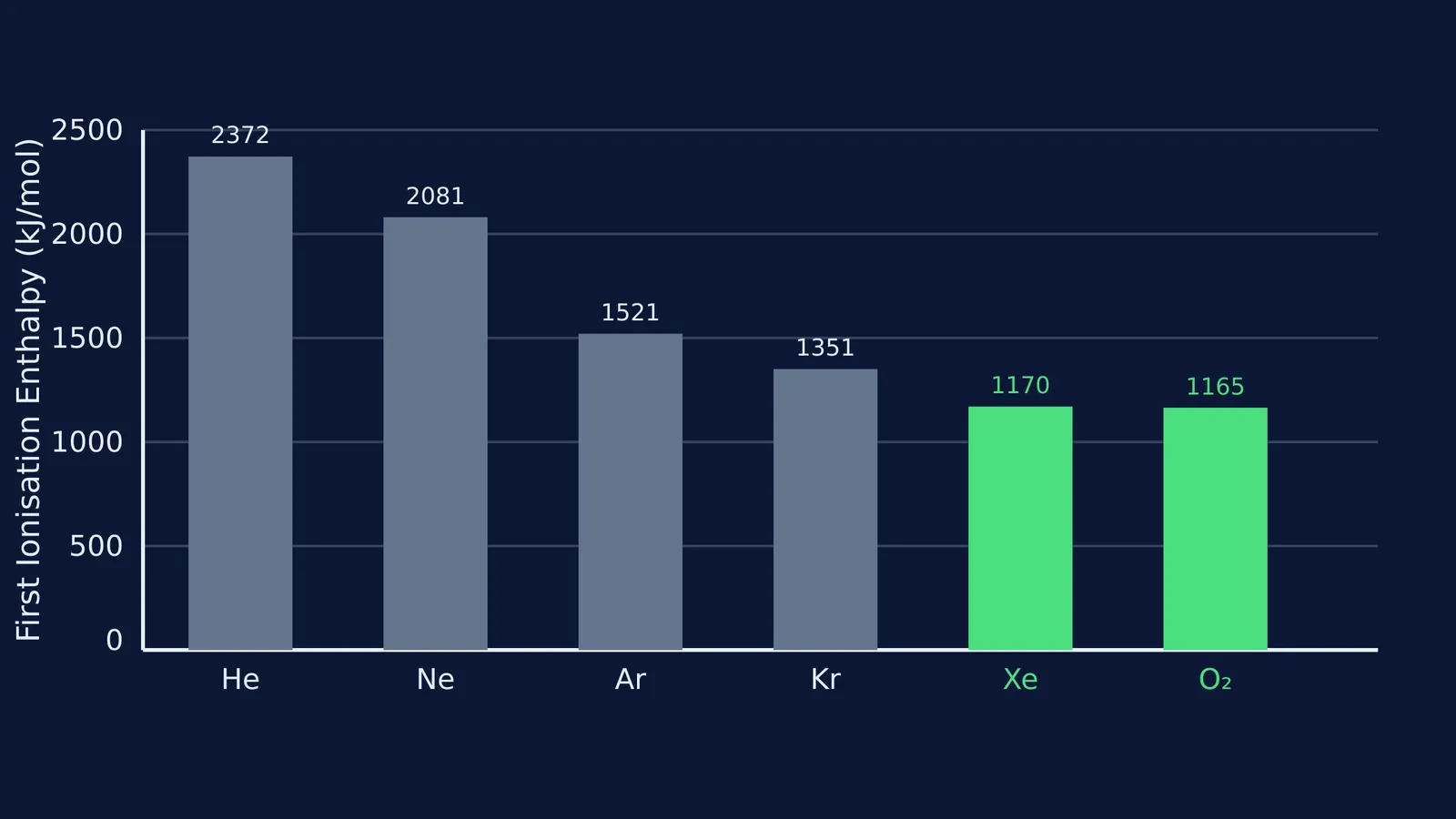
Helium has the highest first ionisation enthalpy of any element at 2372 kJ/mol (Wikipedia)). Neon follows closely at 2081 kJ/mol. Their outermost electrons are very close to the positive nucleus and experience almost no shielding from inner electron shells. Because they hold their electrons so tightly, they do not share or give them up to form chemical bonds, making them genuinely inert.
How did Neil Bartlett discover xenon compounds?
The breakthrough in noble gas chemistry came in 1962 from chemist Neil Bartlett. He had been experimenting with platinum hexafluoride (PtF₆), a very strong oxidising agent. Bartlett found that PtF₆ was powerful enough to strip an electron from molecular oxygen (O₂), forming a solid ionic compound.
This reaction caught his attention because the first ionisation enthalpy of O₂ is 1165 kJ/mol (Wikipedia). Bartlett realised that if PtF₆ could oxidise oxygen, it might also oxidise a noble gas with a similar ionisation enthalpy.
As you move down Group 18 of the periodic table, the atomic radius increases. The outermost electrons are placed in higher energy levels, further from the nucleus, and are shielded by more inner shells. This means the first ionisation enthalpy steadily drops. The first ionisation enthalpy of xenon is 1170 kJ/mol (Wikipedia)). The Fermi Concept Library maps out this trend, showing how the atomic size of Group 18 elements dictates their properties.
Why does xenon form compounds but helium and neon do not?
Bartlett tested his theory by mixing xenon gas with PtF₆. The two reacted immediately at room temperature, forming a mustard-yellow solid—the world's first noble gas compound.
Why did this work? Xenon's relatively low ionisation enthalpy of 1170 kJ/mol (Wikipedia)) makes it vulnerable to the most electronegative elements on the periodic table. Fluorine and oxygen pull strongly enough on electrons to force xenon to share them, resulting in stable molecules like xenon difluoride (XeF₂) and xenon trioxide (XeO₃).
Helium and neon simply hold their electrons too well. Even fluorine, the most powerful electron-withdrawing element, cannot overcome their massive ionisation enthalpies. Krypton, which sits just above xenon, has a higher ionisation enthalpy of 1351 kJ/mol (Wikipedia)); it forms a few compounds, like KrF₂, but they are highly unstable.
How do you predict noble gas reactivity?
If you are studying for JEE Main, JEE Advanced, or NEET-UG, questions often ask you to explain noble gas reactivity or predict which elements form compounds. Use this framework:
Check the ionisation enthalpy. Reactivity in Group 18 depends on the electron being far enough from the nucleus to be pulled away.
Identify the bonding partner. Noble gases only react with the most electronegative elements (fluorine and oxygen).
Compare the numbers. Remember that xenon (1170 kJ/mol) matches oxygen (1165 kJ/mol). Krypton (1351 kJ/mol) is borderline, and argon (1521 kJ/mol), neon (2081 kJ/mol), and helium (2372 kJ/mol) are too tightly bound to react (Wikipedia)).
When you draw the electron dot structures for xenon compounds, you will notice that xenon expands its octet, using empty d-orbitals to hold the extra electrons. If you get stuck balancing these structures, the Fermi Problem Library has a step-by-step solver that explains the reasoning for predicting molecular geometries.


