

On this page
In the 1970s, India was focused on high-cost aquaculture methods such as shrimp farming, according to the Sunhak Peace Prize citation for Gupta. Modadugu Vijay Gupta asked a different question: what can a family with a muddy pond and almost no money grow? His answers spread from India to Bangladesh, Laos and other countries, and in 2005 they won him the World Food Prize.
Who is Modadugu Vijay Gupta?
Gupta was born on 17 August 1939 and worked at the Indian Council of Agricultural Research from 1962 to 1977, then as a fish breeding expert for the UN-ESCAP Mekong Secretariat from 1977 to 1981, as the Sunhak Peace Prize laureate page records. His hometown is Bapatla in Andhra Pradesh, and he retired as Assistant Director General of WorldFish, a fisheries research institute based in Penang, Malaysia, The Tribune reported when his prize was announced.
The $250,000 World Food Prize was presented to him on 13 October 2005, according to WorldFish. In 2015 he and Kiribati's president Anote Tong were named the two inaugural Sunhak Peace Prize laureates, and in January 2023 the Government of India named him for the Padma Shri, Deccan Chronicle reported.
How did Gupta spread low-cost fish farming?
He started from what poor families already had. Four ideas did most of the work.
Use water that is already there. Gupta's work helped turn over a million abandoned pools, roadside ditches and seasonally flooded fields into mini fish farms, says WorldFish.
Pick fish that suit the water. He identified species such as tilapia and silver barb that could thrive in the turbid, shallow waters of Bangladesh, notes the Sunhak citation.
Stock a mix, not one species. Polyculture means culturing a diversified mix of fish species in one pond, and he paired it with methods that use agricultural wastes and by-products, the same citation says.
Teach the people who will do the work. He spread these methods to South and Southeast Asian women who held low social status, which raised household incomes and improved nutrition, the citation adds.
The results were large. Bangladesh's annual fish production was about 170,000 tons in 1986, when the research started, and had soared to about 850,000 tons by the time he retired in 2004, according to the Sunhak Peace Prize. Freshwater fish production rose three to five times in Bangladesh, Laos and other Southeast Asian countries, says WorldFish.
Gupta summed up his approach in the same WorldFish press release: "Science must take into consideration the socio-economic fabric and needs of the societies for whom the research is meant."
Why does mixing fish species in one pond work?
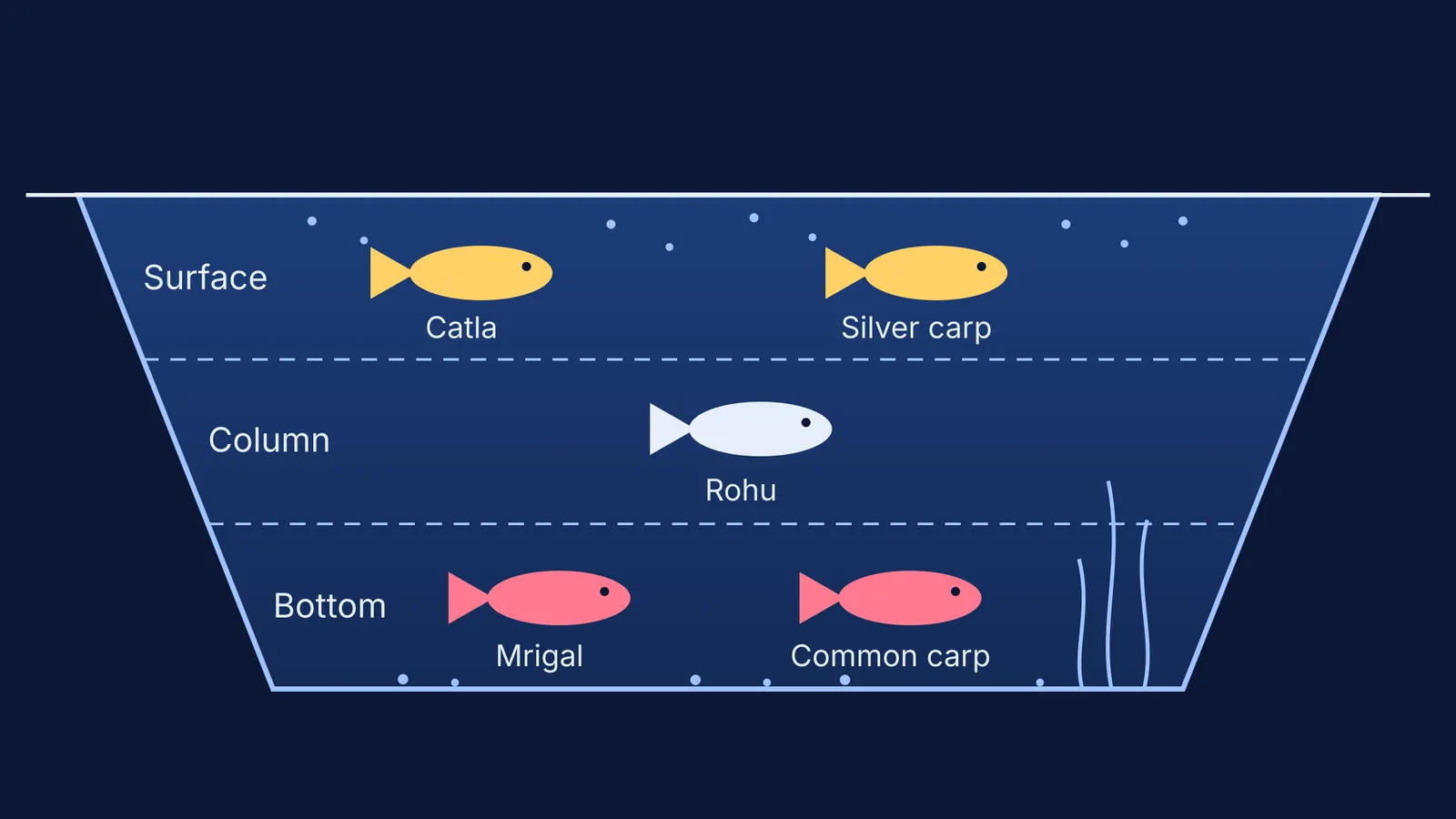
A pond is not one habitat but several stacked on top of each other. An FAO extension manual on fish culture in undrainable ponds describes the carps used in pond culture by where they live and what they eat:
Surface: catla inhabits the surface layer and feeds on plankton; silver carp is a surface dweller that becomes mainly a phytoplankton feeder.
Column: rohu occupies the column region and feeds mostly on vegetable matter, including higher plants and detritus.
Bottom: mrigal is a bottom feeder on algae, plant pieces, mud and detritus, and common carp is an omnivorous bottom dweller living on bottom animals and decaying plants.
The same manual adds grass carp, which starts on plankton and switches to grass, leaves and weeds as it grows. Ecologists call each species' way of living its niche. When species split the pond's food and space, they compete less, and more of what the pond produces ends up as fish. If you have read about Charles Elton's food chains and pyramid of numbers, this is the same logic applied to a farm.
Worked example: explaining composite fish culture in an exam
Suppose a Class 12 question asks why farmers stock catla, rohu and mrigal together. A strong answer has four parts.
Name the practice: composite fish culture, or polyculture, means several compatible species in one pond.
Give the layers: catla at the surface, rohu in the column, mrigal at the bottom.
Give the food: plankton, vegetable matter, and algae, mud and detritus.
State the reason: different niches mean less competition, so the pond's food is used more fully.
Now test yourself: what happens if a farmer stocks only catla? Surface plankton is eaten hard while bottom detritus goes unused. If niche or food chain still feels shaky, the Fermi Concept Library has a lesson for every concept in biology, each placed on its map, so you can see what it builds on.
What can students learn from Gupta's approach?
Gupta's science worked because it fit the water, the money and the people. Ask the same of any project:
Who will use this, and what do they already have?
What is the cheapest version that still works?
Who needs to learn it, and how will they learn it?
Other Indian food scientists asked the same questions. Read how M. S. Swaminathan shaped India's Green Revolution and how Verghese Kurien built the science behind Operation Flood, then compare their methods with Gupta's.


