

On this page
Show a physics student a block on a ramp and they often think "inclined plane problem". Show a physicist the same block and they think "energy" or "Newton's second law", depending on what is asked. That gap between what a problem looks like and what solves it is a classic finding in learning science.
What did Michelene Chi's 1981 study find?
In 1981 Michelene Chi, with Paul Feltovich and Robert Glaser, published "Categorization and Representation of Physics Problems by Experts and Novices" in the journal Cognitive Science. They asked people to sort mechanics problems into groups by similarity of solution.
The paper's abstract states the result plainly: experts "initially abstract physics principles" to approach a problem, whereas novices base their approach "on the problem's literal features" (Chi, Feltovich and Glaser, 1981).
The novices were eight introductory physics students from calculus-based courses, and the eight experts were physics graduate students (Mason and Singh, 2014).
How do experts and novices sort physics problems differently?
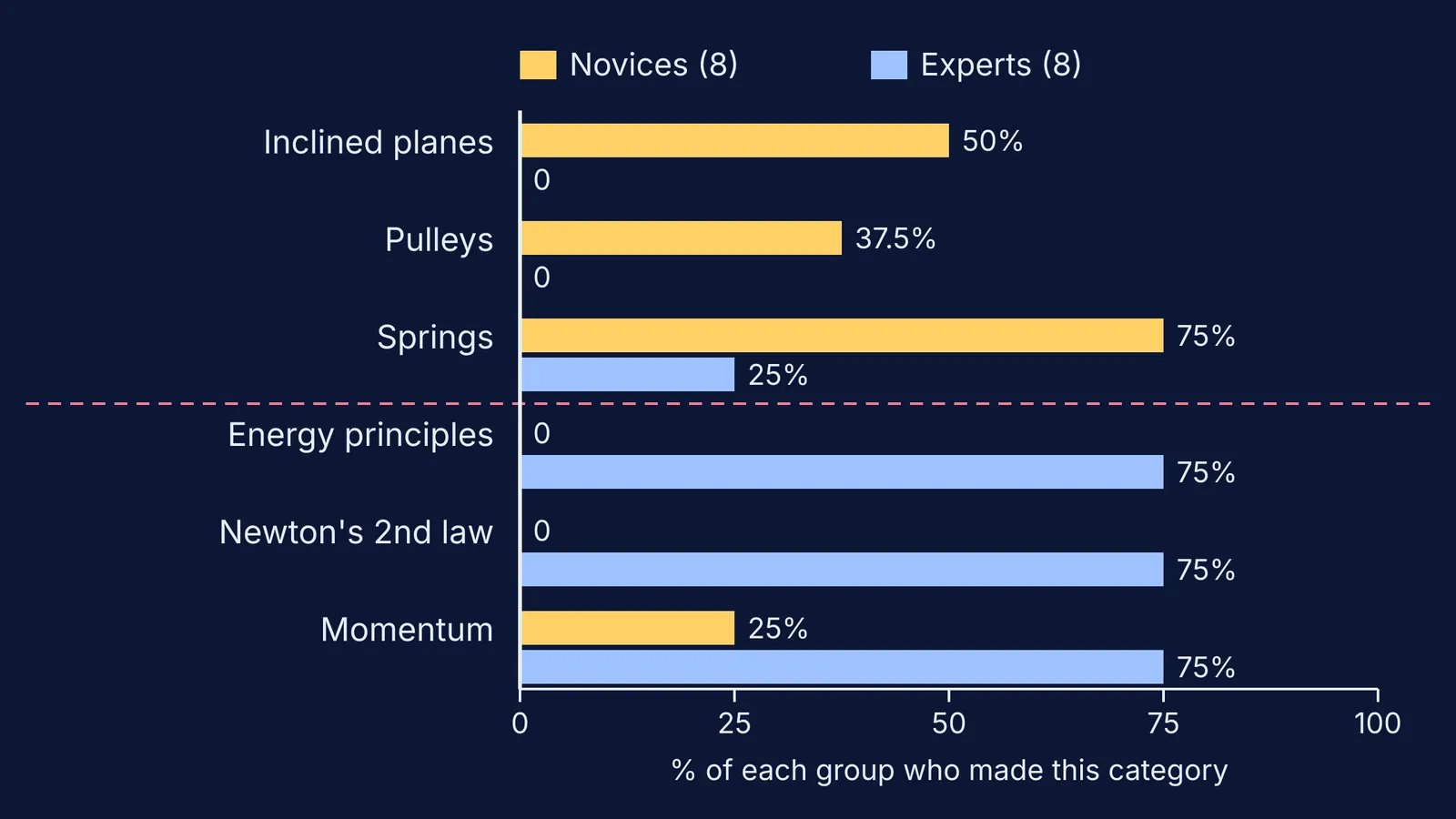
Novices sorted by the objects in the picture. In the 1981 data, as tabulated by Mason and Singh, 50% of the novices made an "inclined planes" group, 37.5% made a "pulleys" group and 75% made a "springs" group.
Experts sorted by the law that does the work. In the same table, 75% of the experts made a group for energy principles, 75% made one for Newton's second law, and 75% made one for momentum principles.
None of the eight novices made an expert-style group such as Newton's second law or energy principles at all, the replication notes (Mason and Singh, 2014).
Did later studies find the same thing?
Partly. Andrew Mason and Chandralekha Singh gave a similar sorting task to three large introductory classes of 109, 114 and 180 students (Mason and Singh, 2014). Among the 109 students who sorted a set including seven of Chi's original problems, 42% made an energy-principles group across all the problems, and only 24% made an inclined-plane group, against 50% of Chi's novices.
They concluded that it is not right to call every introductory student a novice: expertise is spread more widely than the 1981 study suggested. For the same idea outside physics, read how Adriaan de Groot studied what chess masters see.
How can you learn to sort problems by principle?
Here is a worked example. Three problems, two of which look alike:
A block slides from rest down a frictionless ramp 5 m high. How fast is it moving at the bottom?
The same ramp is inclined at 30°. How long does the block take to reach the bottom?
A spring with k = 200 N/m is compressed 0.1 m and launches a 0.05 kg ball straight up. How high does it go?
A surface sort puts 1 and 2 together ("ramp") and 3 on its own ("spring"). A principle sort does the opposite.
Problem 1 asks for a speed at a position, so it is energy: mgh = ½mv², so v = √(2 × 9.8 × 5) ≈ 9.9 m/s. The angle never matters.
Problem 3 is also energy: ½kx² = ½ × 200 × 0.1² = 1 J, and 1 J = mgh gives h = 1 ÷ (0.05 × 9.8) ≈ 2.0 m.
Problem 2 asks for time, which energy alone cannot give you. It needs Newton's second law: a = g sin 30° = 4.9 m/s², the ramp is 5 ÷ sin 30° = 10 m long, so t = √(2 × 10 ÷ 4.9) ≈ 2.0 s.
The question being asked (speed at a point, or time) decides the principle, not the ramp. Our guide to the energy conservation method for physics problems goes further on spotting energy problems.
A 15-minute sorting drill
Take 12 mixed problems from a chapter test or past JEE Main paper. Do not solve them.
Sort them into groups and write one line per group naming the principle: "energy, because it asks for speed at a height".
Banned group names: ramp, pulley, spring, car, ball. If you catch yourself using one, ask what law would solve it.
Check your groups against the worked solutions. Each mismatch shows what the question was really asking.
Repeat weekly with a new chapter mixed in.
For the solving step, our guide to solving physics problems step by step lays out a routine.
When a problem you sorted wrongly still puzzles you, the Fermi Problem Library has worked problems with a step-by-step solver that explains the reasoning rather than printing an answer, so you can follow the reasoning behind each step. If the principle itself is shaky, the Fermi Concept Library gives each concept in physics its own lesson.
Next time you open a problem set, sort first, then solve.


