On this page
Before surgeons could open a heart, someone had to solve a mechanical problem: how do you move blood outside the body without it leaking? One answer began as a student project in New Orleans, and you can work out its numbers with school maths.
Who was Michael DeBakey and what did he invent as a student?
Michael Ellis DeBakey was born on 7 September 1908 in Lake Charles, Louisiana, and died in 2008, according to a 2023 profile in the Journal of Medical Biography. The same profile says he did surgical research under surgeon Alton Ochsner while at Tulane's medical school, and that in Ochsner's lab he built a primitive roller pump from old pumps and rubber tubing. Its first job was blood transfusion.
The profile also notes that his mother taught him to sew. DeBakey is credited with developing Mobile Army Surgical Hospital (MASH) units and went on to research Dacron for repairing blood vessels, but the pump came first.
How does a roller pump work?
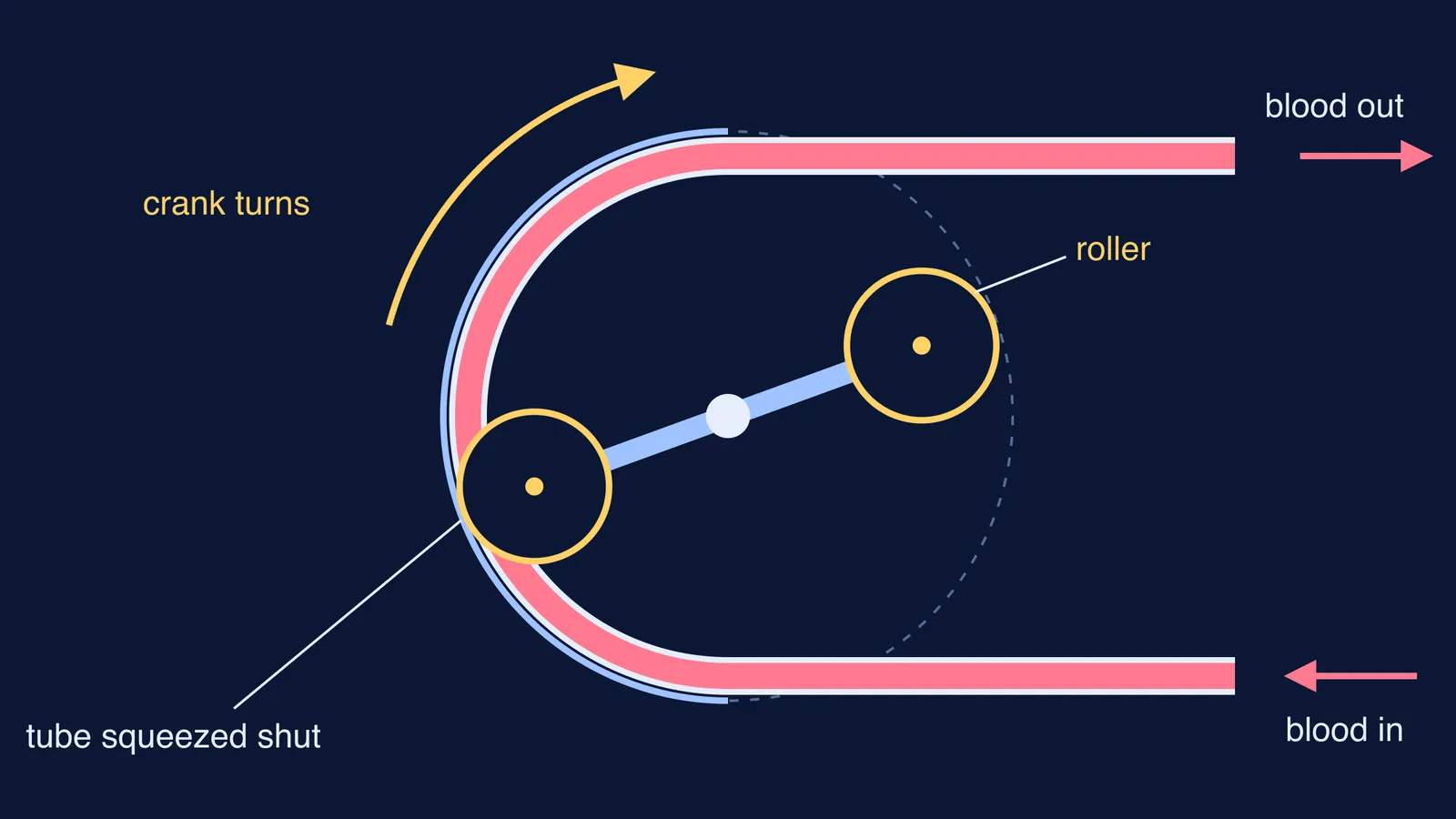
DeBakey published the design in December 1934 as "A simple continuous-flow blood transfusion instrument" in the New Orleans Medical and Surgical Journal (reprint held by the US National Library of Medicine). It describes a circular base, a rubber tube laid around about half of it, and a crank arm carrying two rollers. Turning the crank clockwise makes the rollers "successively compress the rubber tube, producing a 'milking' effect" that pushes the fluid forward.
Three features made it work:
The tube is pinched shut at a moving point. Blood ahead of the roller is pushed on; blood behind it is drawn in as the tube springs open.
Two rollers on opposite ends of the crank arm. Because the tube covers about half the circle, one roller arrives at the curved track as the other leaves it, so a roller is almost always pressing on the tube.
A flange on the tube. Earlier "milking-tube" devices suffered from the tube "creeping" along the track. DeBakey's tube had a built-in flange clamped in place, which stopped it moving.
Worked example: the numbers in DeBakey's 1934 paper
The 1934 paper lets you check the design yourself. The tube had a bore of 1/8 inch and was calibrated so that one full turn of the crank pumped 2 cc. DeBakey reports 100 transfusions of 250 cc to 850 cc each, with about three minutes on average to transfer 500 cc of blood.
Turns for a 500 cc transfusion: 500 ÷ 2 = 250 turns. The paper gives the same figure.
Cranking speed: 250 turns in about 3 minutes is roughly 83 turns a minute, a little more than one turn a second.
Flow rate: 500 cc ÷ 3 min ≈ 167 cc per minute.
Largest transfusion: 850 ÷ 2 = 425 turns, or about 5 minutes at the same pace.
A sanity check on the tube: a 1/8 inch bore is 0.3175 cm across, so its cross-section is π × (0.159 cm)² ≈ 0.079 cm². To hold 2 cc, about 2 ÷ 0.079 ≈ 25 cm of tube must be emptied each turn.
A pump that moves a fixed volume per turn turns flow rate into counting: flow = volume per cycle × cycles per minute. It is the same relation you use for the heart itself, as in our guide to calculating cardiac output, stroke volume and heart rate.
How did the roller pump end up in the heart-lung machine?
A heart-lung machine must add oxygen to the blood and pump it round the body while the heart is stopped. At Jefferson in Philadelphia, surgical residents and IBM engineers working with John Gibbon handled oxygen by running blood over mesh screens. For the pumping side, Jefferson's own magazine says, the team used the smooth-running roller pumps created by DeBakey.
On 6 May 1953, Gibbon used the machine to repair a hole between the upper chambers of the heart (an atrial septal defect) in Cecelia Bavolek, an 18-year-old college student, as Jefferson's account describes. You can read the full story in our post on John Gibbon and the heart-lung machine.
Roller pumps are still used. A US patent on roller pump design describes them as pumping "by positive displacement using revolving rollers that occlude flexible tubing", and says several are commonly used in the circuit that links a patient to a heart-lung machine. For an Indian chapter of the same engineering story, read about M. S. Valiathan and the Chitra heart valve.
What can a student learn from DeBakey's pump?
DeBakey started with one specific problem and, as his paper reports, tested the design on animals before using it on patients. You can practise the same habit on any device in your textbook:
Name the one job the device must do.
Find the quantity that repeats each cycle, such as 2 cc per turn.
Find how many cycles happen per second or per minute.
Multiply, then check the answer against a number you already trust.
If rate problems trip you up, the Fermi Problem Library has worked problems with a step-by-step solver that explains the reasoning rather than printing an answer.
Next time you see a pump, try the four steps on it.