On this page
In September 1935, the journal Physical Review published a three-page note by J. Robert Oppenheimer and Melba Phillips, "Note on the Transmutation Function for Deuterons" (Physical Review record of the paper). It explained the unexpected way accelerated deuterons reacted with other nuclei (University of Chicago Chronicle). Phillips had earned her PhD at Berkeley in 1933 as one of Oppenheimer's first doctoral students, and she went on to spend much of her career on how physics is taught (Physics Today obituary).
What is the Oppenheimer-Phillips process?
A deuteron is the nucleus of deuterium, or heavy hydrogen: one proton and one neutron bound together (see how Harold Urey found heavy hydrogen in a spectrum).
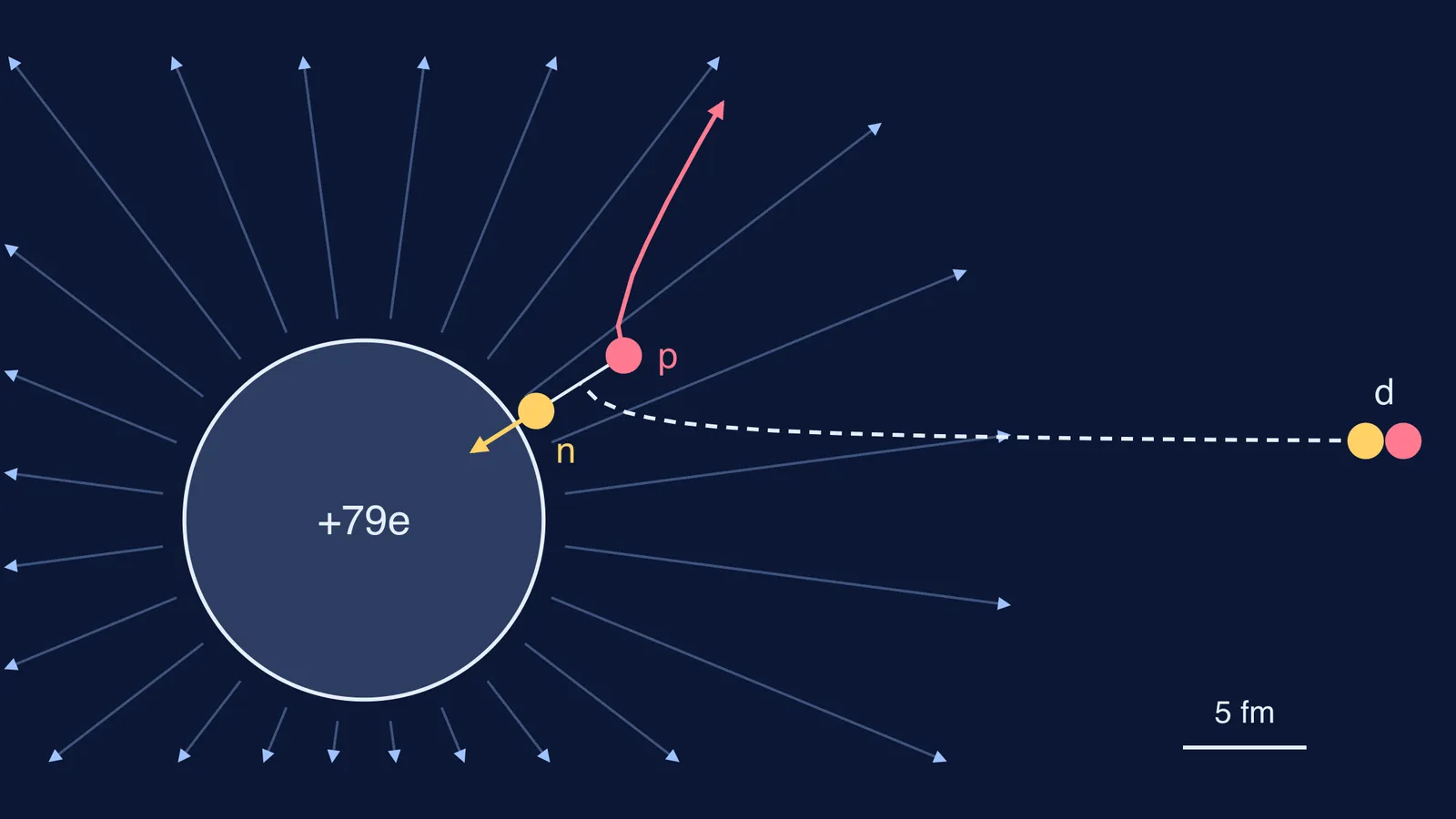
The Oppenheimer-Phillips process is a reaction in which the neutron of an energetic deuteron fuses with a target nucleus, turning it into a heavier isotope, while the proton is ejected (Oppenheimer-Phillips process, Wikipedia). It is also called a strip reaction.
Physics Today describes the mechanism as "polarization and dissociation of the deuteron in the nucleus field" and says the work "is considered one of the classics of early nuclear physics" (Physics Today).
Why does the deuteron give up its neutron?
Three facts make it work (Oppenheimer-Phillips process, Wikipedia):
The nucleus is positive, so it repels the deuteron's proton. The neutron has no charge and feels no electric push at all (see James Chadwick and the 1932 discovery of the neutron).
The deuteron is barely bound: its binding energy is only about 2.23 MeV (Deuterium, Wikipedia).
So the deuteron polarizes. Its proton end turns away from the target and its neutron end faces it, letting the neutron get close enough to be captured at energies lower than a simple Coulomb-barrier calculation predicts. Capture goes ahead when the neutron is bound more tightly to the new nucleus than it was in the deuteron; the proton is then repelled.
Compare how George Gamow explained alpha decay with quantum tunnelling, a different way past the electric wall around a nucleus.
How high is the Coulomb wall around a nucleus?
A nucleus with mass number A has a radius of roughly R = r0 A^(1/3), with r0 about 1.25 fm (Atomic nucleus, Wikipedia). From Coulomb's law, the energy of a charge +e at distance r (in femtometres) from a nucleus with Z protons is U = 1.44 Z / r MeV.
Gold (Z = 79, A = 197): R = 1.25 x 5.82, about 7.3 fm, so U at the surface is about 1.44 x 79 / 7.3 = 15.6 MeV.
Carbon-12 (Z = 6): R = 1.25 x 2.29, about 2.9 fm, so U is about 1.44 x 6 / 2.9 = 3.0 MeV.
The wall around gold is about seven times the 2.23 MeV holding the deuteron together (Deuterium, Wikipedia). Now balance the textbook example, carbon-12 turning into carbon-13: 12C + 2H gives 13C + 1H. Mass numbers: 12 + 2 = 13 + 1. Charges: 6 + 1 = 6 + 1. Physicists write it as 12C(d,p)13C.
How did Melba Phillips shape physics teaching?
Phillips taught at Brooklyn College from 1938 until 1952, when she lost that post and a part-time Columbia University job for refusing to testify before the US Senate's internal security subcommittee (Physics Today). The college publicly apologized in 1987 (AAPT memorial).
Out of a university job, she co-wrote Classical Electricity and Magnetism (1955) with Wolfgang Panofsky and Principles of Physical Science (1957) with Francis Bonner, both widely used in university physics (University of Chicago Chronicle). She joined a teacher-training institute at Washington University in 1957 and the University of Chicago faculty from 1962 to 1972, and developed training for physics teaching at all grade levels.
She became the first woman president of the American Association of Physics Teachers in 1966 and received its Oersted Medal in 1974 (Physics Today). The AAPT created the Melba Newell Phillips award in her honor, and she was its first recipient (AAPT memorial). Her former students remembered the teaching too (University of Chicago Chronicle).
How can you work through a nuclear reaction the way she did?
The 1935 explanation came from asking what each particle feels. Use the same habit on any nuclear reaction question:
Write every particle with its mass number A and charge Z.
Balance A and Z on both sides.
Mark which particles carry charge. Only they feel the Coulomb wall.
Estimate the wall with U = 1.44 Z / r MeV, as above.
Compare energies: is the neutron more tightly bound in the new nucleus than in the deuteron?
Sketch it: nucleus, field lines, and which end of the deuteron faces in.
For step 6, the Fermi Simulation Lab has interactive simulations for ideas that are easier to see than to read. For balancing and energy questions, the Fermi Problem Library has worked problems with a step-by-step solver that explains the reasoning rather than printing an answer.
Next time you balance a (d,p) reaction, picture the proton end turning away from the nucleus. That is the 1935 idea in one image.