

On this page
Doctors knew diabetic urine tasted sweet long before anyone proved it contained sugar. Ayurvedic texts, the Sushruta Samhita and Charaka Samhita, called the disease madhumeha, "honey urine", and the Oxford physician Thomas Willis linked sweet urine to diabetes in 1674, according to the Science History Institute. Willis called the sweetness "a knot not easie to untie", as quoted by the Royal College of Physicians of Edinburgh. About a century later, a Liverpool doctor, Matthew Dobson, began to untie it.
What did Matthew Dobson do in 1776?
Dobson was physician to the Liverpool Infirmary from 1770 to 1780. His five experiments on one diabetic patient appeared in 1776 in *Medical Observations and Inquiries*, and the text of all five was reprinted in Medical Science in 1963. In order:
He left the urine standing in an open vessel. It bubbled, gave off a vinous smell, then smelled of vinegar: it fermented like a sugary drink.
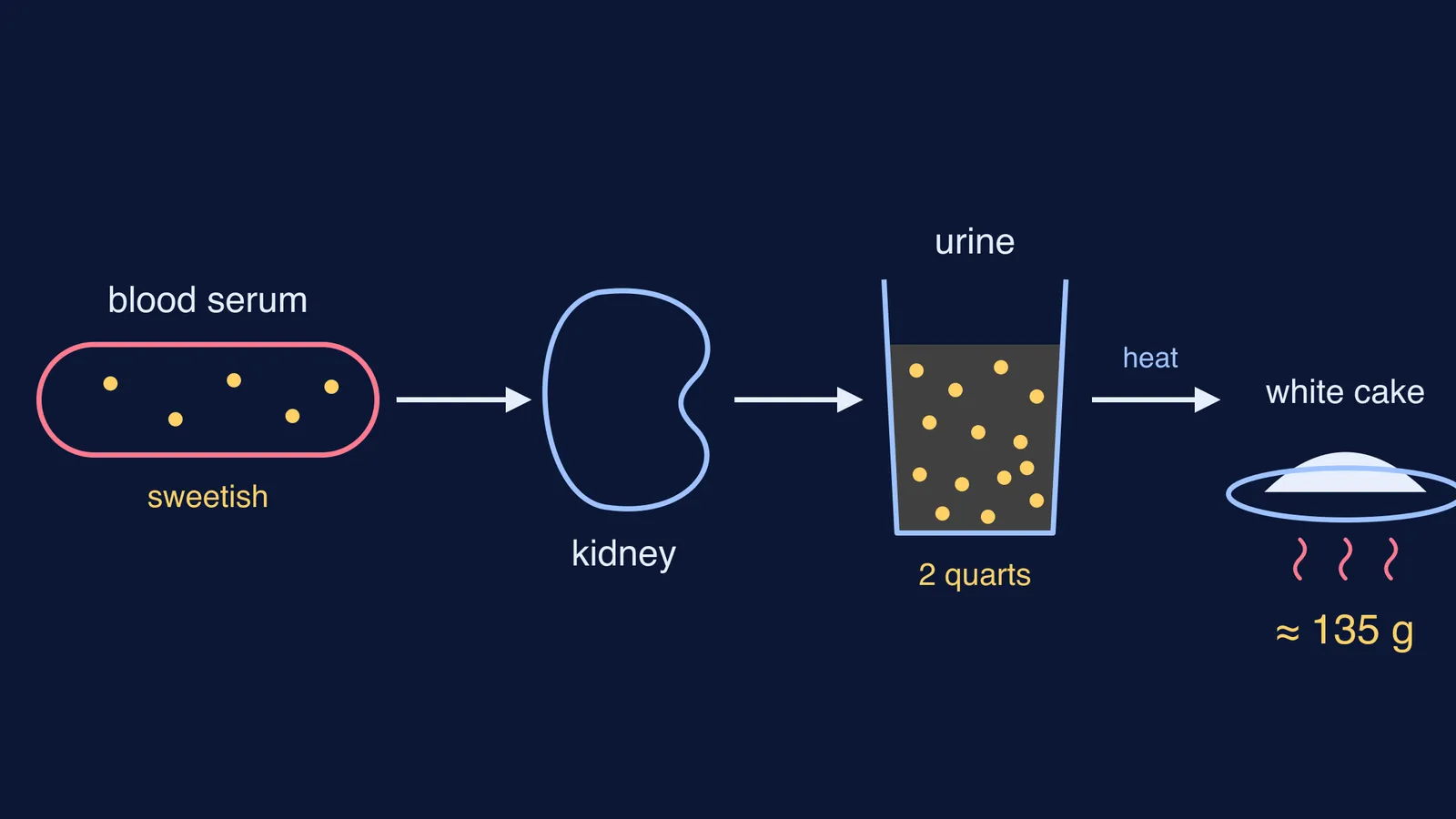
He took eight ounces of blood from the patient's arm. The serum was "sweetish, but I thought not so sweet as the urine".
He boiled the urine. It did not coagulate.
He added mineral acids. It still did not coagulate.
He evaporated two quarts of urine to dryness over a gentle heat. A white cake was left that "smelled like brown sugar, neither could it from the taste be distinguished from sugar".
The cake also had "no saltness", so it was not salt.
How did Dobson show sugar was in the blood too?
Experiment 2 was the turning point. If the serum was already sweet, the kidneys were not making the sugar. Dobson concluded that "this saccharine matter was not formed in the secretory organ, but previously existed in the serum of the blood", as reprinted in Medical Science. Until the 18th century, diabetes was generally assumed to be a disease of the kidneys, and David Haslam's history in Diabesity in Practice calls the sweet serum "the discovery of hyperglycaemia", or high blood sugar.
Today we know why sugar spills into urine: glucose appears in the urine when blood glucose rises above about 180 mg/dL, the renal threshold, according to a 2020 study in the Journal of Diabetes Investigation.
That question led to the pancreas, which you can follow in how Minkowski and von Mering linked the pancreas to diabetes in 1889.
How much sugar was in Dobson's white cake?
Dobson recorded the cake's weight in apothecaries' units, printed in the reprint as "℥ iv. ʒ ij and ℈ ij": 4 ounces, 2 drachms and 2 scruples. In the apothecaries' system, an ounce is 31.1 g, a drachm 3.89 g and a scruple 1.296 g.
Ounces: 4 × 31.1 g = 124.4 g
Drachms: 2 × 3.89 g = 7.8 g
Scruples: 2 × 1.296 g = 2.6 g
Total: about 135 g of residue
A quart is a quarter of a gallon, and 18th-century England used both a wine gallon of 3.785 L and an ale gallon of 4.621 L, according to the history of the gallon. So two quarts was roughly 1.9 to 2.3 litres, about 58 to 71 grams of residue per litre.
Now scale it up. Haslam's history says Dobson's patient Peter Dickonson passed 28 pints of urine in 24 hours: 14 quarts, seven times the sample. If the urine stayed that strong, that is close to a kilogram of residue a day. It is only a rough estimate, but it shows why Dobson said his idea "well explains its emaciating effects": food was leaving the body before it could nourish it.
What can you learn from Dobson's method?
Use Dobson's checklist on any experiment you plan or read:
Run more than one test. Fermentation, taste, smell and weight all pointed to sugar.
Rule out the alternatives. No saltness ruled out salt; no coagulation on heating suggested no protein. School labs still use heat for protein and Benedict's reagent for sugar, as in how to test urine for sugar and albumin.
Look upstream. He checked the blood, not just the urine.
Measure. A weighed cake turns "sweet" into a number.
If filtration and reabsorption in the nephron still feel abstract, the Fermi Concept Library covers every concept in biology and chemistry, each with its own lesson and its place in the map. For ideas that are easier to see than to read, the Fermi Simulation Lab has interactive simulations.
Diabetes is common today: the ICMR-INDIAB national survey found a weighted diabetes prevalence of 11.4% among Indian adults, in a study published in 2023. Dobson's sweet serum was an early step towards measuring sugar in the blood. The next big step came in Toronto: how Banting and Best discovered insulin.


