

On this page
In the 1870s, a respected Harvard doctor told America that school could damage girls' bodies. A physician named Mary Putnam Jacobi answered him the way a scientist should: she collected data. Her essay, *The Question of Rest for Women during Menstruation*, won Harvard's Boylston Prize in 1876, and she was the first woman to win it, as the US National Library of Medicine's Circulating Now blog records.
Her story shows how a confident claim can be tested by careful counting. And her question, whether your period should change how you study, is one students and parents still ask.
What did Edward Clarke claim about girls and school?
Edward H. Clarke published *Sex in Education; or, A Fair Chance for Girls* in 1873; the full text is on Project Gutenberg. He wrote that "a girl cannot spend more than four, or, in occasional instances, five hours of force daily upon her studies", and that "during every fourth week, there should be a remission, and sometimes an intermission, of both study and exercise."
The NLM blog notes that he illustrated his argument with seven case studies. The implication was clear: if girls needed regular time off, co-education and university study for women looked like a bad idea.
What did Mary Putnam Jacobi's 1876 study find?
Jacobi questioned women "at hazard", not picked to fit a story, and measured a smaller group across their cycles: pulse traces, body temperature and grip strength with a hand dynamometer. Her 1877 book is on the Internet Archive, and these are her own figures:
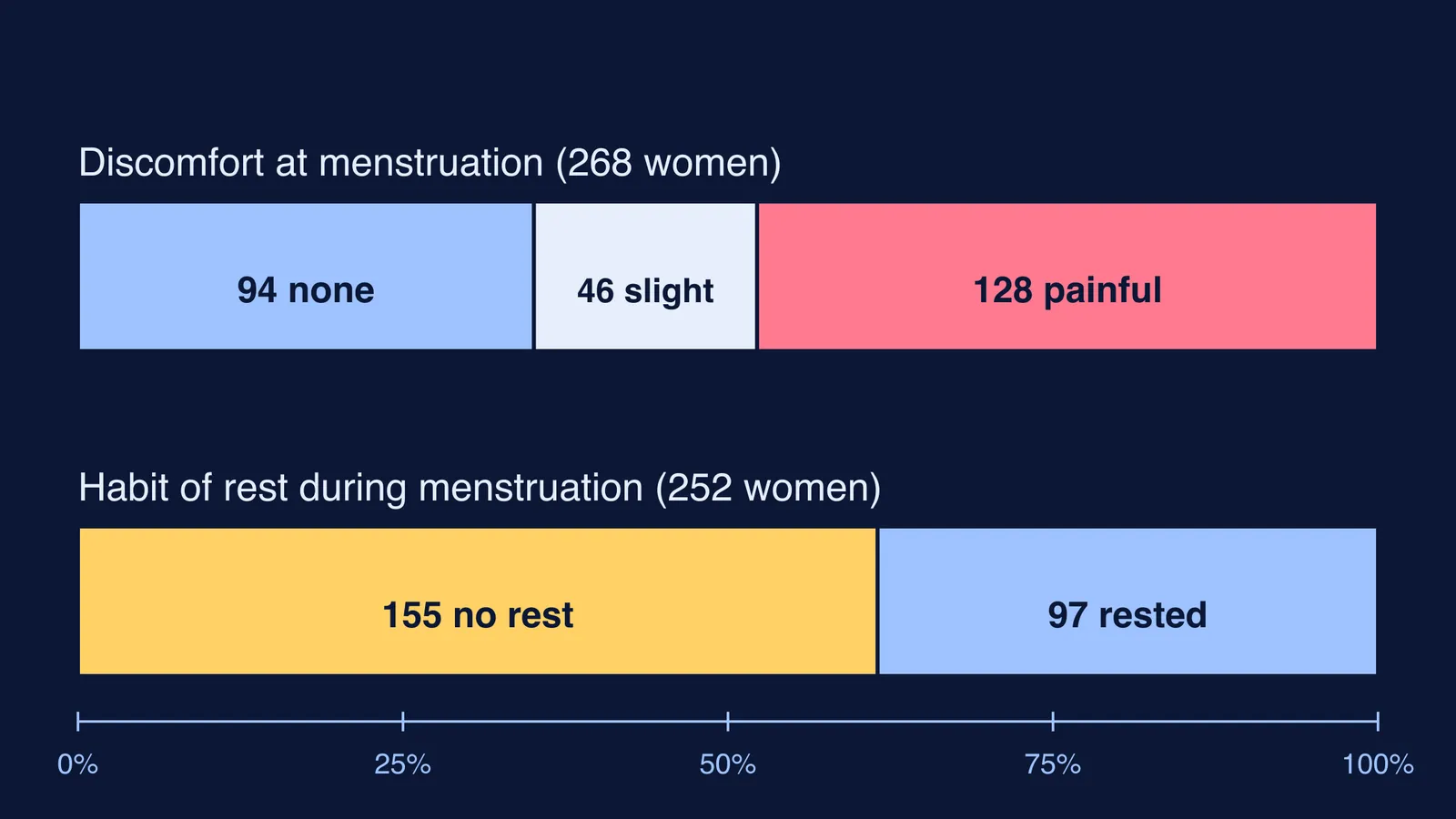
Of 268 women, 94 (35%) said they had always been completely free from discomfort during menstruation.
Adding those with only slight or occasional pain gave 140 women (59%) for whom menstruation was not serious enough to interrupt daily work.
Of 252 women who described their habits, 155 (61%) took no rest at all during their periods; 97 (38%) rested more or less.
Among the women with pain, 53% had had it from the beginning, so later work or study could not have caused it.
In her tables, the highest education then given to women was "much the most favorable to menstrual health", and the women who never had period pain had "exercised a great deal more" in childhood. Her conclusion: "There is nothing in the nature of menstruation to imply the necessity, or even the desirability, of rest, for women whose nutrition is really normal."
Her methods were of their time. She noted that her answers came, by accident, mostly from fairly highly educated women, and some of her physiology reads as dated today. But the core move holds: she replaced a few anecdotes with hundreds of answers and real measurements.
Does your period affect how well you can study?
Modern research broadly fits Jacobi's view on thinking. A 2014 review in Frontiers in Neuroscience by Inger Sundström Poromaa and Malin Gingnell concluded that cycle-related differences in tasks where the sexes differ "are small and difficult to replicate". Emotion-related changes were found more consistently, which fits what many students notice: the work is the same, but some days feel heavier.
Pain is a separate question from ability. The NHS page on period pain lists gentle exercise such as walking, yoga, swimming or cycling, and heat on the tummy, as self-help. It says to see a doctor if period pain stops you doing daily activities, or if periods become more painful, heavier or irregular. In India, that means a family doctor or gynaecologist, not silently pushing through before exams.
How can you plan study around your period?
Jacobi's evidence says you don't need to stop. It does make sense to plan for your own pattern. Try this for three cycles:
Track. Each day, write one line: energy (1-5), pain (none, mild, strong) and hours studied.
Spot your pattern. After three cycles, mark the days that are usually harder.
Match the task to the day. Put new, hard chapters on strong days. Keep lighter work for harder days: flashcards, re-solving problems you have done before, or a recorded lecture.
Keep sessions short. Jacobi wrote that the rest women need is "interruptions to employment every two or three hours, not every three or four weeks."
Practise one mock test on a harder day. The real exam date will not move, so it helps to know you can do it.
For parents, a simple script: "If your period is making a day hard, tell me. We'll swap in lighter work rather than skip the day, and if the pain keeps stopping you, we'll see a doctor."
On a low-energy day, the hardest part is often deciding what to do. Fermi's AI tutor works out what you already know and builds a plan for the session, so you sit down to a clear next step instead of a blank page.
Jacobi used hundreds of women's answers to test one doctor's opinion. A few weeks of your own notes can answer the same question for you.


