

On this page
Marietta Blau (1894–1970) worked at the Vienna Radium Institute from 1923 to 1938, and in those years she turned the photographic plate into a particle detector (Strohmaier and Kutschera, Radiocarbon). The photographic method she helped develop later earned a Nobel Prize, though not for her.
How does a photographic plate record a particle?
A nuclear emulsion is a layer packed with very fine silver halide grains. A fast charged particle passing through ionises the grains along its path and leaves a hidden latent image; developing the plate turns those grains dark, so the path shows up under a microscope as a line of dots (overview of nuclear emulsions).
You never see the particle itself. As the Science History Institute puts it, a particle "isn't seen directly but by the evidence of its passing—the track it leaves behind." Neutral particles do not ionise the grains, so they leave no trail.
What did Marietta Blau change about the method?
Blau experimented with many kinds of plates, comparing the size of their silver bromide crystals and the thickness of the layer, and she had to adjust the time, temperature and chemistry of development (Strohmaier and Kutschera). She then relied on two measurements:
Track length. The length of a track in the emulsion is a measure of the particle's energy, but only if the whole track stays inside the layer, so the particle must travel roughly parallel to the surface.
Grain density. How tightly the dark grains are packed helps tell one kind of particle from another.
At the microscope she traced thousands of tracks of alpha particles and protons, measuring both their length and the density of black silver grains (same source). Her collaborator in this work was Hertha Wambacher, whose 1932 doctoral thesis Blau had supervised (Wambacher biography).
What were the disintegration stars of 1937?
Victor Hess had shown that ionisation in the air rises with altitude, which led to the discovery of cosmic rays. So in 1937 Blau and Wambacher left emulsion plates for five months at the cosmic-ray observatory Hess had set up on the Hafelekar, 2,265 m above sea level near Innsbruck (Strohmaier and Kutschera).
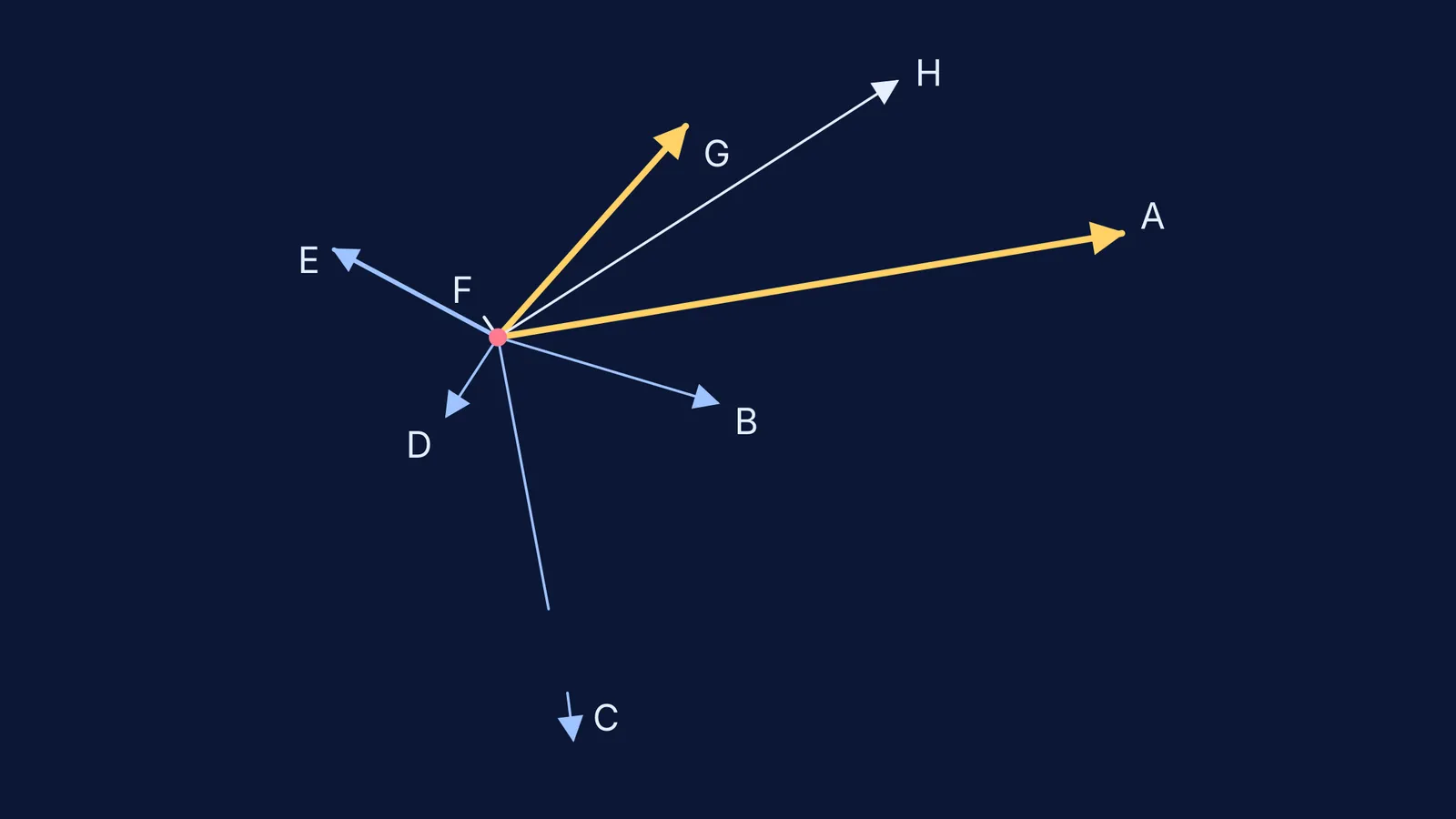
The developed plates showed several tracks radiating out from a single point. They read these as fragments of heavy nuclei in the emulsion, bromine or silver, broken apart by a high-energy cosmic ray; because of their star-like shape the tracks were called disintegration stars (same source). Their letter, Disintegration Processes by Cosmic Rays with the Simultaneous Emission of Several Heavy Particles, appeared in Nature on 2 October 1937.
They registered 60 stars and, from four of them, estimated the total kinetic energy of the emitted particles at several hundred MeV (Strohmaier and Kutschera). That year the Austrian Academy of Sciences gave both women the Lieben Prize (Blau biography).
How do you read a disintegration star?
The diagram at the top of this page traces the eight-track star, labelled A to H, from Blau and Wambacher's 1937 sketch (the original figure on Wikimedia Commons). Read it in four steps, the way you would read any track picture.
Find the origin. Follow every track backwards. If they meet at one point, you are looking at one nucleus that broke up, not a coincidence.
Count the prongs. Eight tracks means at least eight charged fragments. Neutrons leave no trail, so the true number of pieces may be higher.
Compare lengths. For the same kind of particle, a longer track that stays inside the layer means more energy. In the sketch, A is by far the longest.
Compare darkness. In the sketch, A and G are drawn with the heaviest lines. On a real plate you would compare how densely the grains are packed, the clue Blau used to tell particles apart.
If alpha particles and protons still feel hazy, start with why Rutherford called the radiations alpha and beta. If ionisation or binding energy is the gap, the Fermi Concept Library gives every physics concept its own lesson and its place in the map, so you can see what to learn first.
What happened to Blau after 1938?
Blau left Vienna for Oslo in March 1938; the Anschluss came the next day, and because of her Jewish ancestry she did not return (Strohmaier and Kutschera). Thanks to Einstein's earlier intervention she found a post in Mexico City, where she could not continue cosmic-ray work. She moved to the United States in 1944 and returned to Vienna in 1960 to supervise analysis of plates from CERN experiments (same source). Wambacher, who had belonged to the Nazi Party since 1934, stayed in Vienna (Wambacher biography).
In 1950 Erwin Schrödinger nominated Blau and Wambacher for the Nobel Prize in Physics (Strohmaier and Kutschera). That year the prize went to Cecil Powell "for his development of the photographic method of studying nuclear processes and his discoveries regarding mesons made with this method" (Nobel Prize).
Cosmic rays have an Indian chapter too: read about Piara Singh Gill's cosmic-ray research, and compare Blau's plates with how Carl Anderson discovered the muon.


