

On this page
Ernest Rutherford fundamentally changed our understanding of radioactivity shortly after its discovery. While scientists knew that uranium emitted strange rays, the exact nature of these emissions was a mystery. In 1899, Rutherford published a landmark paper that split this radiation into two distinct types based purely on their ability to pass through matter.
How did Rutherford measure penetrating power?
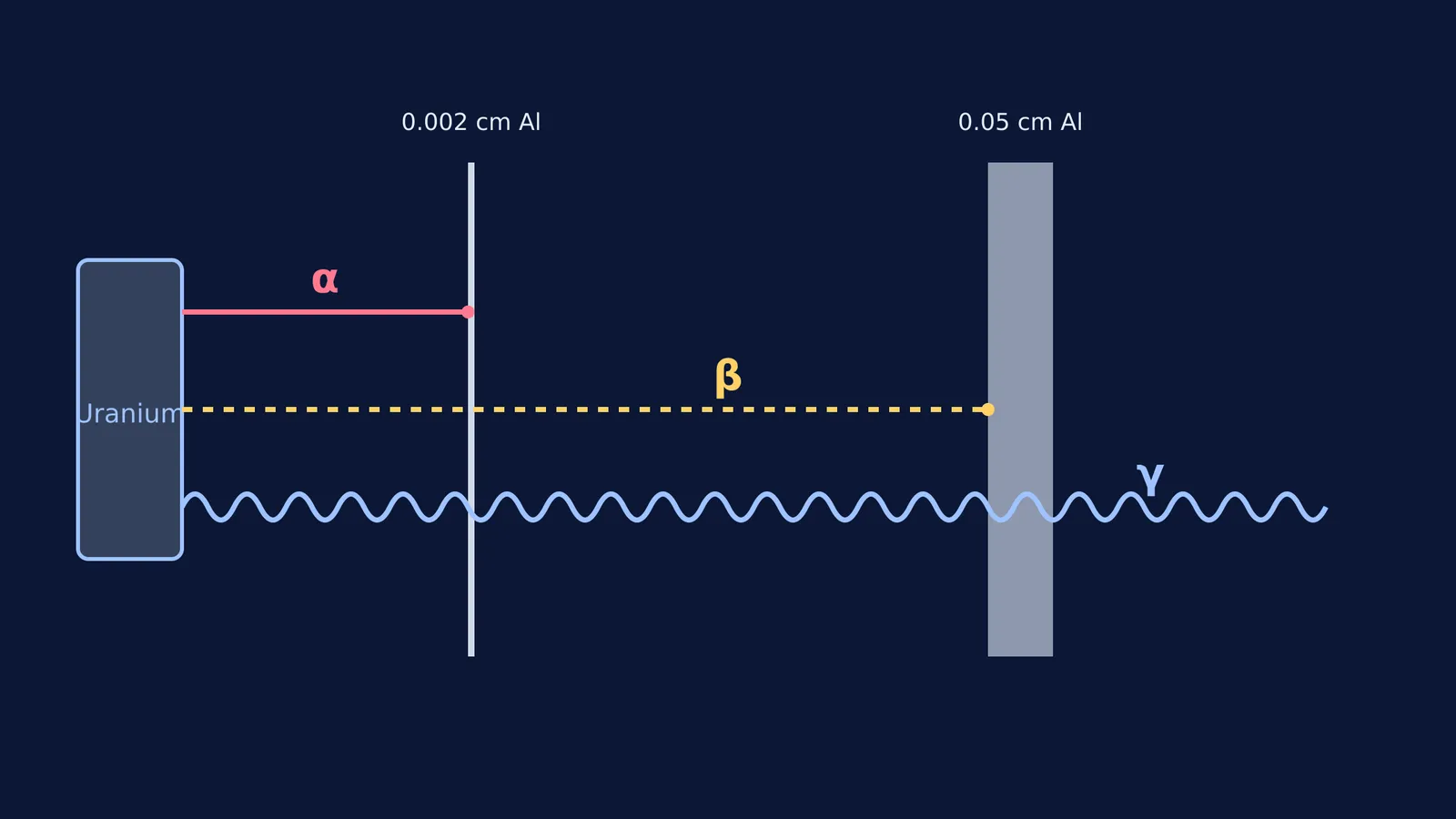
Rutherford investigated uranium emissions by placing thin layers of metal foil over a radioactive sample. He used aluminium foils that were approximately 0.0005 cm thick (Rutherford, 1899). To measure the radiation making it through the foil, he tracked the "rate of leak"—the electrical conduction or ionization produced in the surrounding gas.
He observed that the radiation's intensity did not drop off uniformly as he added more layers. Instead, the absorption happened in two clear stages. The first few layers of foil caused a massive drop in the ionization current, but after that, the remaining radiation passed through many subsequent layers with very little absorption.
How did he name alpha and beta rays?
Based on these differing absorption rates, Rutherford concluded that the uranium was emitting a complex mixture of at least two types of rays. He named them using the first two letters of the Greek alphabet:
Alpha (α) radiation: These rays were very easily absorbed. Rutherford found that just four layers of his aluminium foil (a total thickness of 0.0020 cm) absorbed the alpha component almost entirely (Rutherford, 1899).
Beta (β) radiation: This second component was of a more penetrative character. It was roughly 100 times more penetrating than the alpha rays, requiring greater thicknesses such as 0.05 cm of aluminium to be significantly absorbed (Rutherford, 1899).
Though alpha rays were easily stopped, Rutherford noted that they were responsible for the vast majority of the ionization produced near the bare uranium. Beta rays were more penetrating but produced significantly less ionization along their path.
Later research proved that these were not just "rays" but high-speed particles. Alpha radiation consists of heavy helium nuclei, while beta radiation is made of fast-moving electrons.
For modern students, visualising how different particles interact with matter is a core part of modern physics. The Fermi Simulation Lab provides interactive simulations for the ideas that are easier to see than to read, such as particle scattering and absorption.
How do you identify radiation types in exam questions?
The distinct properties of alpha, beta, and gamma radiation are a staple of physics and chemistry curricula. Questions often test your understanding of how these particles behave in electric or magnetic fields, or how they shift an atom's mass and atomic numbers during decay.
When you encounter an exam problem asking you to identify an unknown emission based on an experiment, use this checklist:
Check the barrier: If a single sheet of paper or a few centimetres of air stops the emission entirely, it is alpha radiation. If it passes through paper but is stopped by a few millimetres of aluminium, it is beta. If it requires thick lead or concrete to stop, it is gamma.
Check the ionization: Alpha particles are heavy and carry a positive charge, so they ionize gas heavily over a very short distance. Beta particles leave a thinner, longer trail of ionization.
Check the deflection: If the question mentions a magnetic or electric field, alpha particles will deflect slightly towards the negative plate, beta particles will deflect sharply towards the positive plate, and gamma rays will not deflect at all.
If you find yourself stuck on nuclear physics calculations, the Fermi Problem Library provides worked problems with a step-by-step solver that explains the reasoning rather than printing an answer. And if you are still building your foundation in modern physics, the Concept Library holds a dedicated lesson for every concept in physics and chemistry.
Read more about the history of subatomic physics in our articles on George Johnstone Stoney, who named the electron or Victor Hess and the balloon flights that found cosmic rays. For exam practice, try Counting alpha and beta decays in a radioactive decay series.


