

On this page
Before 1914, blood transfusions were desperate, surgical procedures. Blood clots almost immediately when it leaves the body. Because of this, early transfusions had to be "direct"—a doctor would surgically connect a donor's artery directly to a patient's vein. It was slow, difficult, and impossible to perform on a large scale.
This changed on November 9, 1914, at the Rawson Hospital in Buenos Aires. Argentine physician Luis Agote successfully treated a patient suffering from postpartum hemorrhage. He transfused exactly 300 mL of citrated blood into her, proving the procedure was safe (Wikipedia). Agote had discovered how to break the biological chain reaction that causes blood to clot, simply by adding a common chemical.
Why do calcium ions matter in blood clotting?
When you cut yourself, your body prevents excessive blood loss through a cascade of enzymatic reactions. Platelets release factors that form an enzyme complex called thrombokinase. This complex converts inactive prothrombin into thrombin, which then turns soluble fibrinogen into a solid mesh of fibrin threads. This mesh traps the red blood cells, which are part of the formed elements of blood, to form the clot.
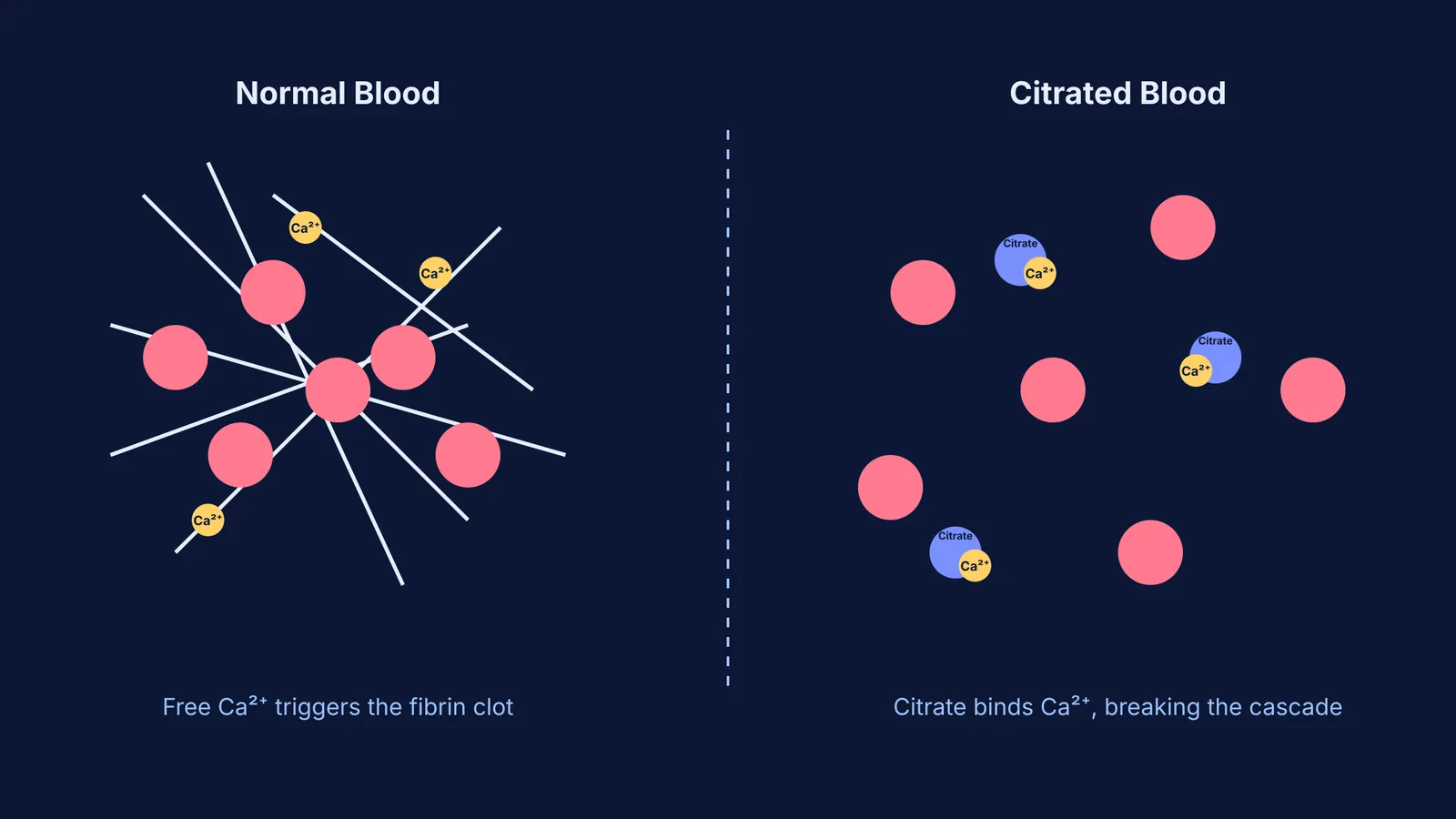
Every major step of this cascade requires free calcium ions (Ca²⁺) to work. If you remove the calcium, the enzymes cannot activate, and the blood remains a liquid.
When you are studying the coagulation cascade, keeping track of these moving parts can be difficult. Fermi's AI tutor can work out what you already know and build a plan for the session, checking understanding as it goes.
How did Luis Agote use sodium citrate?
Agote knew that calcium was the key to clotting, and he needed a way to remove it without poisoning the patient. He turned to sodium citrate, a chemical salt derived from citric acid.
When sodium citrate is added to blood, the citrate ions bind tightly to the positively charged calcium ions. This chemical process is called chelation. Once bound to citrate, the calcium is no longer free to participate in the clotting cascade. Agote found that adding a small amount of sodium citrate was enough to stop the clotting process without harming the patient (Wikipedia).
What happened to blood transfusions after 1914?
Agote made a deliberate choice not to patent his discovery. With World War I raging in Europe, he communicated his findings to the diplomatic corps of the Allied nations. This chemical breakthrough meant blood could finally be collected in a container, stored, transported to the battlefield, and given to wounded soldiers when they needed it most. It paved the way for modern blood banks, an effort later pioneered by scientists like Charles Drew, and saved countless lives. In Argentina, November 9 is now celebrated as the National Day of the Voluntary Blood Donor (Casa Rosada).
If you are struggling to picture how these different ions and proteins interact in the bloodstream, the Simulation Lab has interactive simulations for the ideas that are easier to see than to read.
How can you test your knowledge of blood coagulation?
If you are preparing for biology exams, you will be tested on the sequence of the clotting cascade and the roles of its components. Use this checklist to test your active recall:
Identify the trigger: Can you name the substance released by injured tissues and platelets? (Answer: Thromboplastin, which leads to the thrombokinase complex).
Trace the proteins: Write out the two main conversions (Prothrombin to Thrombin, and Fibrinogen to Fibrin) from memory.
Locate the calcium: Note where Ca²⁺ is required (it acts as a necessary cofactor in nearly every step of the cascade).
Connect the chemistry: Explain in one sentence why a chelating agent like sodium citrate acts as an anticoagulant.
Understanding the history behind the science, like Agote's 1914 experiment, makes these abstract chemical concepts much easier to remember.


