On this page
Your textbook gives you three kinds of magnetic material: diamagnetic, paramagnetic and ferromagnetic. Louis Néel, a French physicist born in Lyon in 1904, added two more. His half of the Nobel Prize in Physics 1970 was "for fundamental work and discoveries concerning antiferromagnetism and ferrimagnetism which have led to important applications in solid state physics". Here is how he did it, plus a calculation you can do yourself.
What is antiferromagnetism, and how did Néel explain it?
Start with Pierre Weiss's picture of a ferromagnet: each atomic magnet feels a "molecular field" from its neighbours that lines it up parallel to them (see how Pierre Weiss explained ferromagnetism with magnetic domains). Néel asked what happens when that interaction has the opposite sign, so neighbours prefer to point opposite ways.
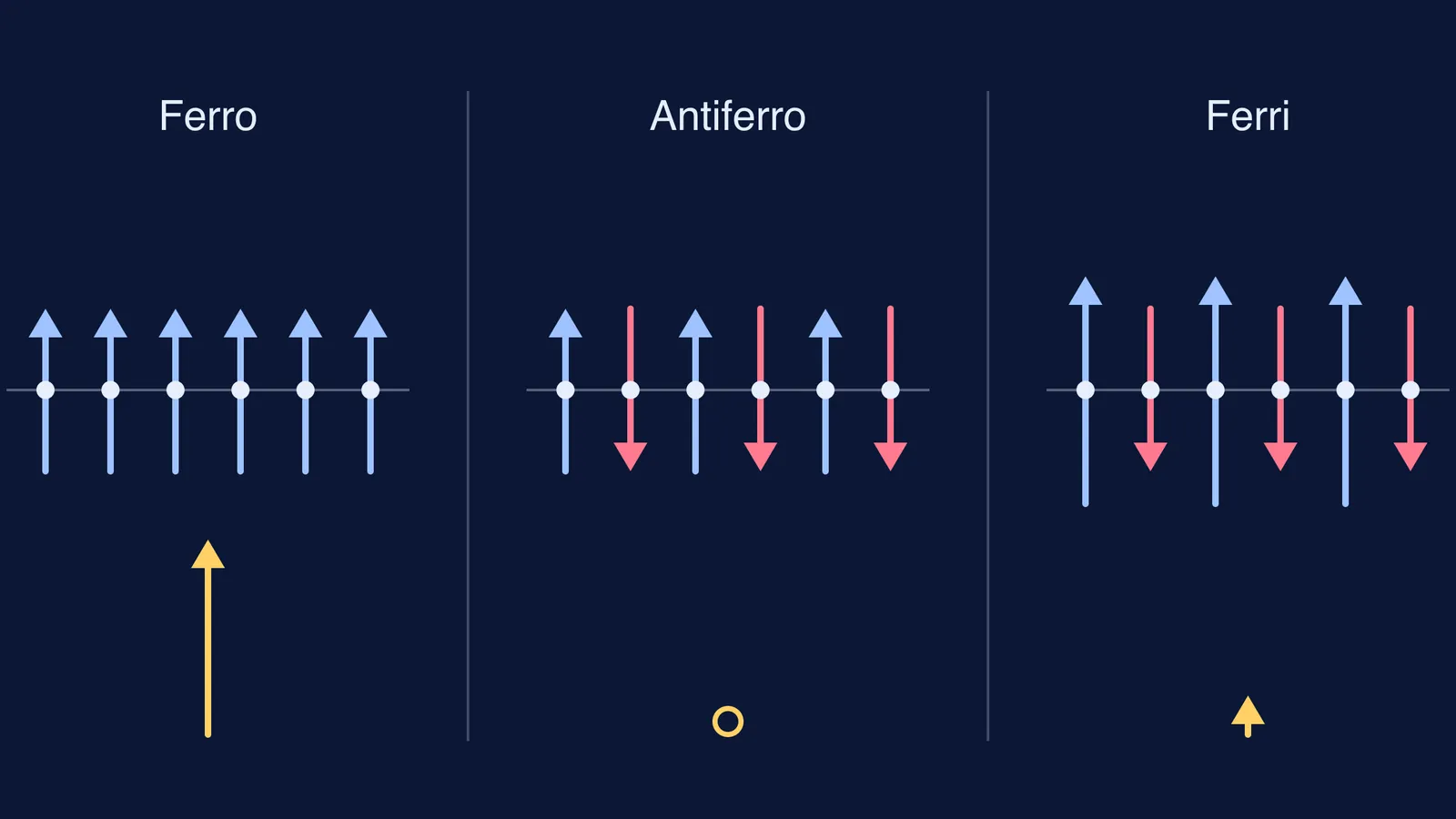
His answer, described in his Nobel lecture, came in 1936. Split the crystal into two interlaced sub-lattices, A and B. Below a transition temperature, each magnetises spontaneously, but in opposite directions, so they cancel and the material looks almost non-magnetic from outside.
Antiferromagnetism is magnetic order in which neighbouring atomic moments line up antiparallel, so equal sub-lattices cancel (Néel, Nobel lecture). The temperature at which this order disappears is now called the Néel temperature. Two years later, Squire, Bizette and Tsaï found the predicted behaviour in manganese oxide (MnO), with a transition at 116 K. In 1949 Shull and Smart used neutron diffraction to show the moments really were antiparallel (Physical Review).
In 1970 Néel said antiferromagnets "are extremely interesting from the theoretical viewpoint, but do not seem to have any applications" (Nobel lecture).
What is ferrimagnetism and why does it matter for ferrites?
The practical payoff came next. In 1947, after reading Verwey and Heilmann's work on the structure of ferrites, Néel returned to these iron oxides (Nobel lecture). Ferrites of manganese, cobalt or nickel are electrical insulators, which made them technically useful, but their saturation moment, 1 to 5 μB per molecule, was much weaker than the total moment of their ions, 1 to 15 μB (Nobel lecture).
Néel kept his two sub-lattices but made them unequal. Ions on A sites and B sites interact negatively, so A points one way and B the other, but B carries more moment. Ferrimagnetism is magnetic order in which two antiparallel sub-lattices have unequal moments, leaving a net magnetisation equal to their difference (Néel, Nobel lecture). He coined the name "ferrimagnetics", and neutron diffraction later confirmed that the A and B moments in magnetite point opposite ways.
How do you calculate a ferrite's magnetic moment?
This is the test Néel applied to his theory, and you can do it with Class 12 chemistry. In an inverse ferrite Fe2O3·MO, one Fe3+ ion sits on an A site, and the other Fe3+ shares the B sites with the M2+ ion (Nobel lecture).
Count unpaired electrons. Fe3+ (d5) has 5; Ni2+ (d8) has 2; Co2+ (d7) has 3; Fe2+ (d6) has 4.
At absolute zero, each unpaired spin gives about 1 Bohr magneton (μB) of saturation moment.
Add up each sub-lattice. A: one Fe3+, 5 μB. B: one Fe3+ plus M2+, 5 μB plus M's moment.
Subtract, because A and B are antiparallel. The two Fe3+ cancel, leaving just M.
So nickel ferrite gives about 2 μB, cobalt ferrite about 3 μB and magnetite about 4 μB per formula unit. Comparing predictions like these, corrected for a little orbital moment, with experiment, Néel wrote: "The agreement is very satisfactory." Watch the trap: this saturation moment is n μB, not the √(n(n+2)) of the spin-only magnetic moment formula used for paramagnetic ions.
If d-electron counting is shaky, the Fermi Concept Library gives each concept its own lesson, so you can fill that gap before trying the ferrite.
How did Néel's ideas help read rock magnetism records?
Volcanic rocks carry tiny grains of ferrimagnetic minerals such as magnetite. In 1942 Néel showed that small enough grains hold a single magnetic domain and can behave as small permanent magnets (Nobel lecture). He later wrote Some theoretical aspects of rock-magnetism (1955).
As lava cools in Earth's field, these grains lock in the field's direction, a record called thermoremanent magnetisation. Néel's theories of it "underlie all of rock magnetism", according to a 2003 review by David Dunlop, and his relaxation-time equation for single-domain grains has been verified over geological time scales. That physics lets geologists read ancient field directions from rocks, including the magnetic stripes on the seafloor.
A quick check: which magnetic order is it?
Strong net magnetism, all moments parallel: ferromagnet (iron).
Strong net magnetism, but less than the ions' total: likely a ferrimagnet (magnetite, ferrites).
Almost no net magnetism, with a sharp susceptibility peak at one temperature: antiferromagnet (MnO).
No order at any temperature: paramagnet.
Try sketching the three orders as arrows before you look at the diagram above. The Fermi Simulation Lab has interactive simulations for ideas that are easier to see than to read.