

On this page
Before 1839 nobody could keep the picture that a lens throws onto a wall. Louis Daguerre found a way to fix it on a sheet of metal. His method is a neat lesson in chemistry and optics, and you already know most of the science behind it.
What did Daguerre announce in 1839?
Daguerre was put in touch with the inventor Nicéphore Niépce in 1829 and became his partner. After Niépce died in 1833, Daguerre drew up a new contract with Niépce's son Isidore, according to the Wikipedia history of the daguerreotype. In it, Isidore accepted that Daguerre's new process was 60 to 80 times as rapid as his father's older bitumen method (Wikipedia).
The French government bought the rights and gave Daguerre and Isidore Niépce lifetime pensions. On 19 August 1839, at a joint meeting of the French Academy of Sciences and the Académie des Beaux-Arts, François Arago presented the process, and the government gave it "free to the world" as a gift. The exception was England and Wales, where Daguerre's agent had filed a patent five days earlier (Wikipedia). A 2018 study in *Scientific Reports* puts it plainly: the 1839 presentation "enabled photography to become a part of everyday life" (Kozachuk et al., 2018).
How did the daguerreotype process work, step by step?
The Historic New Orleans Collection describes the steps clearly. Here they are in order, with what was happening chemically.
Plate. A sheet of copper was plated with a thin coat of silver, then cleaned and polished to a mirror finish.
Sensitise. In a lighttight box, the plate was held over iodine (and later bromine) vapour until the surface turned yellow. Iodine reacted with silver to form light-sensitive silver iodide.
Expose. The plate went into the camera in a lightproof holder. Light falling on the plate left an invisible "latent" image (Wikipedia).
Develop. The plate was placed face down over heated mercury. Mercury vapour combined with the exposed silver to form a silver-mercury amalgam, and the picture appeared.
Fix. The leftover silver halide was removed, first with salt solution and later with sodium thiosulfate, so the plate stopped reacting to light.
Gild. A gold chloride treatment strengthened the image.
The same museum notes that early exposures took three to fifteen minutes, and that better lenses plus bromine, which made the plate more sensitive, brought portraits down to about one minute (HNOC).
That fixer fact comes from the sodium thiosulfate entry. For the same family of compounds, see our guide to telling chloride, bromide and iodide apart with silver nitrate.
Why was the picture so sharp?
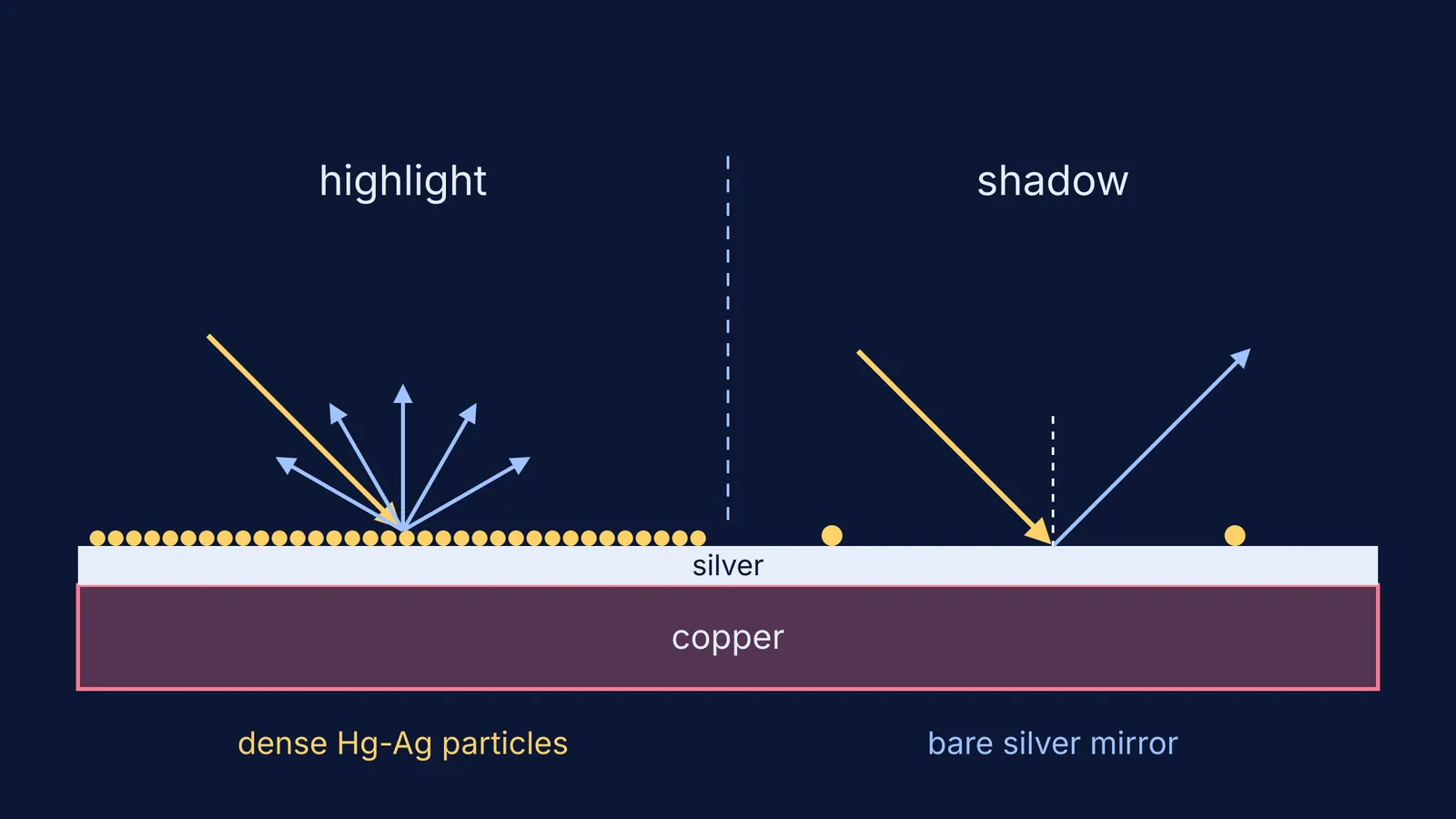
The image is made of tiny particles sitting on a mirror. In brightly lit areas there are about 200,000 image particles per square millimetre, according to the 2018 *Scientific Reports* paper, and particles in these areas have been reported to measure 0.1 to 1 micrometre across (Kozachuk et al., 2018). Areas that got little or no light have fewer than 100 particles per square millimetre, and the paper says these changes in particle number and size create the range of grey tones (Kozachuk et al., 2018).
Where particles crowd together, light scatters in all directions, so that patch looks white from most angles. Bare silver acts as a mirror, reflecting light at one angle, so it looks dark when it reflects something dark. Particles this small, packed this tightly, help explain why the detail is so fine.
Why is a daguerreotype a mirror image?
You look at the same face of the plate that faced the lens, so daguerreotypes are normally laterally reversed, like a mirror (Wikipedia). There is no negative either, so each plate is unique; a copy could be made by re-daguerreotyping the original, which also corrected the reversal. If you want to see how a lens or a hole makes the image in the first place, try our pinhole camera experiment, and for photography's next leap, read about Marey's photographic gun.
How can you use the daguerreotype to revise chemistry?
One process touches several chapters at once. Try this with a notebook.
Write the six steps from memory.
Next to each, name the idea: metal plating, a halogen reacting with a metal, light decomposing a silver halide, forming an amalgam, dissolving a sparingly soluble salt, and a gold coating.
Write one line on why each step needs it. For example, the plate must be fixed because leftover silver iodide would keep reacting to daylight.
Mark any idea you cannot explain and look it up before moving on.
If step 4 shows gaps, the Fermi Concept Library has a lesson for every concept in chemistry and physics. Ideas such as mirror versus scattered reflection are often easier to see than to read, and the Fermi Simulation Lab has interactive simulations for ideas like these.


