

On this page
In 1921, working in the Fly Room at Columbia University, Lilian Vaughan Morgan spotted a female fruit fly that broke the usual rules of inheritance. Her crosses showed that its two X chromosomes were joined and passed on as one piece. She published the result in May 1922 as Non-criss-cross inheritance in Drosophila melanogaster in The Biological Bulletin. Her attached-X chromosome is still a clear way to see how sex-linked inheritance works.
Who was Lilian Vaughan Morgan?
Lilian Vaughan Morgan was born on 7 July 1870 in Hallowell, Maine, and died on 6 December 1952 in Los Angeles, according to her biography on Wikipedia. She studied biology at Bryn Mawr College, finishing a bachelor's degree in 1891 and a master's in 1894. In 1904 she married the geneticist Thomas Hunt Morgan, who later won a Nobel Prize.
In his Fly Room she kept her own Drosophila stocks but held no official position. She published sixteen single-author papers between 1894 and 1947, yet her first official appointment, as a research associate at Caltech, came only at the age of 76.
What is an attached-X chromosome?
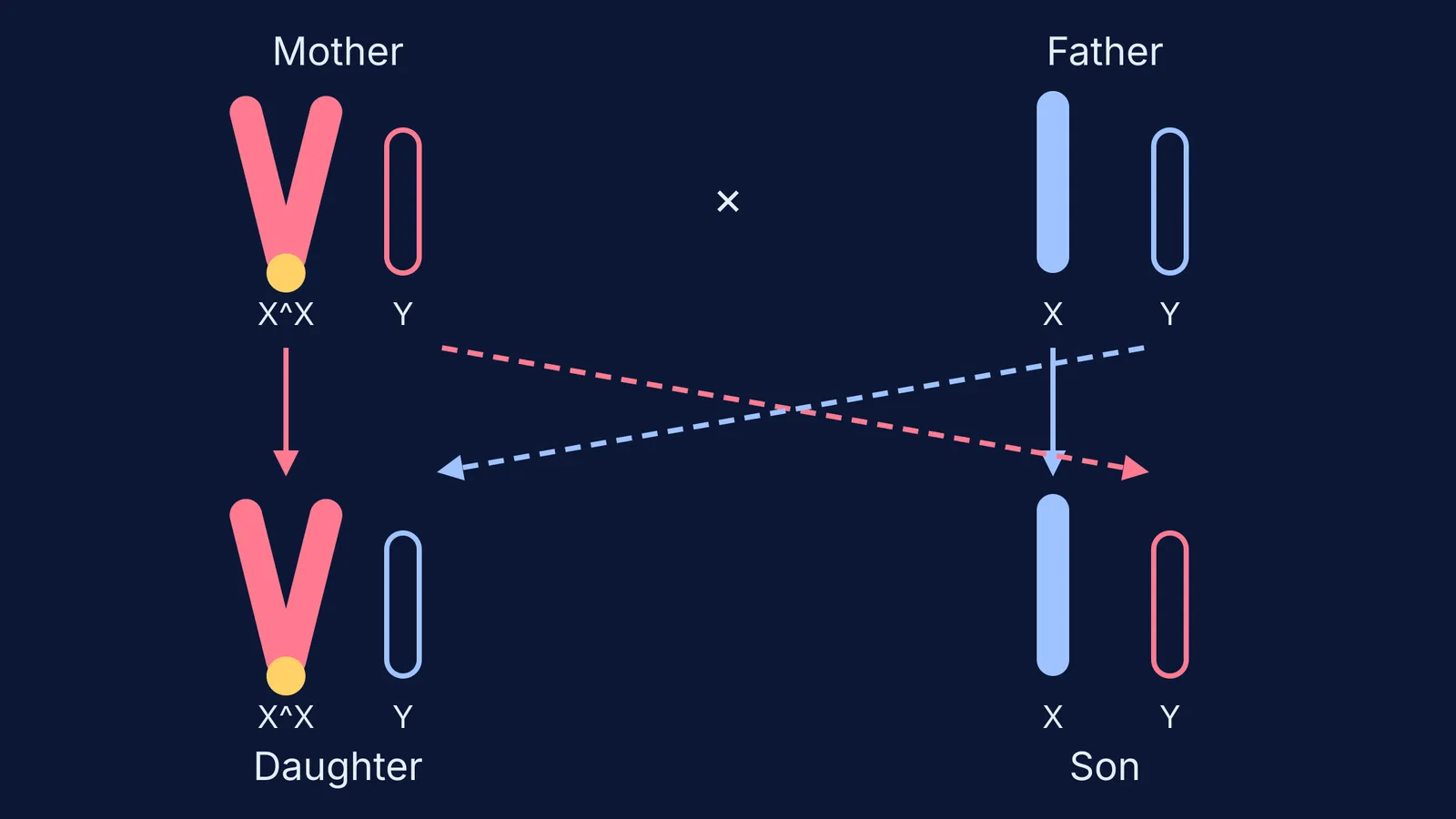
An attached-X chromosome is "two full-length X chromosomes sharing a common centromere so that they are always inherited together", in the words of the Bloomington Drosophila Stock Center. Geneticists write it as X^X. In the crosses below, the attached-X female also carries a Y chromosome, which she can pass on to her sons.
To see why this matters, recall the normal pattern. Fruit fly females are XX and males are XY, so a son gets his X from his mother and his Y from his father, as this LibreTexts chapter on sex-linked traits explains. Eye colour sits on the X, and red eyes are dominant to white. So a white-eyed mother crossed with a red-eyed father gives red-eyed daughters and white-eyed sons: the trait criss-crosses from mother to son.
How did attached-X reverse criss-cross inheritance?
Here is a worked example. Take an attached-X female whose two joined Xs both carry the white allele, so she has white eyes. Cross her with an ordinary red-eyed male.
Her eggs carry either the joined X^X (both white) or her Y.
His sperm carry either his X (red) or his Y.
Daughters come from an X^X egg and a Y sperm. They are X^X Y, with white eyes, like their mother.
Sons come from a Y egg and an X sperm. They are X Y, with red eyes, like their father.
The result is the mirror image of the ordinary cross. The Bloomington stock centre puts it simply: in these crosses, male offspring "inherit their X from their father and their Y from their mother". That is why Lilian Morgan called it non-criss-cross inheritance.
Why was the attached-X chromosome such a useful tool?
A chromosome that always travels as one unit let geneticists control exactly which X went where. The Bloomington Drosophila Stock Center lists uses that still matter in fly labs:
Stable stocks of X-linked visible and female-sterile mutations can be set up "instantly" by crossing mutant males to attached-X females, because every son carries his father's X.
The same trick stops spontaneous lethal and male-sterile mutations from piling up on the X chromosomes of a stock.
The discovery also backed the chromosomal theory of inheritance, and other scientists used it to study when crossing-over happens during meiosis, as this profile by Nila Pazhayam in The Pipette Pen describes. Lilian Morgan later described a ring-X chromosome in Drosophila, and the same profile notes that her 1933 paper on them became her most highly cited work.
For an earlier chapter of the same story, read how Calvin Bridges proved genes sit on chromosomes.
How do you solve an attached-X genetics problem?
Unusual sex-chromosome crosses trip students up because the criss-cross habit kicks in automatically. Use this checklist:
Circle the parent with the attached X and write her gametes: X^X or Y.
Write the father's gametes: X or Y.
Build daughters from X^X plus the father's Y, and sons from the father's X plus the mother's Y.
Read each phenotype from the alleles on those chromosomes.
Check: if your sons look like their mother, you used the ordinary rule by mistake.
If the steps still feel slippery, the Fermi Problem Library has worked problems with a step-by-step solver that explains the reasoning rather than printing an answer. If the gap is in the basics, such as what a centromere is, the Fermi Concept Library gives each biology concept its own lesson.
To practise the ordinary pattern first, try this X-linked colour blindness simulation, and read why Drosophila is used in genetics experiments for the bigger picture.
Next time you draw a Punnett square for a sex-linked trait, draw the attached-X version beside it: if you can explain why the sons flip, you understand the X chromosome.


