

On this page
Calvin Bridges was a PhD student in Thomas Hunt Morgan's fly lab at Columbia University when he published the paper that helped settle one of biology's big arguments. The title said exactly what it claimed: Non-disjunction as proof of the chromosome theory of heredity. It was the first paper in the first issue of the journal Genetics, in 1916, and it reported his PhD thesis work (Ganetzky and Hawley, Genetics).
He had started in the lab as an undergraduate, washing the milk bottles the flies were bred in (Embryo Project Encyclopedia). You can follow his argument from a handful of odd flies with a pencil.
What did Calvin Bridges discover?
By the 1910s, the idea that genes travel on chromosomes was on the table, but it was not accepted. According to Ganetzky and Hawley's centenary article, even Morgan had once said he was "not in sympathy with all this modern way of referring everything to the chromosomes", and William Bateson, who coined the word genetics, was also a sceptic.
Bridges worked with the gene for white eyes, which sits on the X chromosome. Female fruit flies are XX and males XY. Cross a white-eyed female with a red-eyed male and every daughter should get her father's red-eye X, and every son his mother's white-eye X.
Nearly always, that is what happened. But about 1 in 1,600 offspring broke the rule: a white-eyed daughter or a red-eyed son (Ganetzky and Hawley). Bridges asked what the chromosomes would have to be doing to produce it.
What is nondisjunction?
Nondisjunction is the failure of a pair of chromosomes to separate when eggs or sperm are made, so a cell ends up with an extra copy or none (Embryo Project Encyclopedia).
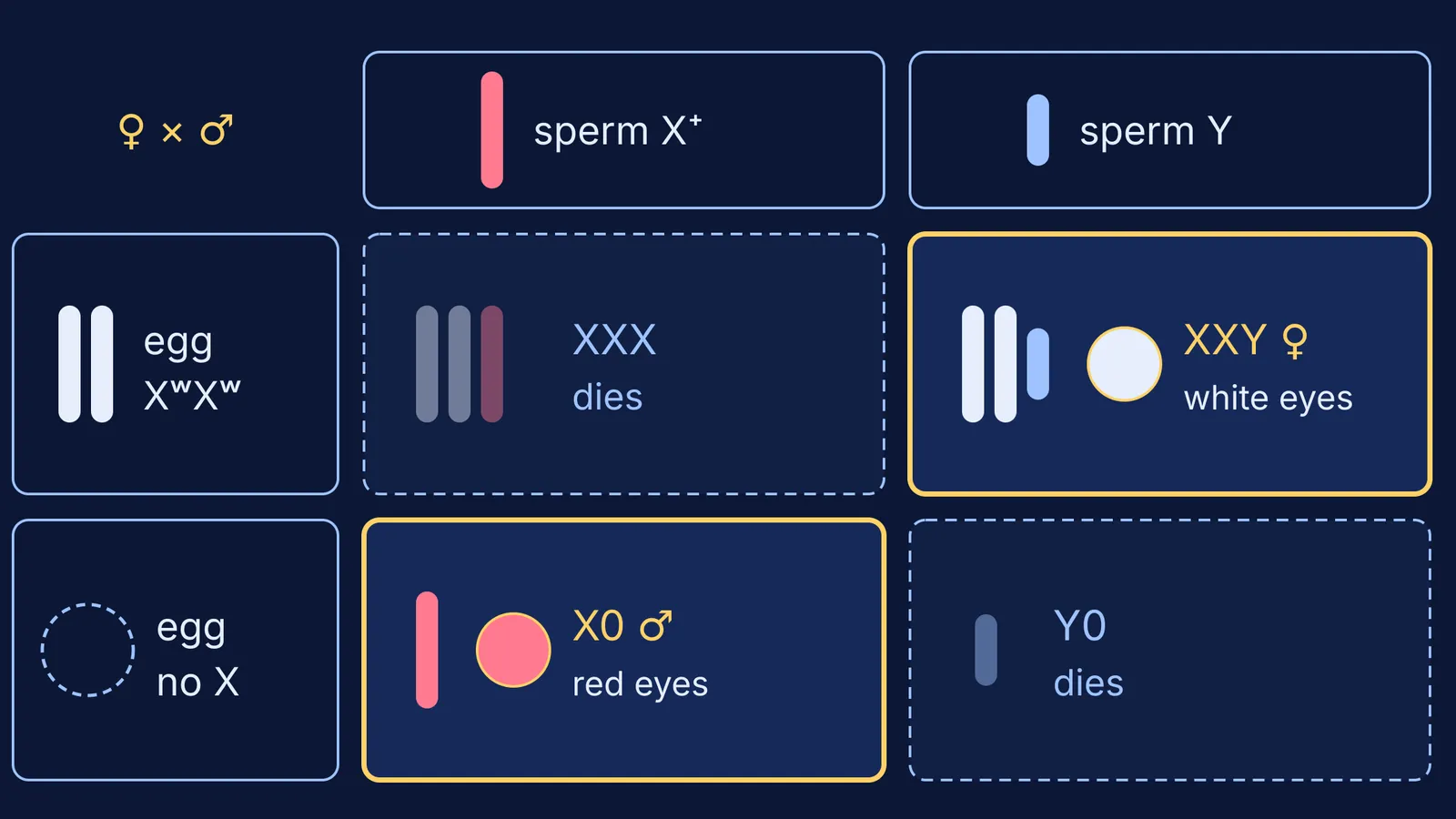
Bridges proposed that the white-eyed mother's two X chromosomes now and then stayed together, giving some eggs two X chromosomes and some none. Fertilise an XX egg with a Y sperm and you get an XXY daughter whose only X chromosomes came from her mother: white eyes. Fertilise an empty egg with an X sperm and you get an X0 son whose only X came from his father: red eyes. Flies with three X chromosomes, or a Y and no X, die as eggs or embryos, so those never showed up.
How did nondisjunction prove genes are on chromosomes?
The proof came from predictions that could fail. The exceptional white-eyed females kept producing exceptions of their own, at 4 to 5 percent instead of about 1 in 1,600 (Ganetzky and Hawley). Bridges explained this by proposing that they were XXY, and that idea made a testable prediction: half of the ordinary daughters of these XXY mothers, and all of the exceptional ones, should be XXY. Nobody had ever seen an XXY fly. He looked at their cells and found the extra chromosome where he said it would be. The red-eyed X0 sons were normal males in every way except that they were sterile.
His conclusion, in his own words: "The genetic and cytological evidence in the case of non-disjunction leaves no escape from the conclusion that the X chromosomes are the carriers of the genes for the sex-linked characters" (quoted by Ganetzky and Hawley).
Because XXY flies were female and X0 flies male, the same flies showed that in fruit flies the number of X chromosomes, not the Y, sets sex (Embryo Project Encyclopedia). Morgan won the 1933 Nobel Prize in Physiology or Medicine "for his discoveries concerning the role played by the chromosome in heredity" (Nobel Prize), and he shared part of the prize money with Bridges (Embryo Project).
How do you work through Bridges' cross yourself?
Do this on paper before you look at the diagram at the top.
Write the parents: white-eyed female XʷXʷ, red-eyed male X⁺Y.
Draw the normal Punnett square. Check that you get red-eyed XʷX⁺ daughters and white-eyed XʷY sons only.
Now let the mother's X chromosomes fail to separate. Her eggs are XʷXʷ or carry no X.
Cross those two eggs with the two kinds of sperm, X⁺ and Y. You should get four boxes: XXX, XXY, X0 and Y0.
Cross out the two that die. Read the eye colour of the two survivors from their X chromosomes alone.
Ask the test question: what would a microscope have to show if this story is true? If your answer is "an extra Y in the white-eyed daughters", you have the proof.
If step 3 feels shaky, the gap is usually meiosis. The Fermi Concept Library gives each biology concept its own lesson, so you can go back one step. For practice crosses, the Fermi Problem Library has worked problems with a step-by-step solver that explains the reasoning rather than printing an answer.
What can you learn from the way Bridges worked?
Write down the exception. A result that does not fit is information.
Turn your explanation into a prediction that could be wrong, then check it.
Use two kinds of evidence. Bridges matched breeding results with what he saw in cells.
Next time a genetics question gives you an odd offspring, ask what Bridges asked: what are the chromosomes doing?


