

On this page
In 1876 a young draughtsman in a Boston patent office prepared the drawings for Alexander Graham Bell's telephone patent application. His name was Lewis Howard Latimer, and nobody had taught him to draw. Here is what the records say, and how to use his method.
Who was Lewis Latimer?
Lewis Latimer was born in Chelsea, Massachusetts, on 4 September 1848, according to Lemelson-MIT. The US National Park Service describes him as the son of an escaped slave who "overcame poverty and racism in his scientific career."
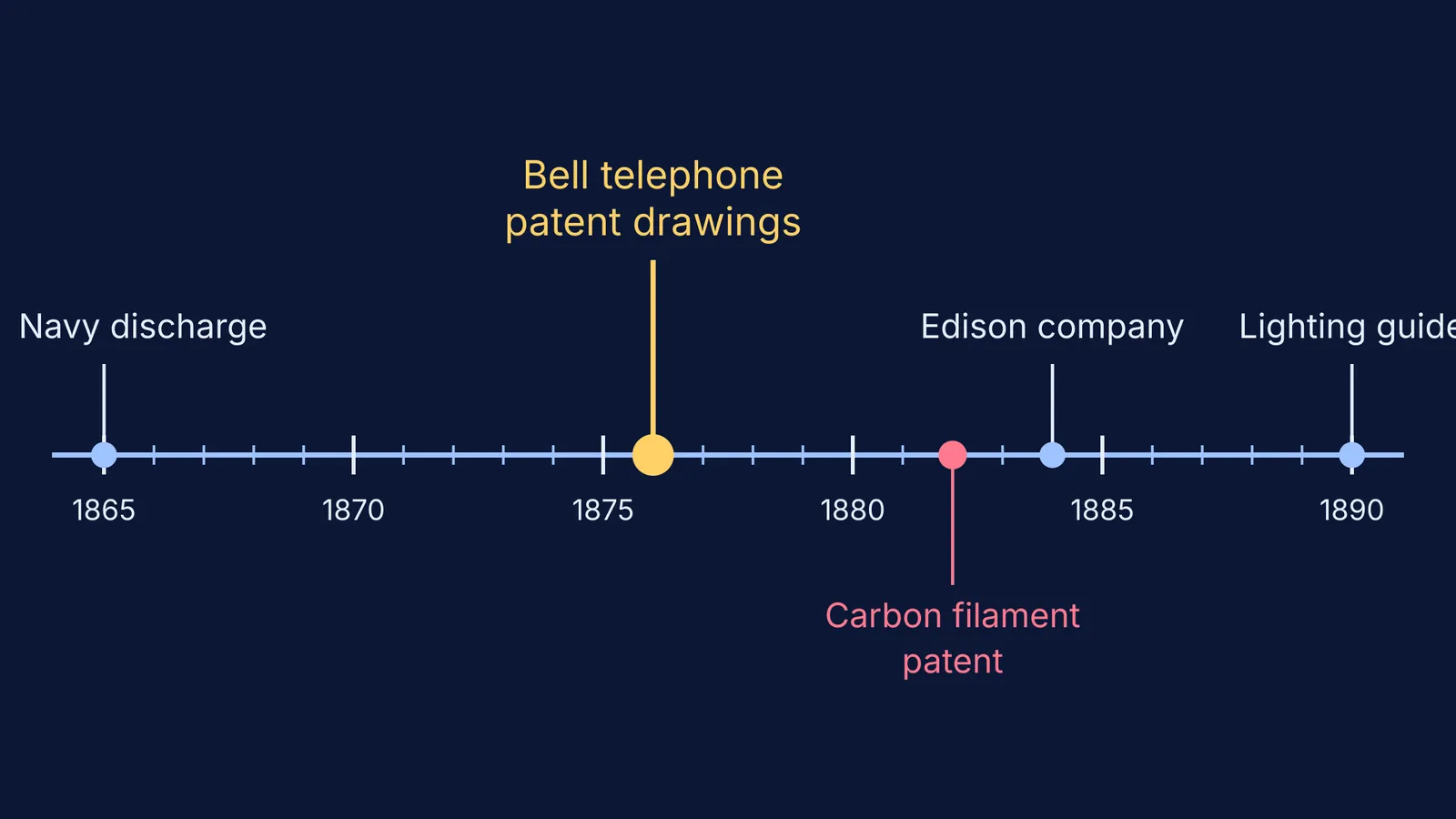
During the American Civil War he enlisted in the Union Navy on 16 September 1864 and was honourably discharged on 3 July 1865, says the IEEE Engineering and Technology History Wiki. Back in Boston, he later recalled, the patent firm Crosby, Halsted & Gould was looking for a "colored boy with a taste for drawing." He got the job as an office boy.
As an office boy he watched the firm's draughtsman, bought second-hand books and learnt the skills himself. When the draughtsman left, the firm gave Latimer the post (ETHW).
Did Lewis Latimer really draw the telephone patent drawings?
Yes, according to ETHW and Lemelson-MIT. ETHW says he prepared "the mechanical drawings for Alexander Graham Bell's patent application for his telephone" (ETHW), and Lemelson-MIT says he drew "the blueprints for Bell's patent for the telephone in 1876" (Lemelson-MIT).
Bell's best-known telephone patent, US 174,465, was filed on 14 February 1876 and granted on 7 March 1876 (Google Patents).
The Lewis Latimer House Museum holds a copy of an article on the telephone's invention, from around 1911, with a pencilled inscription across the top that the museum says is probably by Latimer: "Drawings for Mr. Bell's patent application were made by L. H. Latimer, then in the employ of Crosby & Gould, 34 School St., Boston, Mass. U.S.A." (Latimer House catalogue). The museum notes that this inscription and his other autobiographical writings are "the only known evidence" of his part. Dramatic details in popular retellings, such as all-night sessions, are not in a primary source we could find.
What did Latimer do for electric lighting?
In 1880 Latimer joined the U.S. Electric Lighting Company under Hiram Maxim (Lemelson-MIT). There he patented a "process of manufacturing carbons", US 252,386, filed on 19 February 1881 and granted on 17 January 1882 (Google Patents). Thin carbon blanks for lamp filaments could crack or distort as they were baked; he baked them inside cardboard envelopes that shrank at about the same rate.
From 1884 to 1896 he worked for the Edison Electric Light Company in New York "as an engineer, draftsman and legal expert" (National Park Service). For context, see our story on Thomas Edison's Pearl Street power station of 1882.
In 1890 he published Incandescent Electric Lighting: A Practical Description of the Edison System (Lemelson-MIT). His own copy, now at the Lewis Latimer House, is No. 57 in the Van Nostrand Science Series and carries the note: "This was the first book on Electric Lighting published in the United States" (Latimer House catalogue). The museum also says it revised a book first published in 1881, so treat "first" as Latimer's claim. ETHW says it became "a standard guide for lighting engineers."
In 1918 he became a member of the Edison Pioneers (Lemelson-MIT), its only African-American member (National Park Service). He died on 11 December 1928 and was inducted into the National Inventors Hall of Fame in 2006 (Lemelson-MIT).
How can you teach yourself technical drawing the Latimer way?
Latimer's route was to watch an expert, copy, then make your own. It still works for ray diagrams in board exams or views in first-year engineering drawing. A four-week plan:
Week 1, watch. Pick one textbook figure a day: a ray diagram, a circuit, a free-body diagram. Before copying it, write down what each line means.
Week 2, copy. Redraw five figures from memory, then check them against the book. Mark every difference in red.
Week 3, draw first. Take problems that come without a figure and draw one before any algebra: forces as arrows, lengths labelled, axes named. Our guide on why drawing the diagram first helps you solve physics problems explains why this pays off.
Week 4, explain. Show someone your drawing without saying anything. If they can say what happens, it works; if not, redraw it.
Use this patent-drawing checklist on any diagram:
Every part has one label, and the text uses the same label.
Lines are clean and arrows show direction.
Nothing appears in the figure that the explanation does not mention.
Someone else could rebuild the set-up from the drawing alone.
If a textbook figure stays flat on the page, watch the idea move: the Fermi Simulation Lab has interactive simulations for ideas that are easier to see than to read. And when your diagram is right but the answer is not, the Fermi Problem Library has a step-by-step solver that explains the reasoning rather than printing an answer.
Start this week with one figure a day. Latimer started with second-hand books.


