

On this page
Before satellites or electronic computers, an English mathematician tried to work out the weather the way you solve a physics numerical: write the equations, put in the measured values, and calculate. Lewis Fry Richardson (1881-1953) published the attempt in 1922 in his book Weather Prediction by Numerical Process, as NASA's Earth Observatory history of forecasting records.
His answer was wildly wrong. His method was sound, and why it failed is a lesson for every numerical you solve.
How did Richardson forecast the weather by hand?
According to Brian Hayes's account in American Scientist, Richardson started from observations made across Europe at 7 a.m. on 20 May 1910. He divided the region into a lattice of 25 boxes, each about 200 kilometres on a side, and used the equations of physics to step the weather forward six hours.
He did the work during the First World War, while serving as a volunteer with the Friends Ambulance Unit in northern France. Hayes quotes his description of the conditions: "My office was a heap of hay in a cold rest billet."
He calculated only two of the vertical columns of air. In his book he wrote: "It took me the best part of six weeks to draw up the computing forms and to work out the new distribution in two vertical columns for the first time." NASA's history says the whole effort took him several months, working alone.
Why was Richardson's forecast wrong?
At one point in Bavaria, his result had surface pressure rising by 145 millibars in six hours, while in reality the barometer stayed nearly steady (Hayes, American Scientist). A millibar is the same as a hectopascal (hPa), the unit on today's weather maps.
The meteorologist Peter Lynch of University College Dublin later reworked the calculation. As Hayes explains, the starting pressures and winds must first be brought into balance. Without that step, the equations produce fast, spurious oscillations called gravity waves that swamp the real weather. With that conditioning and no other changes, Richardson's model gives an essentially correct forecast. A 1998 Irish Times report calls the fix initialisation: smoothing out tiny inconsistencies in the original observations.
Where did the 64,000 human computers come from?
In 1922 a "computer" meant a person who did calculations. Near the end of his book Richardson imagined a forecast factory, which Lynch describes in an essay for the European Meteorological Society. It begins: "Imagine a large hall like a theatre, except that the circles and galleries go right round through the space usually occupied by the stage." The walls are a map of the globe, and "a myriad computers are at work upon the weather of the part of the map where each sits". A man in a central pulpit keeps everyone in step with beams of rosy and blue light.
The number was not a guess. Here is his arithmetic, from the book's text:
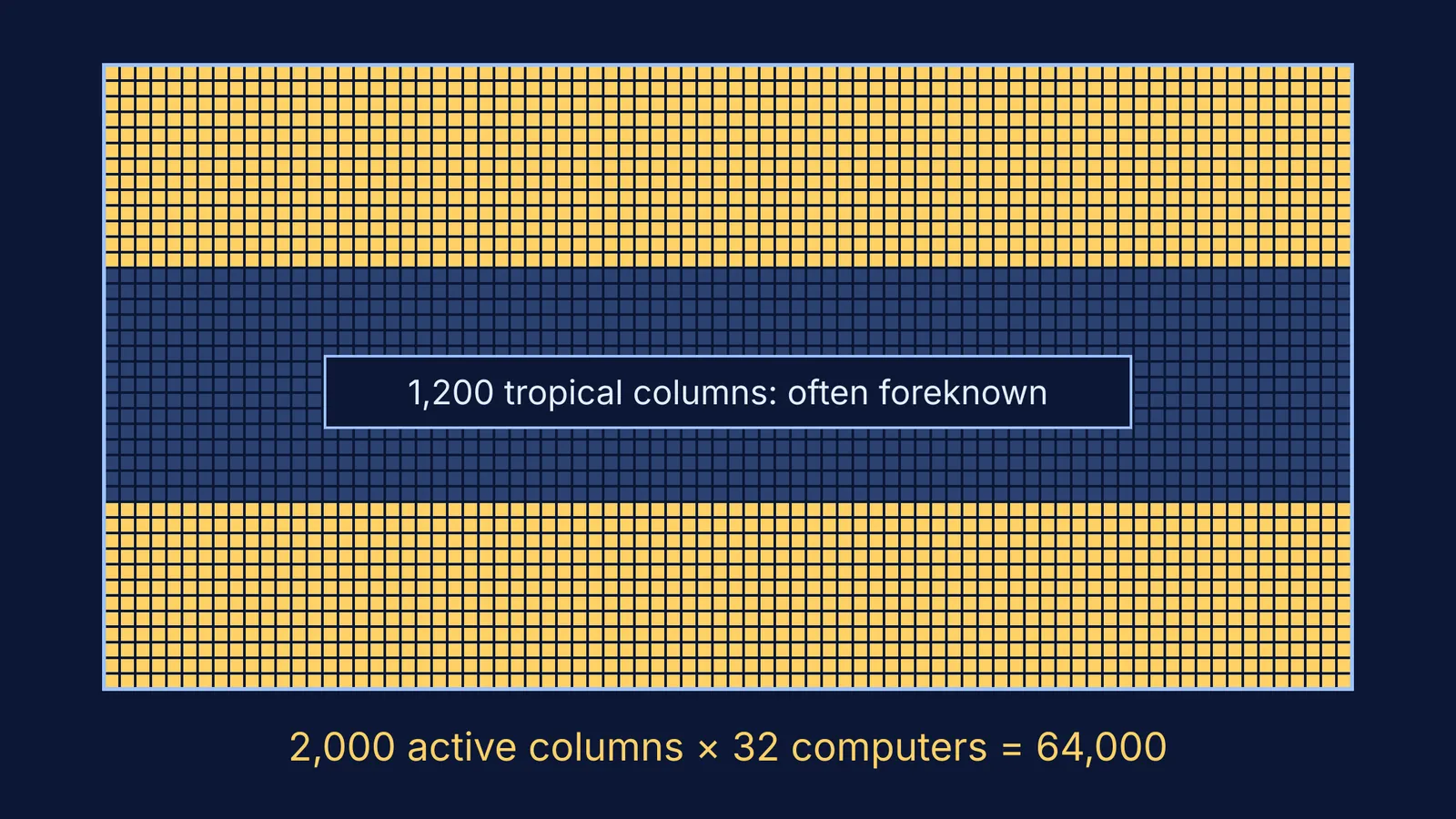
With a 3-hour time step, 32 people could compute two points just fast enough to keep pace with the weather.
With grid squares 200 km across, the whole globe has 3,200 columns.
Tropical weather is often known in advance, so only about 2,000 columns need active work.
32 × 2,000 = 64,000 computers.
Now try it yourself: shrink the squares to 100 km and keep his other assumptions, including the 3-hour step. Halving the side gives four times as many squares, so 12,800 columns. If the same 5 in 8 are active, that is 8,000, and 32 × 8,000 = 256,000 people. A sharper picture of the weather costs far more arithmetic, which is why forecasting had to wait for machines.
What happened after Richardson?
In 1950 Jule Charney, Ragnar Fjörtoft and John von Neumann published four 24-hour forecasts made from real 500 mb data, solving a single, simpler equation for the swirl of the winds (Tellus, 1950). Read how Jule Charney ran the first computer weather forecast on ENIAC, how Vilhelm Bjerknes treated weather as a physics problem, and why forecasts still have limits in Edward Lorenz and the butterfly effect.
How can you use Richardson's method in your own numericals?
His mistakes and his good habits both carry over to a board exam or JEE Main paper:
Make a form first. Richardson spent weeks on his computing forms. For a long numerical, list the steps and quantities before any arithmetic.
Check the starting values agree. His data were fine one by one but did not fit together. Check units and consistency before you solve.
Ask whether the answer is possible. A pressure jump that large should have rung an alarm. Compare your answer with a value you already know.
Split the work. His factory gave each person one small piece. Break a hard problem into parts you can check separately.
To see this kind of working on real problems, the Fermi Problem Library has worked problems with a step-by-step solver that explains the reasoning rather than printing an answer.
Next time you check the forecast on your phone, remember it began on a heap of hay in France, with one person and six hours of weather.


