

On this page
Ask for a "birome" in Argentina and someone will hand you a ballpoint pen. The word joins the surnames of László Bíró and his business partner Meyne, says the Argentine presidency's tribute to Bíró. Argentina marks Inventor's Day every 29 September, Bíró's birthday, and the same page says he went on to patent 32 inventions.
Who invented the ballpoint pen?
Bíró did not have the very first ball-tipped pen. John J. Loud of Weymouth, Massachusetts, was granted US patent 392,046 on 30 October 1888 for a pen with a ball-shaped marking point, meant for rough surfaces such as wood and coarse wrapping-paper. The patent pitches it mainly as a marking tool rather than a pen for everyday writing.
The pen you use in class traces back to Bíró. He was born in Budapest on 29 September 1899 and died in Buenos Aires on 24 October 1985, according to his Wikipedia biography. Working as a journalist, he noticed that newspaper ink dried quickly without smudging. When he tried that kind of ink in a fountain pen, it would not flow, because it was too thick.
His brother György, a chemist, helped him perfect a ball sitting in a socket that could pick up thick ink and lay it on paper, as Mental Floss's history of the ballpoint also describes.
What did Bíró patent, and when?
The paper trail is clear, and you can read the original documents yourself:
Britain, 1938. Patent GB 498,997, filed on 15 June 1938, describes a pen with a rotating ball as the writing point. A piston pressed a "soft pulpy dye" against the ball, which also sealed the tip when the pen was not in use.
Argentina, 1943. Bíró and György fled Europe during the Second World War and settled in Argentina. Their Argentine patent was awarded on 10 June 1943, Mental Floss reports.
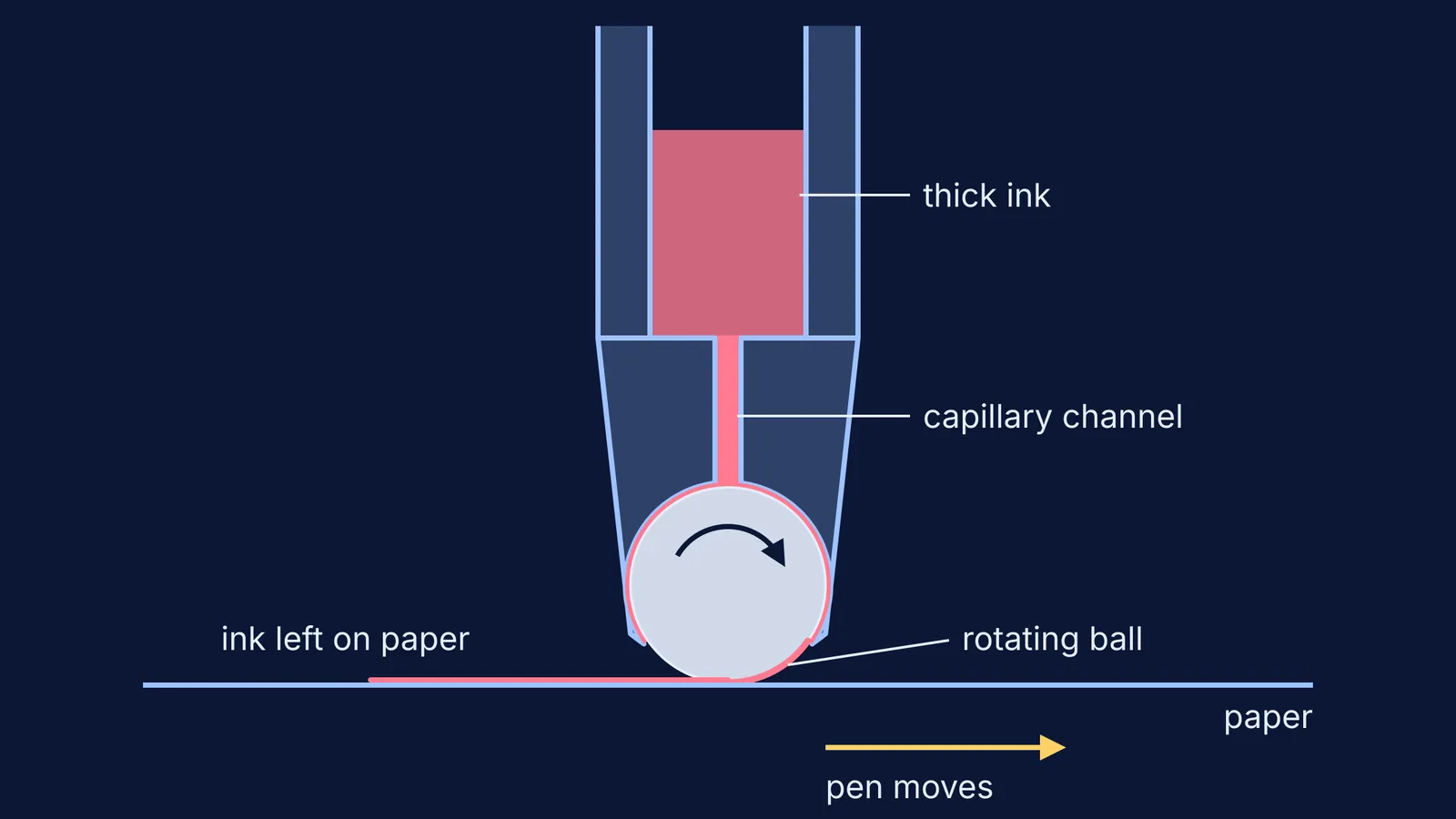
United States, 1945. US patent 2,390,636, filed on 17 June 1943 and granted on 11 December 1945, uses "thick or dense ink". Ink reaches the ball through a channel of "a capillary nature" and is fed by "simple gravity and capillarity", with no piston.
Britain's air force adopted the pen because it could write at high altitude without losing ink, according to the Casa Rosada page.
Why does a ballpoint pen need thick ink?
The word for "thickness" in a liquid is viscosity: how strongly it resists flowing. Water at 20 °C has a viscosity of about 1.002 mPa·s (Engineers Edge water table). A 2024 Pilot patent for an oil-based ballpoint ink sets its viscosity between 500 and 15,000 mPa·s at 20 °C and a shear rate of 500 per second (US patent 11,993,099).
Here is the worked comparison. Divide the ink's viscosity by water's: 500 ÷ 1.002 is about 500, and 15,000 ÷ 1.002 is about 15,000. So the ink in that patent is roughly 500 to 15,000 times as viscous as water.
That is why Bíró's idea works. A nib needs ink that runs; a ball does not. His 1945 patent says the device suits "a very adhesive ink, capable of forming a thin layer on the surface of the ball", so the ball does the moving. As you write, the ball rolls: its top turns through the ink inside the socket, carries a thin film round its side, and leaves it on the paper behind the pen. That is what the diagram above shows. If viscosity is new to you, our explainer on George Stokes and the physics of viscosity covers the basics, and this one shows why liquids get runnier when warm.
What can you learn from how Bíró solved it?
Bíró's story fits a four-step pattern you can use on any design or physics problem. Call it "keep the good property, change the rest":
Name the property you want. Newspaper ink dries fast and does not smudge.
Name the conflict. That ink is too thick to flow through a fountain pen.
Change the part in the way, not the property. Swap the nib for a rolling ball that can carry thick ink.
Test it in real use and revise. Compare the two patents: the 1938 pen pushed the ink with a piston, while the 1943 design relied on gravity and a capillary channel.
Try it on three things on your desk tonight: a highlighter, a glue stick and a pencil eraser. For each one, write one line for every step. Many physics problems are built the same way, around two properties that pull against each other.
If words like capillarity or viscosity feel shaky, the Fermi Concept Library gives each concept in physics and chemistry its own lesson, so you can fill one gap in a single sitting. For numericals on these ideas, the Fermi Problem Library has a step-by-step solver that explains the reasoning rather than printing an answer.
For another story of ink and machines, read about Johannes Gutenberg and his printing press. Then take a pen apart and look at the ball.


