

On this page
You know intuitively that heating syrup makes it run faster. But if you heat the air inside an engine, its resistance to flow goes up. Why do liquids and gases behave in exactly opposite ways when heated? The answer lies in what causes viscosity in each state.
Why does the viscosity of a liquid decrease with temperature?
In a liquid, molecules are packed closely together. Viscosity is the "internal friction" caused by cohesive forces — such as hydrogen bonds or van der Waals forces — holding them in place.
When a liquid flows through a pipe, the layer of liquid touching the wall stands still, while the layers closer to the center move progressively faster. This creates a velocity gradient. For the faster layers to slide over the slower ones, they have to physically push past the molecules blocking their path.
This requires the molecules to break their temporary bonds with their neighbours. When you add heat, you give the molecules more kinetic energy. They vibrate and move more vigorously, which weakens the intermolecular bonds holding the fluid together.
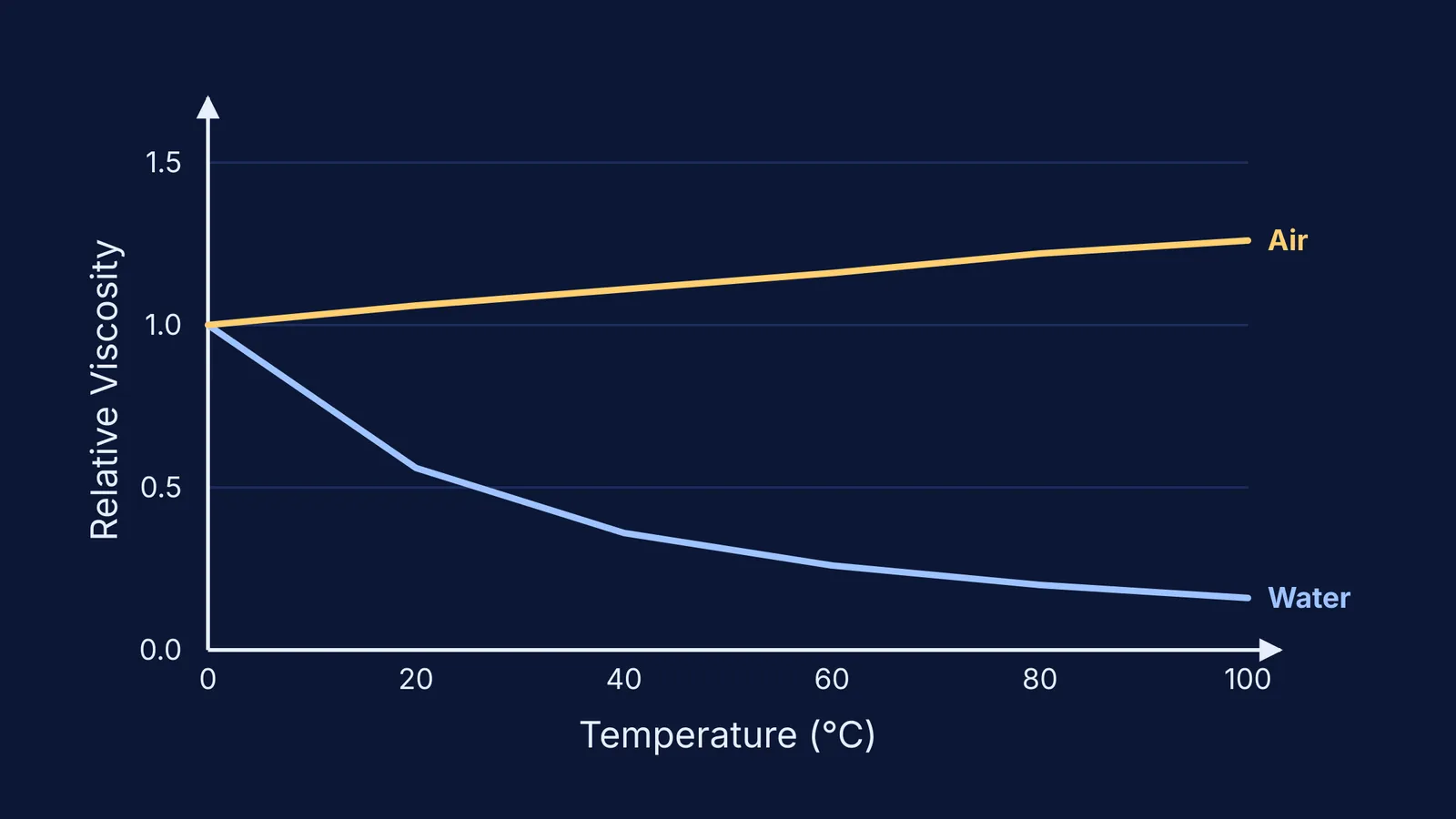
With weaker bonds, the layers slide more easily. The viscosity of water, for example, drops from 1.79 mPa·s at 0 °C to just 0.28 mPa·s at 100 °C. Small increases in temperature lead to large, exponential drops in a liquid's resistance to flow.
If you are struggling to picture how these bonds hold molecules together, the Fermi Concept Library contains every concept in physics, chemistry, biology, mathematics and computing, each with its own lesson and its place in the map.
Why does the viscosity of a gas increase with temperature?
Gases are mostly empty space. Unlike liquids, cohesive forces between molecules are negligible (which you can read more about in our guide to real gases and the van der Waals equation). Because molecules are far apart, attractive forces do not cause viscosity here.
Instead, gas viscosity comes from the transfer of momentum. Imagine a slow-moving layer of gas next to a fast-moving layer. Molecules randomly zip between the layers due to thermal motion.
If you are driving on a highway and suddenly a heavy, slow truck merges into your fast lane, everyone behind it has to brake. The same thing happens in a gas. When a slow molecule jumps into the fast layer, it acts as a brake, forcing the fast layer to share its forward momentum to speed the newcomer up. Conversely, when a fast molecule jumps into the slow layer, it drags the slow layer forward. This constant exchange of molecules creates drag between the layers.
When you heat a gas, its molecules move faster. According to the kinetic theory of gases, the root-mean-square speed of the molecules goes up with temperature. Faster molecules cross between layers more frequently. They make more "lane changes" per second, carrying more momentum each time. This means more drag, or higher viscosity.
The viscosity of air, for instance, rises from 0.017 mPa·s at 0 °C to 0.022 mPa·s at 100 °C.
The formulas: Arrhenius vs Sutherland
Because the mechanisms are different, the temperature dependence follows two different mathematical models:
Liquids follow an exponential decay. Viscosity is often described by an Arrhenius-type equation, showing that resistance falls off quickly as thermal energy overcomes binding energy. The equation treats sliding past a neighbour as a barrier that heat helps you jump over.
Gases follow Sutherland's law. While simple kinetic theory predicts that gas viscosity should scale exactly with the square root of temperature, real gases have a slight stickiness to them. Sutherland's law corrects for this by including a constant that accounts for weak intermolecular attractions. As the gas gets hotter, these weak attractions stop mattering entirely, and viscosity is driven entirely by collision rates.
How do you answer viscosity questions in exams?
When you face a question asking why viscosity of liquids decreases but gases increases with temperature, use this framework to build your answer:
Identify the cause: State that liquid viscosity comes from cohesive forces, while gas viscosity comes from momentum transfer (collisions).
Apply heat to the liquid: Explain that higher kinetic energy breaks the cohesive bonds, letting layers slide (viscosity drops).
Apply heat to the gas: Explain that higher speeds mean more frequent momentum exchanges between layers, creating drag (viscosity rises).
This exact contrast is a frequent target for assertion-reason questions in exams, because it tests your understanding of the microscopic model over everyday intuition.


